


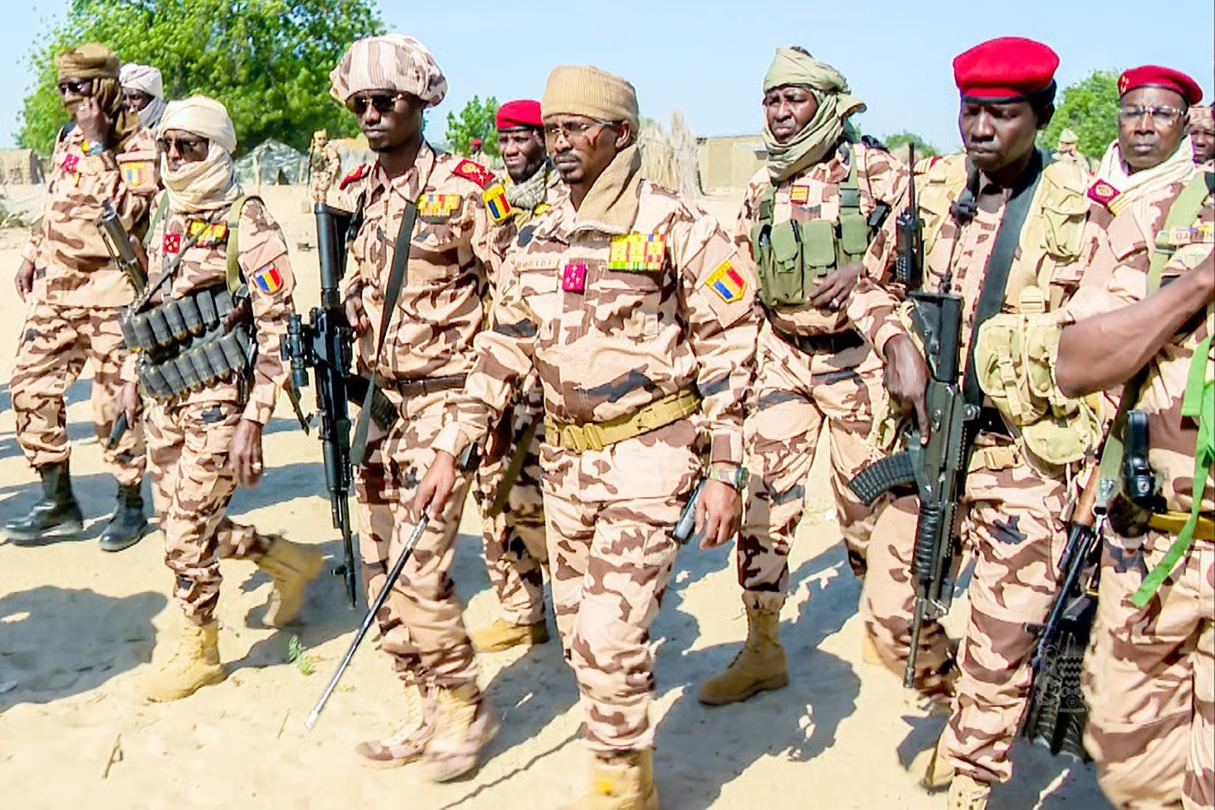
A wind of cautious hope blew over the Haitian capital this Wednesday, standing in brutal contrast to the smell of smoke and mourning that still hangs over the commune of Petite-Rivière de l’Artibonite. Around fifty Chadian police officers set foot on the ground in Port-au-Prince. They form the pre-deployment of what is set to become, in the coming days, a major contingent of the new Gang Repression Force (FRG), intended to break the deadly stranglehold of armed groups.
A Pre-deployment to prepare for the arrival of 1,500 men
“This is a pre-deployment. Of the 1,500 Chadian police officers who will take part in the FRG, 350 are to be deployed shortly,” a source within the Haitian government revealed. Strictly speaking, these first elements constitute the first FRG agents deployed in Haiti since the adoption of UN Security Council Resolution 2793, which transformed the former Multinational Security Support Mission (MSS).
The FRG, which replaces the mission led until now by Kenya (deployed since June 2024), aims to ramp up its capabilities with a total force of up to 5,500 members from eighteen countries committed to participating in this force. “It’s about preparing the ground for a broader deployment,” detailed the government source, without specifying the exact date for the arrival of the main body of troops. This reinforcement comes as most countries that sent troops under the MSS have begun repatriating them in recent weeks. Only a handful of Kenyan police officers are expected to remain on the ground at least until October to ensure the transition to the FRG.

Parallel to this arrival on the ground, the FRG made official on the social network X the arrival in Haiti of its Special Representative, Jack Christofides. The U.S. Embassy confirmed this information, specifying that he was accompanied by a team from the United Nations Support Office in Haiti (BANUH), including Under-Secretary-General Daniela Kroslak. “The FRG, with the support of BANUH, will strengthen efforts to combat terrorist gangs and will help bring security and stability to Haitians,” the U.S. representation emphasized on X.
The day before, on Tuesday, the head of the Haitian government, Alix Didier Fils-Aimé, and the Minister of Foreign Affairs, Raina Forbin, met with a UN delegation led by Atul Khare (Assistant Secretary-General for Operational Support) and Daniela Kroslak to finalize the last logistical details of this new setup.
The CSPN promises a “total response” despite a heavy human toll
While the Chadians are landing, the national security apparatus is trying to get into battle formation. Prime Minister Alix Didier Fils-Aimé thus chaired, this same Wednesday, an expanded strategic meeting of the Superior Council of the National Police (CSPN). “The government’s determination is total: to restore republican order, protect the population, and regain control of the national territory. The State is engaged in a dynamic of reconquest,” the executive branch hammered in a statement.
This declaration of war on gangs comes as the country is still licking its wounds. According to several national human rights organizations and the UN, more than 70 people were killed over the past weekend in the single commune of Petite-Rivière de l’Artibonite, more precisely in the locality of Jean-Denis. The reality could be even darker: residents reached by phone speak of a toll of around a hundred dead after three days of uninterrupted violence.

The testimonies gathered on the ground are horrifying. It all began on the night of Saturday to Sunday, as the population was participating in a rara evening, a major cultural and traditional event in Haiti. It was then that the heavily armed men of the “Gran Grif” gang, whose stronghold is in Savien, struck. According to Bertide Horace, a local official, the attackers first cut off access routes to prevent any intervention, then fired indiscriminately into the crowd and set homes on fire.
The ordeal continued on Sunday and saw another episode on Monday. Videos circulating on social media show rows of charred houses and wounded people lying on makeshift stretchers.
Faced with the scale of the tragedy, the official toll from the Haitian National Police (PNH) appears to be a vast underestimate. In a statement, the police institution reported 16 people killed and 10 wounded by gunfire, explaining that a joint operation involving police officers from Saint-Marc and Kenyan troops from the former MSS took place on Sunday morning. Police operations continued on Monday and Tuesday in Jean-Denis and other localities in the lower Artibonite, according to the police institution.
Government silence and International condemnations
Until the special CSPN meeting on Wednesday, there had been no official government communication condemning the massacre, leaving a staggering void. This silence was filled by diplomatic missions and international organizations.
The U.S. Embassy said it was “deeply saddened,” extending condolences to the victims’ families while reaffirming its support for the FRG. “We condemn the terrorist gangs who continue to murder their fellow Haitian citizens, with no respect for human life or dignity,” the U.S. representation stated.
The French Embassy, for its part, “condemned in the strongest possible terms” the attack attributed to “Gran Grif,” a group already targeted by UN sanctions for serious human rights violations. Paris reaffirmed its commitment alongside the PNH and the Armed Forces of Haiti (FAd’H).
United Nations Secretary-General António Guterres also strongly condemned the attacks, urging Haitian authorities to conduct a thorough investigation. Finally, the Office of the Citizen Protector (OPC) denounced the “insufficiency of interventions” and called for urgent humanitarian and psychosocial assistance for the survivors.
While the bodies of the victims from Jean-Denis were being identified, the government tried to show that it is anticipating the post-crisis period. In a move revealing the gravity of the situation, described as a “defense-level” crisis, the Ministry of Defense launched a call for applications to recruit military experts and strategic risk analysis specialists. The goal is to move beyond a simple logic of police repression to adopt a comprehensive defense approach, by profoundly reforming the Armed Forces of Haiti (FAd’H) and developing a new military doctrine.
As the Chadian police officers settle into their positions in Port-au-Prince, the equation remains formidable for the FRG and the CSPN: will they manage to stem the terror of the gangs before the country sinks into even deeper chaos? The coming months will be decisive for Haiti’s future.