

As the 2025 annual report of the United Nations Secretary-General reveals more than 2,000 grave violations committed against children in Haiti, BINUH and UNICEF welcome the listing of three new armed gangs – Gran Grif, Kraze Barye, and 400 Mawozo – on the list of parties responsible for crimes against minors. A decision that strengthens the international accountability framework, but also raises the crucial question of the release and reintegration of child soldiers, the forgotten victims of systemic violence.
Every year, the United Nations Secretary-General draws up a ruthless assessment of the worst atrocities committed against children in conflict zones around the world. And in recent years, Haiti has featured prominently – a tragic distinction for a country where armed gangs have turned violence into a system of governance and childhood into a bargaining chip in their territorial struggles.
Published on Monday, July 13, 2026, the 2025 annual report on children and armed conflict once again confirms the catastrophic situation facing Haitian minors. The numbers are staggering: 2,088 verified grave violations affecting 1,661 children over the past year. These violations include the forced recruitment of 892 children, murders, mutilations, sexual violence used as a weapon of war, mass kidnappings, systematic attacks on schools and hospitals, and deliberate obstruction of humanitarian access.
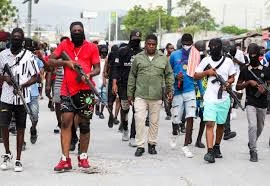
But it is in its form that this report breaks new ground. For the first time, three new Haitian armed gangs – Gran Grif, Kraze Barye, and 400 Mawozo – have joined the ranks of “parties responsible for grave violations” listed in the annexes to the UN document. They thus join the powerful “Viv Ansanm” coalition, which was already sanctioned in the previous reporting cycle.

A decision welcomed by the United Nations Integrated Office in Haiti (BINUH) and UNICEF in a joint statement issued the same day, describing it as “an essential accountability mechanism” and “an opportunity to develop action plans to end violations.”
“List of shame”: a label for a harsh reality
The official designation is sober: “Annexes to the report of the Secretary-General on children and armed conflict.” In practice, international observers readily refer to it as the “list of shame.” For being named is not an honor, but a stigma. An inscription that exposes the armed groups to potential Security Council sanctions, funding restrictions, and enhanced international scrutiny.
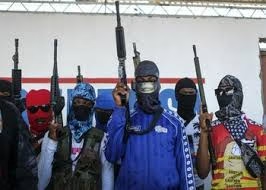
For the three gangs now listed, the news lands like a hammer blow. Gran Grif – whose name means “big claw” in Creole – is active in the Artibonite plain and has gained notoriety for attacks of unprecedented violence against rural populations. Kraze Barye (“barrier breaker”), based in the Port-au-Prince metropolitan area, has made its mark with mass kidnappings targeting schoolchildren and teachers. As for 400 Mawozo, a gang already well known to authorities for its extortion and hostage-taking, it continues its atrocities in the West and Center departments, not hesitating to recruit children to swell its ranks forcibly.
Their listing on the UN list is not merely symbolic. It activates a precise legal and political mechanism: that of accountability. As BINUH and UNICEF recall, this measure obliges the designated parties to commit to concrete action plans to end violations. It paves the way for efforts to release children still held in their ranks.
Listing on these lists constitutes an essential accountability mechanism established by the Security Council. It also offers the opportunity to develop action plans aimed at ending and preventing violations against children, as well as promoting their release from armed gangs,” reads the joint statement.

892 children recruited: The accusing number
Among the 2,088 verified violations, the recruitment and use of children by armed gangs constitutes the largest and most unspeakable share. 892 children, sometimes under the age of 15, have thus been turned into soldiers, scouts, informants, or servants. Some are even used as human shields or cannon fodder in clashes between rival groups.
This already dizzying figure is very likely underestimated. Areas under gang control are largely inaccessible to UN verification teams. And families, terrified, rarely dare to report the recruitment of their children for fear of reprisals.
The Secretary-General’s report does not merely denounce. It also highlights the efforts made to pull these children out of hell. This is where the PREJEUNES program comes into play.
Launched in 2025 by the Haitian authorities and the United Nations – following the adoption of the Transfer Protocol in 2024 – this program offers children released from gangs specialized protection services: psychosocial support, access to education, family tracing and reunification when possible, and finally community reintegration.
In 2025, this mechanism provided care for 573 children. An encouraging figure, but one that remains modest given the scale of needs. For every child released, how many others remain prisoners of a gang’s improvised uniform, rifle on their shoulder, their eyes emptied of childhood?
“BINUH and UNICEF therefore call on all listed armed gangs to immediately end the recruitment and use of children, as well as any other grave violation, and stand ready to participate in efforts towards their peaceful release,” insists the joint statement.
A statement that challenges Haitian authorities
Beyond the gangs, it is also the Haitian authorities who are being called to account. BINUH and UNICEF certainly commend the government’s efforts to strengthen national child protection mechanisms, but they call above all for enhanced leadership by the Haitian state in this area.
“The government must continue to ensure leadership of these efforts, through the National Commission for Disarmament, Demobilization and Reintegration (NCDDR), to ensure that child protection remains at the heart of all DDR initiatives,” the text states.
A barely veiled warning: the reintegration of children must not be a mere box-ticking exercise in a political disarmament process. It must be the guiding thread of any pacification strategy. Children associated with gangs are not delinquents. They are victims. Victims who must be referred to child protection actors, not to courts or prisons.
“BINUH and UNICEF remain determined to support the Haitian government and its partners in preventing grave violations against children, facilitating the safe release and reintegration of children associated with armed gangs, and ensuring that every child can grow up free from violence,” concludes the statement.
As the 2025 Secretary-General’s report is published, all eyes turn to the international community. Are the listings of Gran Grif, Kraze Barye, and 400 Mawozo on the UN list sufficient to move the needle? Nothing is less certain.
https://ctninfo.com/haiti-childhood-…un-list-of-shame/
https://www.facebook.com/CaribbeanNewsMedia