

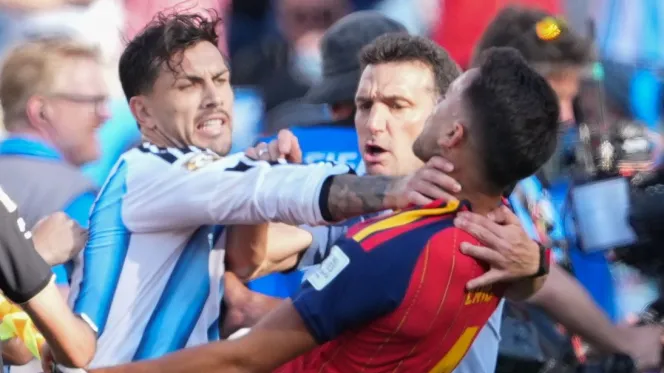
FIFA’s Disciplinary Committee has handed down a wide-ranging set of punishments over conduct at this summer’s FIFA World Cup 2026, fining the Argentine Football Association (AFA) USD 321,000, ordering it to play home matches with partial stadium closures, and suspending five individuals — four players and a team official — for incidents that culminated in a brawl after the final between Spain and Argentina.
“After a thorough assessment of the relevant cases, the FIFA Disciplinary Committee has imposed the following sanctions for incidents at different FIFA World Cup 2026 matches,” FIFA said in announcing the decisions. The rulings close one of the tournament’s more turbulent chapters, which ended with Spain lifting the trophy — and with a confrontation on the MetLife Stadium turf that drew global attention.
The heaviest institutional sanction fell on the AFA.
FIFA fined the association a total of USD 321,000 for breaches of four separate provisions of the FIFA Disciplinary Code: article 13, paragraph 2 c), covering “using a sports event for demonstrations of a non-sporting nature”; article 14, paragraph 5, on “team misconduct”; article 15, on “discrimination and racist abuse,” which FIFA said it applied “in light of discriminatory chants and gestures by its supporters”; and article 17, governing “order and security at matches.”
Because of the breach tied to article 15, FIFA went further than a fine.
“The AFA has been ordered to play its next two home matches with a limited number of spectators (50%),” the committee stated — a partial stadium closure that targets the association directly in front of its own supporters.

The committee also attached conditions to how the money is used and how much takes effect immediately. It determined that “USD 100,000 of the USD 321,000 must be invested in a plan to combat discrimination,” steering a portion of the penalty toward prevention rather than punishment alone. And it built in a probationary element: “the implementation of part of the sanction (one of the two matches and USD 100,000 of the fine) is suspended, with a probationary period to apply.” In practice, that means one of the two reduced-capacity matches and a third of the fine are held over, conditional on the AFA’s conduct during the probation.
The disciplinary action stems largely from the tournament’s closing match.
On July 19, at the venue FIFA calls New York New Jersey Stadium — MetLife Stadium in East Rutherford, New Jersey — Spain defeated defending champion Argentina 1-0 after extra time to claim its second world title, 16 years after its first in 2010. Substitute Ferran Torres settled a one-sided final in the 106th minute, driving home the only goal after Spain had dominated possession and outshot Argentina by a wide margin. Argentina played all of extra time a man down after Enzo Fernández was sent off for a second bookable offense in stoppage time at the end of regulation.
The result denied Argentina back-to-back titles and, in all likelihood, brought the curtain down on Lionel Messi’s World Cup career. Multiple match reports also described it as an ill-tempered evening that boiled over at the whistle.
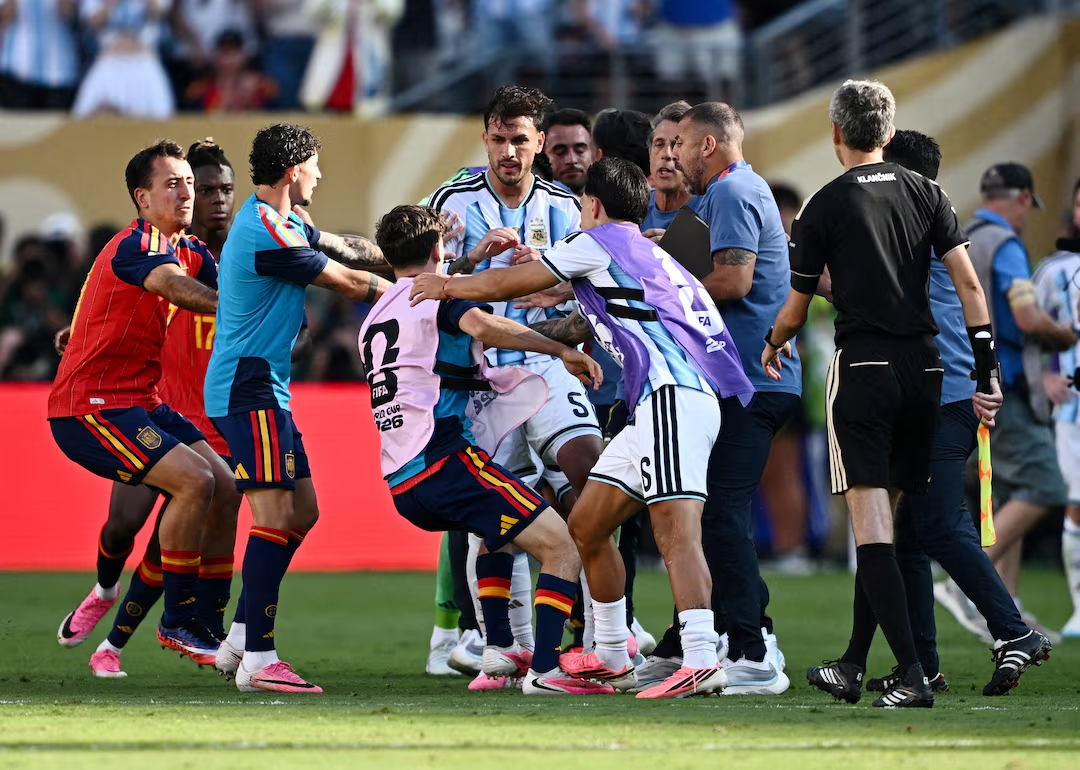
As Spain celebrated, players and staff from both sides clashed on the pitch.
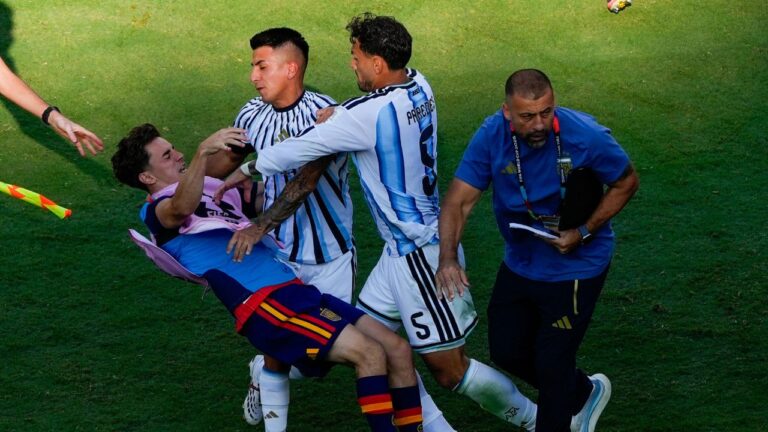
Footage reviewed by news outlets including ESPN and The Associated Press showed Argentina’s Leandro Paredes and Nahuel Molina striking Spain players, with Paredes tangling with Eric García and knocking down Spain midfielder Gavi, and Spain captain Rodri caught in the melee.

Argentina assistant coach Roberto Ayala was seen appearing to strike Spain’s Dani Olmo. Argentina head coach Lionel Scaloni and other players rushed in to pull people apart.
FIFA’s discipline and ethics prosecutor compiled a report on the scenes, and the committee acted on it. As FIFA put it, the sanctions followed “the submission of the report by the appointed Disciplinary and Ethics Prosecutor on the incidents that occurred at the FIFA World Cup 2026 final between Spain and Argentina played at New York New Jersey Stadium on 19 July.”
Five people were sanctioned.
Paredes received the most severe individual penalty: a ten-match suspension and a fine of USD 90,000. Molina received a seven-match suspension and a USD 90,000 fine. Ayala, the team official, received a three-match suspension and a USD 30,000 fine. Two players drew lighter penalties — Argentina’s Thiago Almada, a one-match suspension and a USD 30,000 fine, and Spain’s Pablo Martín Páez Gavira, better known as Gavi, an identical one-match suspension and USD 30,000 fine, his inclusion a reminder that the committee found fault on both sides of the altercation.
Crucially, the bans will not expire on the shelf. “In line with article 69 paragraphs 2 a) and 3 of the FDC, the match suspensions are carried over to the next matches of the relevant representative teams,” FIFA said — meaning the Argentina players and Ayala will serve their bans in Argentina’s upcoming fixtures, and Gavi in Spain’s.
Beyond the brawl, FIFA’s proceedings touched on other flashpoints in Argentina’s campaign.
After the Albiceleste beat England 2-1 in the semi-finals, players displayed a banner reading “Las Malvinas son Argentinas” — “The Malvinas are Argentine” — a political reference to the Falkland Islands, which the United Kingdom controls and Argentina claims. That display fell under the article 13 charge of using a sporting event for a non-sporting demonstration, and members of the British government had called on FIFA to examine it.
The discrimination and racist-abuse charge under article 15 concerned chants and gestures by Argentine supporters across several matches. Argentine teams have faced FIFA scrutiny over discriminatory chanting before, including after the 2024 Copa América. The governing body has repeatedly said it condemns discrimination by players, fans, and officials alike.
The cases are not necessarily closed.
FIFA said the parties “were notified of the terms of the FIFA Disciplinary Committee’s decisions today,” and that under the code “they have ten days to request a motivated decision, which, if requested, will subsequently be published on legal.fifa.com.” The rulings, FIFA added, “remain subject to appeal based on article 61 of the FDC.”
Any appeals would extend a disciplinary saga that has trailed the tournament since its final whistle — one that, for a competition FIFA billed as its largest ever, ended not only with a new champion but with the governing body drawing hard lines over what happened on and around the pitch.
https://ctninfo.com/fifa-sanctions-a…iminatory-chants/
https://www.facebook.com/CaribbeanNewsMedia