


A new institutional crisis is brewing in Haiti. While the government of Prime Minister Alix Didier Fils-Aimé claims it wants to accelerate the electoral process, the Provisional Electoral Council (CEP) is denouncing a flagrant violation of the Constitution. At the heart of the dispute is the draft 2026 electoral decree, which the Executive intends to adopt and publish despite formal opposition from the CEP and criticism from several political groups and civil society organizations.
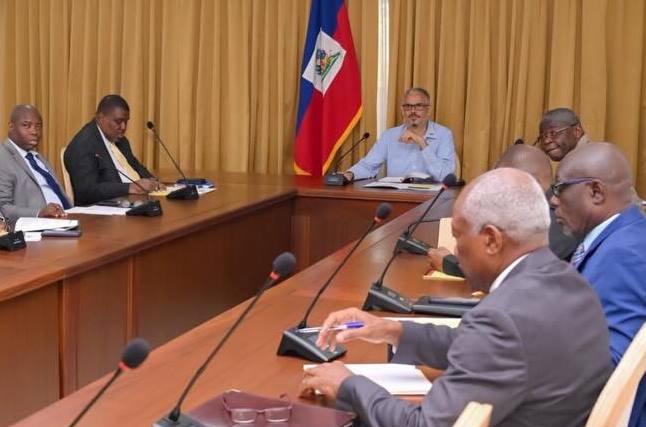
On Tuesday, June 2, 2026, an “informational” meeting was held at the Prime Minister’s invitation between the Prime Minister’s office and CEP members. But the two institutions offer diametrically opposed accounts of the meeting.
In a government press release, the Executive reports a “convergence of views” between the two parties on the need to organize credible and transparent elections. The Prime Minister reaffirms his “determination to mobilize all institutional, administrative, and financial resources of the State” to ensure the vote takes place, and even announces an upcoming meeting with the Gang Repression Force (FRG) to strengthen electoral security.
Yet the CEP’s press release, published the same day, tells a completely different story. According to the Electoral Council, the meeting was purely “informational.” The Head of Government reportedly announced his decision “to adopt and publish an electoral decree” without prior agreement. Worse still, this document, presented to the councilors for the first time, is allegedly “totally different” from the draft submitted to the Executive by the CEP on April 24, 2026.

For the CEP, this government action confirms the “unconstitutional nature of the Prime Minister’s decision, which violates the principle of independence of any Electoral Council,” the press release reads. CEP members firmly recall that “the initiative to draft the electoral decree falls under the exclusive jurisdiction of the CEP.”
Thus, the councilors express their “disagreement with the Prime Minister regarding the application of a text that does not comply with constitutional requirements.”
Government inflexible despite criticism
According to sources close to the matter, the government is expected to publish this contested electoral decree imminently, despite objections from the CEP and sharp criticism from several political parties and civil society organizations. Critics denounce an attempt by the Executive to interfere in electoral affairs in order to lock down the process to its advantage.
Haiti’s amended 1987 Constitution is clear: the organization of elections falls under the exclusive jurisdiction of the Electoral Council, and the government is required to respect the independence of this institution. By imposing a decree rewritten behind closed doors, the Executive exposes itself to serious accusations of authoritarian drift.

On another front, the Prime Minister has announced the upcoming holding of a coordination meeting with security sector actors, notably the Gang Repression Force (FRG). The stated objective: to strengthen the electoral security apparatus and provide the CEP with essential elements for developing the electoral calendar.
But this security commitment is not enough to ease tensions. For now, the CEP and the Executive have simply “agreed to continue technical work at a future session” – a cautious formulation that hardly conceals the gap separating them.
As the Haitian population desperately hopes for elections to emerge from the political and security crisis, the open confrontation between the government and the CEP casts an additional shadow over the process.