



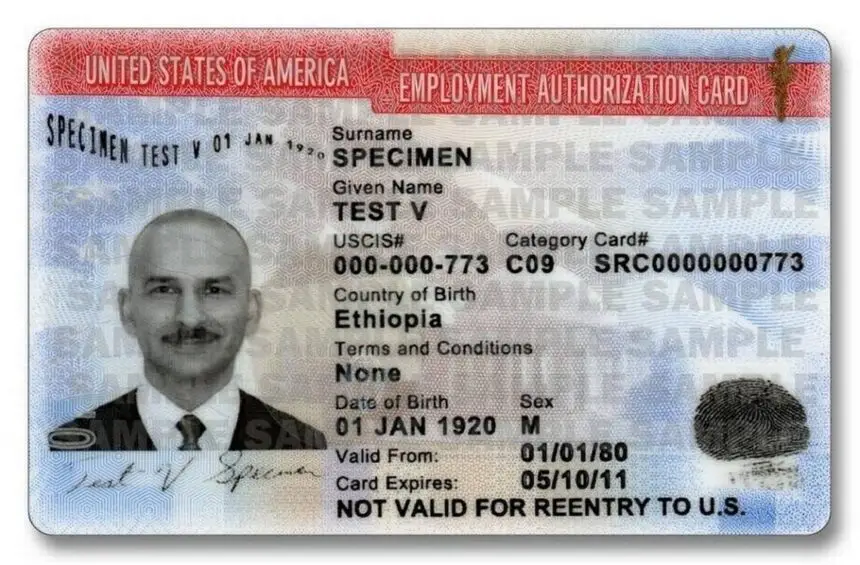
WASHINGTON — The Department of Homeland Security has put a date on the uncertainty facing Haitian workers. In new guidance, E-Verify — the DHS system employers use to confirm work authorization — instructs employers to treat July 10, 2026, as the expiration date for the work permits of Haitian holders of Temporary Protected Status, the clearest signal yet of how quickly the ground is shifting after last week’s Supreme Court decision.
The instruction is technical, but its consequences are concrete. When completing an employee’s Form I-9, employers are told to enter “as per court order” in Section 1 and “July 10, 2026” in Section 2, with a note in the additional information box, and to enter that same July 10 date when running a case in E-Verify. The guidance supersedes the update USCIS posted on March 25, 2026, which had listed July 1 as the marker.
In practical terms, a Haitian TPS holder’s Employment Authorization Document (EAD) — the card many workers know simply as a work permit, bearing category code A12 o
The July 10 marker is not a normal expiration. The E-Verify notice describes it as “limited relief until the lower courts align with the U.S. Supreme Court’s favorable decision in Mullin v. Doe,” the 6-3 ruling issued June 25 that removed the judicial barriers blocking the administration from ending TPS for Haiti and Syria.

The extension traces back to litigation. After reviewing country conditions, then-Secretary of Homeland Security Kristi Noem determined in late 2025 that Haiti no longer met the conditions for TPS, a decision published in the Federal Register on Nov. 28, 2025 (90 Fed. Reg. 54733). Haiti’s designation was set to end Feb. 3, 2026. One day before that, on Feb. 2, the U.S. District Court for the District of Columbia stayed the termination in Miot et al. v. Trump et al., and courts ordered a series of rolling extensions of affected EADs. The Supreme Court’s June 25 decision knocked out the legal foundation for those stays, and USCIS has been moving its placeholder dates forward as the lower courts prepare to fall in line, from late March to July 1, and now to July 10.
Not just Haiti
Haitian families are far from alone. The same coordinated guidance from USCIS and E-Verify applies to most of the other countries whose TPS designations remain tangled in litigation — a group that has included Burma, Ethiopia, Somalia, South Sudan, and Syria, each of which has been assigned its own court-ordered EAD extension in parallel notices. Mullin v. Doe reaches well beyond Haiti and Syria: the ruling puts the futures of roughly 1.3 million TPS holders from 17 countries in question, and immigration lawyers say it sharply limits lower courts’ ability to keep protections in place while challenges proceed.
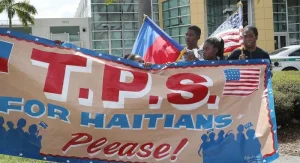
At stake for Haiti specifically are an estimated 350,000 people, many of whom have lived and worked legally in the United States since the 2010 earthquake, and whose employers span nursing homes, hospitals, factories, and small businesses across Massachusetts and the country.
What Haitian workers and employers should do
The guidance is an administrative marker, not the final word, and immigration attorneys are urging both sides to act carefully rather than rashly.
For workers, the message is to prepare, not panic. TPS holders should confirm the exact category and dates on their EAD, keep copies of the USCIS Alert and the USCIS TPS Haiti page, and — most importantly — seek a case-by-case review from a qualified immigration attorney or accredited representative to determine whether another pathway to work authorization or permanent status may apply. As DHS Secretary Markwayne Mullin himself acknowledged on CNN last week, TPS holders can still pursue permanent residence through family, employment, or asylum channels, though eligibility is individual and far from automatic.

For employers, legal advisers caution against premature or discriminatory action. Under guidance from the Justice Department’s Immigrant and Employee Rights Section, employers should not reverify workers early, demand specific documents, or take adverse action based solely on the original date printed on an EAD, practices that can trigger discrimination liability. Instead, they should update I-9 records with the July 10 date and the “as per court order” notation, and watch for further DHS instructions — including any Federal Register notice setting an actual termination effective date and transition period.
For months, the fight over Haitian TPS has played out in abstractions — statutes, stays, and split Supreme Court votes. The E-Verify guidance turns it all into something a family can read on a calendar: July 10, 2026. Whether that date holds, moves again, or gives way to a formal termination notice now depends on how fast the lower courts act and what DHS does next. CTN will continue to track the guidance as it changes.
Individuals and employers should check the USCIS and E-Verify websites regularly, as the agencies have revised these instructions repeatedly and may do so again.
Editorial Disclaimer: This article was originally written in English. The French and Haitian Creole versions are produced using AI translation, and errors are possible — the English version is authoritative. CTN also uses AI to convert text into audio. Readers and listeners should rely on the English text where any discrepancy arises.
https://ctninfo.com/dhs-sets-july-10…tian-tps-holders/
https://www.facebook.com/CaribbeanNewsMedia