

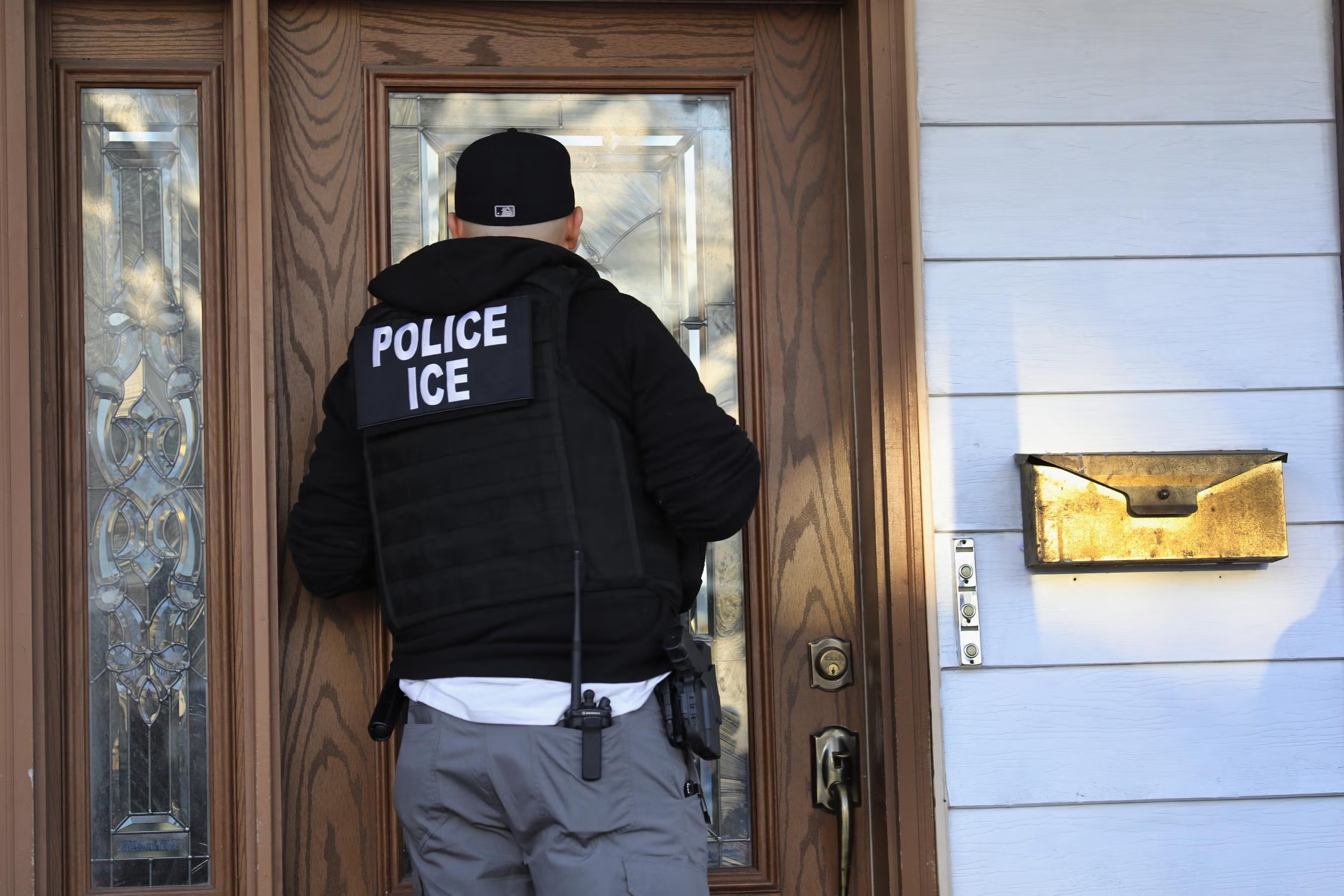
A federal appeals court panel sharply questioned the Trump administration on Thursday over whether immigration officers may use a tactic known as “knock-and-talk” to carry out arrests at people’s homes, in the latest court test of how Immigration and Customs Enforcement (ICE) conducts its operations, the Washington Examiner reported.
The three-judge panel of the U.S. Court of Appeals for the Ninth Circuit heard arguments from the Department of Justice and from lawyers for a group of immigration advocates on two questions, according to the Washington Examiner: whether the practice runs afoul of the Fourth Amendment’s protections against warrantless arrests, and whether the advocacy groups have the legal standing to challenge it at all.
As described in the Washington Examiner’s account, a knock-and-talk occurs when immigration officers go to the residence of someone they are seeking, approach the door, and ask to speak with the person inside. Officers can use the encounter to confirm a person’s identity before attempting to detain them. The advocates contend that when an officer has no judicial warrant, the maneuver functions as a warrantless arrest — which, they argue, conflicts with Supreme Court precedent on entering a person’s home.
A federal district court judge agreed and restricted the practice, prompting the Justice Department to appeal to the Ninth Circuit. In its filing to the appeals court, the DOJ argued that the lower court’s order “directly impedes mission-critical civil immigration enforcement practices that the Executive Branch has deemed vital to law enforcement and national security,” the Washington Examiner reported. The advocates countered that the policy amounts to “entering into a person’s home property, without a judicial warrant, for the purpose of carrying out an immigration arrest.”

The panel presses both sides
The judges appeared unpersuaded by the government’s defense, according to the Washington Examiner. They asked whether the knock-and-talk procedure should be available at all when officers already intend to arrest the person, or whether a warrant should be required before officers arrive to pursue someone. Drew Ensign, the DOJ lawyer, resisted the idea that the tactic qualifies as a warrantless arrest, arguing it does not trigger the Fourth Amendment’s warrant requirement — but the judges seemed unconvinced, the outlet reported.
The panel did not reserve its skepticism for the government. The judges also questioned the advocates’ lawyers about what standing their clients had to bring the lawsuit in the first place, the Washington Examiner reported. That line of inquiry tracks the administration’s broader strategy in the case: the government has asked the Ninth Circuit to dismiss the suit on the grounds that the challengers lack standing to seek forward-looking relief, Bloomberg Law reported. Much of the dispute turns on whether the contested practices are likely to recur — a threshold question that will help determine whether the injunction blocking the stops and arrests stays in place.
The panel consisted of U.S. Circuit Judges Johnnie Rawlinson, appointed by former President Bill Clinton; Milan Smith, appointed by former President George W. Bush; and Danielle Forrest, appointed by President Donald Trump, the Washington Examiner reported. The judges did not signal how or when they would rule.
A broader wave of litigation
The hearing is one piece of a far larger legal fight over the administration’s immigration enforcement, which has become one of the most heavily contested issues in the federal courts since the president returned to office early last year, the Washington Examiner noted. Enforcement operations in Los Angeles, in particular, have drawn both street protests and lawsuits, though the outlet reported that the administration has generally prevailed as those cases have moved up to higher courts.
That pattern was underscored last year at the Supreme Court. In September 2025, the justices lifted a district court’s restrictions on how federal authorities conducted immigration operations in Southern California, the Washington Examiner reported. The order that was set aside had barred officials from relying on a person’s apparent race, the language they spoke, their location or their type of work as the sole basis for questioning their immigration status in the Los Angeles area.
For now, the knock-and-talk question rests with the Ninth Circuit, whose decision will shape how immigration officers may approach homes across the nine western states under the court’s jurisdiction — and whether the advocacy groups can keep their challenge alive at all.
https://ctninfo.com/?p=45425&preview=true
Source: WashingtonExaminer

AI Use Policy:
Some of CTN’s journalists are not native English speakers and draft their work in French or Haitian Creole. We then use AI-assisted translation software to produce the English versions, and traces of machine-generated phrasing may occasionally remain. Every article — in any language — is written, reviewed, and edited by CTN’s staff writers and editors, who remain responsible for its accuracy. CTN also uses AI to convert text into audio.