


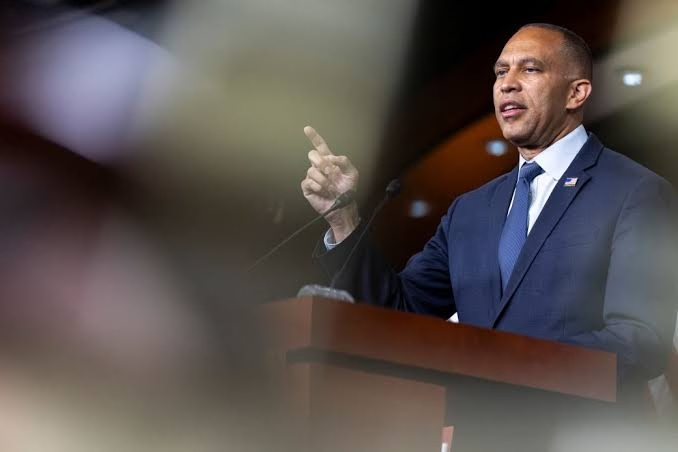
House Democrats have formally nominated Hakeem Jeffries to serve as Speaker of the House when the party takes control of the chamber in the new year, a step that puts the New York Democrat on track to make history. The nomination was reported by NPR, which covered Wednesday’s caucus vote.
The vote begins the formal process of choosing a Speaker, which concludes with a vote on the House floor when the new Congress convenes on January 3, according to NPR’s account. Should Jeffries prevail — an outcome the network described as widely expected — he would become the first Black lawmaker to hold the post, which is second in line to the presidency.
Jeffries, who has led House Democrats since 2023, ran unopposed and won the closed-door vote by a tally of 251 to 11, NPR reported. He marked the moment on social media. “Thank you House Democrats,” he wrote in a post cited by NPR. “Together, we will deliver bold change. And make a big difference in the lives of the American people!”
The mechanics now favor him. To be elected Speaker on the floor, Jeffries will need a simple majority of votes, and NPR reported that Democrats are poised to control at least 257 seats, with several races still to be decided. That cushion stands in contrast to the position House Republicans found themselves in four years ago, when, facing very narrow margins after regaining the majority, GOP leaders struggled to unite their conference and, as NPR noted, were forced to negotiate with a handful of holdouts before eventually rallying around outgoing Speaker Mike Johnson of Louisiana.

The nomination came a little over a week after Republicans settled their own leadership question. House Republicans selected Rep. Jim Jordan of Ohio as the conference’s minority leader — a contest Jordan won by defeating Majority Leader Steve Scalise of Louisiana, as the party absorbed losses that cost it the majority. In the Senate, Republicans tapped South Dakota’s John Thune for a second term as their leader, NPR reported.
The size of the Democratic majority, the network noted, gives Jeffries room to absorb some dissent as he navigates divisions within his own party.
Pushback from the left
That dissent surfaced in the 11 votes against him. NPR reported that Jeffries has faced resistance from the party’s leftmost flank, some of whom argue Democrats should pursue a more progressive agenda next year, pressing for floor votes on Medicare for All and on legislation that would halt the transfer of offensive weapons to Israel.
Among those voting against him, according to NPR, were several newly elected members, some backed by the Democratic Socialists of America. In a statement after the vote, they said they had held “good-faith conversations” with Jeffries over their policy priorities. “While we have seen meaningful progress, there is still work to be done to ensure that the direction our party takes this coming Congress reflects what our constituents are demanding of leadership,” the statement said. “Those conversations are ongoing. As such, our caucus vote today was no.”
NPR identified the signatories as members-elect Darializa Avila Chevalier and Claire Valdez, both of New York; Adam Hamawy of New Jersey; Frederick Haynes of Texas; Melat Kiros of Colorado; Donavan McKinney of Michigan; and Chris Rabb of Pennsylvania.

How much leverage that wing will ultimately carry is uncertain. NPR reported that Democrats will hold double-digit margins in the chamber, an advantage driven in part by the success of more moderate candidates in districts that President Trump carried in 2024 — a dynamic that complicates the left’s ability to extract concessions in the Speaker’s race.
Sharper divisions across the Capitol
The friction appears more pronounced on the other side of the Capitol. NPR reported that some Senate Democrats are more openly questioning whether Minority Leader Chuck Schumer of New York is the right person to meet voters’ demands for change. Schumer faces a challenge from Maryland’s Chris Van Hollen, who entered the race last week and has presented himself as an alternative to the status quo, drawing on the populist themes that several successful Senate candidates ran on this cycle. Both men, NPR noted, have served in Congress for decades.
Schumer, the top Senate Democrat for nearly a decade, maintains that he still has the votes to be elected majority leader, though NPR reported that a handful of current and incoming members have declined to back him. Both camps have time to firm up support, with Senate leadership elections set for early December.
https://ctninfo.com/?p=45390&preview=true
https://www.facebook.com/CaribbeanNewsMedia
AI Use Policy:
