

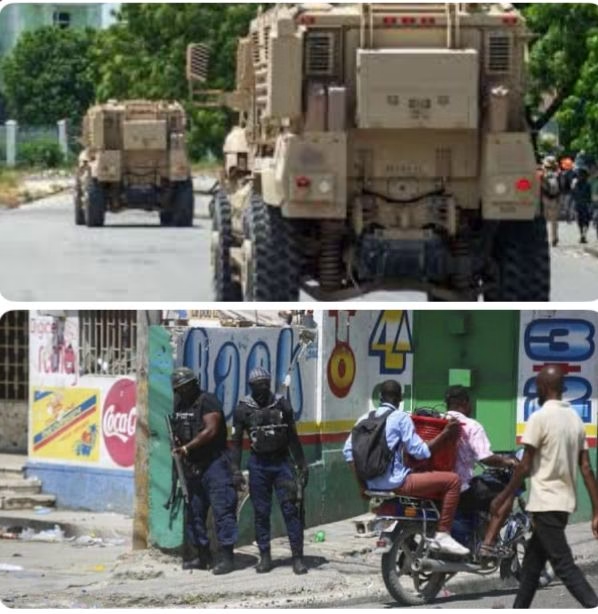
As a new international force gears up to confront the gangs that have driven years of killing and displacement across Haiti, the International Crisis Group has published a detailed examination of the country’s own security institutions. The report, A Force in Pieces: The Security Complex Fighting Haiti’s Gangs, released on 17 November 2026, describes a collection of police, soldiers, foreign contractors and an armed environmental brigade that are being asked to hold the line against criminal groups even as they struggle with corruption, political interference and a near-total absence of coordination.
The study, the organization’s Latin America and Caribbean Report N°113, is built on around 110 interviews conducted in Port-au-Prince and in international capitals between March and November, roughly a quarter of them with women, a balance the group says reflects the gender imbalance of Haiti’s security sector.
What emerges is a portrait of a state that has turned abroad for help precisely because its own forces have been unable to cope.
For the Crisis Group, the arrival of outside troops is itself a form of admission. “By turning to police and troops from abroad,” the report states, “Haitian authorities have made overt recognition of their own security system’s shortcomings.” The mission’s “very existence,” it adds, “testifies to the collapse of trust at home and abroad in the ability of Haiti’s array of security forces to protect public safety.”
A devastating backdrop
The report situates its analysis against a human toll it describes as devastating. Over the last five years, it says, gang-related violence has killed more than 20,000 people, displaced some 1.5 million, and left nearly half of Haiti’s population facing acute food insecurity. After the assassination of President Jovenel Moïse in July 2021, the authors write, gangs exploited the power struggles among the country’s political forces to expand their reach, growing increasingly independent from the political and business patrons who once used them.
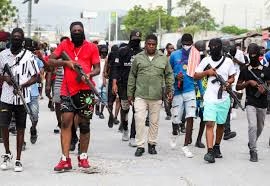
The looming prospect of foreign intervention, the group notes, had an unintended effect: it pushed rival gang coalitions to unite. Under the banner of Viv Ansanm — “Live Together” in Haitian Creole — the gangs launched their first major offensive on 29 February 2024, attacking the international airport, the two main ports, police stations, hospitals and Haiti’s two largest prisons, where they freed more than 4,700 inmates.
The first international response, the Kenya-led Multinational Security Support mission, disappointed its backers. Funded entirely by donations that never proved sufficient, the report says, only 1,000 of the anticipated 2,500 officers ever arrived. Its successor, the Gang Suppression Force (GSF) approved by the UN Security Council in September 2025, was designed to be different: composed primarily of military personnel, financed mostly through the UN’s assessed budget rather than voluntary pledges, and given a mandate oriented toward offense. Deployment began in April 2026. At the time of writing, the report says, the force had around 2,000 personnel on the ground and was expected to reach its full strength of 5,500 by early 2027.
Yet even the sense of cautious optimism around the Haitian public’s hopes is tempered. “Despite its offensive mandate and considerable firepower,” the executive summary reads, “the mission may nevertheless struggle to match the hopes invested in it.” That warning was underscored, the authors note, when four Salvadoran soldiers were ambushed in late October while venturing into a gang-controlled area of northern Port-au-Prince. In response, El Salvador deployed some 2,500 soldiers in what President Nayib Bukele described as a “mission rescue,” even as several gang leaders asserted the missing men had already been killed. Only about 200 of those troops might formally join the GSF; the rest, the report says, are operating separately, “placing yet another heavily armed force into an already crowded field.”
That crowding is the heart of the Crisis Group’s concern. The hope, it writes, is that international support will embolden Haiti’s forces. “But the fear is that the new foreign intervention will simply add another layer to Haiti’s bulging security complex.”
A system in disarray
The report describes a “patchwork” of institutions improvised, often under emergency conditions, into what it calls “an array of incomplete and often competing forces.” The Haitian National Police has been the country’s only security body for nearly three decades, since the army was disbanded in the 1990s, and by necessity it has led the fight. But internal power struggles, weak discipline and corruption, the authors write, have limited its effectiveness.
Perhaps the most striking finding concerns the cost of recent operations to ordinary people. Drawing on UN monitoring, the report says nearly 5,000 people were killed or injured during security force operations last year, around 15 per cent of them civilians. In the first quarter of 2026, it continues, the share of bystanders killed or injured by security forces as a fraction of all casualties during their operations rose to 24 per cent.
A central problem, the group argues, is that no one is in charge of the overall design. Political disputes have repeatedly blocked the creation of a national security plan. A proposed National Security Council — intended to be staffed by experts crafting a long-term strategy — became, in the report’s account, a casualty of the rivalry between the prime minister and the now-expired Transitional Presidential Council. The government created the body by decree in December 2024 but never appointed its members; it was later reshaped, then shelved, and in May 2026 the decrees establishing it were rescinded altogether. The result, the authors write, is that “the transitional government spent the entirety of its two-year mandate haggling, without reaching any agreement on how security policy was to be devised and run.”
The consequences play out on the battlefield. A foreign adviser who trains police combat units told the Crisis Group that the lack of a national strategy has meant different police units fighting on the same fronts often follow different operational guidelines depending on which foreign donor backs them. In early November, Prime Minister Alix Didier Fils-Aimé established an office to facilitate “deconfliction” among the various forces — a first step, the report allows, though it notes that experts complain the fight is still largely shaped by foreign priorities, including those of President Bukele and U.S. contractors, rather than Haitian authorities.
The police: thin ranks, fast training
The force at the center of Haiti’s response is, by the report’s telling, badly depleted. Official figures put it at under 13,000 officers by 2025, but the Crisis Group calls even that “an overcount.” Several sources with first-hand knowledge estimated that until last year the police had no more than 8,000 active officers, many in command or administrative roles, others guarding high-profile officials, and some still drawing pay despite having abandoned their posts. The report cites an even starker assessment delivered to the U.S. Senate in February by then-Chargé d’Affaires Henry Wooster, who said the force had “approximately 6,000 personnel on the books, of whom maximally 400 — and often, less than half that — do most of the fighting.”
Haitian authorities have responded with an accelerated recruitment drive called P4000+, aimed at adding at least 4,000 officers within eighteen months. In one year, the report says, the program added more than 3,000. But to speed deployment, training for new recruits was shortened from seven months to less than four, with a curriculum emphasizing urban combat. That trade-off worries some of the experts the group consulted. A senior police officer noted that recruits learn little about standards such as the proportionate use of force, while a former member observed that “Haiti’s combat-centred approach measures success primarily by the number of people killed or injured, whereas in other countries such results are viewed as a sign of unprofessional police practices.”
The report links that benchmark to a troubling reality. Because officers of all ranks tend to perceive residents of gang-controlled areas as potentially complicit with the criminals, the authors write, a rising share of those killed during police operations are reportedly people with no links to armed groups.

Instability, corruption and collusion
Running through the police section is a recurring theme: instability at the top breeds dysfunction below. Since 2020, the report notes, no police director has completed a full three-year term before being replaced, and the selection of chiefs has become bound up with their political ties to the executive. One officer described how personnel at odds with the leadership “put banana peels” in their way to engineer their removal. A diplomat characterized promotions within the force as “fratricidal negotiations reflecting what happens in the political arena.” A special commission concluded that around 6,300 promotions had been granted in violation of regulations in just over a year.
With career advancement rarely tied to merit and rank-and-file officers earning roughly 39,000 Haitian gourdes — about $300 — a month, the report describes powerful pressures to seek income elsewhere. Some officers moonlight as private bodyguards; others, it says, cross into unlawful activity. The authors invoke a phrase familiar across Latin America, plata o plomo — “silver or lead” — “the choice presented to officials by criminal groups of welcoming bribes or being killed.”
The forms of collusion catalogued are specific and serious. Some officers divert weapons and ammunition from police stocks to the gangs; the report cites UN findings that 70 per cent of ammunition recently seized from two gangs in the capital had come from police stockpiles. Others, it says, take part in kidnappings, using uniforms and official vehicles to seize victims in relatively secure neighborhoods such as Upper Delmas and Pétion-Ville before delivering them to gang strongholds. Efforts to clean the force have met resistance: in one episode, officers wearing balaclavas blocked major roads in Port-au-Prince until colleagues arrested over an alleged kidnapping were released. A vetting office established within the police inspectorate in 2023, the report adds, was never properly staffed, and its premises were later overrun by gangs.
Erik Prince, drones and an ‘obscure’ task force
Some of Haiti’s modest recent security gains, the Crisis Group writes, can be partly traced to a body it describes as “an obscure operation staffed by foreign contractors and local security officers whose operating methods have never been publicly disclosed.” Created in early 2025 under the prime minister’s office, the task force began with the U.S. firm Studebaker Defence Group and, after a change of government, continued under a company linked to Blackwater founder Erik Prince — now called Vectus Global.
The force’s distinguishing feature is its use of explosive drones and helicopters, which Haitian forces lack. The report credits those weapons with helping put the gangs on the defensive: after the first drone strikes, it notes, the Viv Ansanm coalition stopped mounting the large-scale coordinated offensives it had launched since early 2024. The prime minister, who has never officially confirmed the drones’ use, nonetheless remarked that “drone operations stopped the bleeding.” The current police chief, Vladimir Paraison, has publicly denied that the force uses explosive drones at all — a statement the report says contradicts documented accounts of its operations.
But the Crisis Group is unsparing about the costs and limits. The strikes have killed bystanders, including, in one aerial attack, ten residents — nine of them minors — when a drone missed its intended target, a gang leader in Cité Soleil who was distributing gifts to children on his birthday. The weapons have brought “diminishing returns,” the report concludes, producing “no meaningful changes in territorial control or on the balance of power on the ground.” The task force has failed to retake any sizeable stretch of the national roads that Prince himself named a main objective. “One key measure of success for me,” Prince is quoted as saying, “will be when you can drive from Port-au-Prince to Cap Haitian in a thin-skinned vehicle and not be stopped by gangs.”
The report also scrutinizes the opacity around Prince’s arrangements, describing a chain of holding companies that it says obscured Vectus Global’s role. It quotes Prince’s own account of an earlier era of his career: “Critics attacked us for using ‘fronts’ and ‘shell’ companies,” he wrote, “but there was no grand secret there: I owned them all.” For months, the authors note, the task force operated without coordinating with the national police; the then-police director had not even been informed of the first drone operation.
The army’s slow rebirth
A parallel thread is the revival of the armed forces, disbanded in 1995 after years associated with coups and abuses under and after the Duvalier dictatorships. The report traces decades of stop-start efforts to rebuild the military, long resisted by international partners wary that a reconstituted army could become a tool of repression. One diplomat’s framing, cited from 2011, still echoes: the proper question was not “should Haiti have an army?” but rather “can Haiti afford to have one?”
The gangs’ 2024 siege of the capital, the authors write, shifted that calculus. Under a framework developed with the UN, the Haitian military is now expected to reach 3,000 trained troops by early 2027, with a long-term goal of 12,000, though its current size is murky — sources estimate around 2,000 troops while the July payroll listed just over 1,400. Its budget has grown nearly fivefold since 2022. Yet the report records persistent skepticism: critics question the rationale for a conventional army in a country facing no foreign invasion, warn it could duplicate and compete with the police, and note that Haiti already struggles to train and equip one force, let alone two.
A ‘rogue’ brigade
The most unusual entity in the report is the Protected Areas Surveillance Brigade, known by its French acronym BSAP. Created to safeguard ecologically sensitive areas, it has, in the Crisis Group’s account, “largely fallen out of state control,” ballooning into a “freelance force” whose members have been accused of smuggling, drug and arms trafficking, kidnappings and extortion. Though the Haitian constitution recognizes only the police and the army as security forces, the report notes, the BSAP has grown larger than the army. It officially counts more than 3,000 officers — a 2025 personnel count found over 3,100 — though senior officials believe the real number is several thousand higher, even as only around 90 people appear on the environmental agency’s payroll.
The brigade’s entanglement in politics is, for the authors, its most troubling feature. For years it functioned at the service of Jeantel Joseph, a close ally of Guy Philippe, the convicted drug trafficker and former coup leader who, after being deported back to Haiti, called on citizens to seize power by force while escorted by armed men in BSAP uniforms. A spokesperson for Philippe’s party, the report says, described the brigade as its armed wing. A new agency head appointed in March 2026 has pledged to refocus the force on its environmental mandate, but, the authors caution, “bringing order to thousands of armed officers operating under different chains of command and political and economic patrons will require a far-reaching state effort.”
The road ahead
Having catalogued the fractures, the Crisis Group turns to what it believes Haiti must do. Its central message is that the foreign mission is temporary, and that the country must prepare for the day it leaves. “The new foreign mission promises temporary relief from the bane of gangs,” the report states, “but its goal is to weaken, not dismantle them. Haiti should start preparing now for the day when its own forces are once again summoned to take sole charge of the nation’s security.”
The recommendations are concrete. Haiti should revive the proposal for an expert-staffed National Security Council to craft a coherent long-term strategy and define the roles of the police, army and task force. It should bring greater transparency to the task force’s methods and gradually phase out foreign contractors once the GSF can hold the line. It should rein in the BSAP, confining it to environmental duties, limiting its weapons and shrinking its ranks. It should resist the temptation to build the army around urban gang-fighting and instead focus on border protection and disaster response. Across all forces, the report urges better pay and training, merit-based promotion, firm drone protocols that make “the safety of innocent bystanders the highest consideration,” and robust vetting to root out collusion with criminals.
The report closes on a warning that doubles as its thesis. A string of transitional governments have called security their priority, the authors write, yet Haiti still cannot define each force’s role, coordinate operations, contain corruption or choose its officers on merit. “The government can afford to delay no longer,” they conclude. “Unless Haiti prepares to assume responsibility once foreign troops withdraw, its leaders may well find themselves ceding ever more control over public security to foreign interests.”
https://ctninfo.com/a-force-in-piece…ing-haitis-gangs/
https://www.facebook.com/CaribbeanNewsMedia

AI Use Policy:
CTN uses artificial intelligence tools to support research, drafting, and editing. All content is reviewed and verified by a human editor before publication. This article is a summary of the International Crisis Group’s report “A Force in Pieces: The Security Complex Fighting Haiti’s Gangs” (Latin America & Caribbean Report N°113, 17 November 2026); all figures, characterizations and quotations are drawn from that report.