


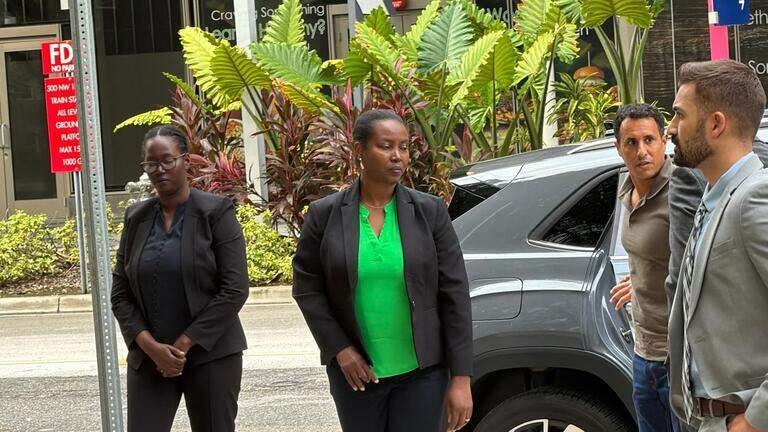
A former Colombian soldier Mario Antonio Palacios Palacios who took part in the operation that ended with the assassination of Haitian President Jovenel Moïse told a Miami jury that he and his comrades “were lied to, duped,” recruited under false pretenses by a South Florida security company that never paid them, according to Miami Herald Caribbean correspondent Jacqueline Charles, who is covering the trial from the courtroom.
The account came from Mario Antonio Palacios Palacios, an ex-soldier in the Colombian army, during cross-examination by Humberto Dominguez, the defense attorney for Christian Emmanuel Sanon, Charles reported on her X account. “We were lied to, duped,” Palacios testified, saying he had been hired by a team leader known as Captor — now dead — and was to be paid by CTU, the Doral-based security firm at the center of the case.
By Palacios’s account, the money never came.
During the month he spent in Haiti before the July 2021 assassination, Charles reported, CTU never paid the Colombians. The 21 former soldiers were supposed to receive $2,600 a month.
Palacios also described a language barrier that, he testified, left the Colombian recruits dependent on a small group of leaders for information. James Solages and Joseph Vincent, two Haitian Americans who were part of the plot to depose Moïse, did not speak Spanish, Palacios said, according to Charles. It was two Colombians — identified as Rivera and Captor — who translated for them, and who told the team that “the President was no longer the President.”

Palacios testified that the operation had been presented to the recruits as a mission to install Sanon, not to kill the president. He said they were told Sanon was to take the presidency in September and that the Haitian police lacked training, so the Colombians would accompany officers as security while the police themselves captured the president. “We were shown an arrest warrant,” Palacios said, according to Charles — but, he testified, he did not know it was fake.
Among the most striking details Palacios gave the jury, Charles reported, was that the men had been told there was $40 million stored inside Moïse’s residence.
Palacios also acknowledged that he personally took money and jewelry, according to Charles’s account of his testimony — a rare courtroom admission from one of the former soldiers about what they did inside the home the night the president was killed.
Charles noted a significant shift in strategy from the earlier proceedings in the case. Unlike the first federal conspiracy trial, she reported, defense attorneys are not disputing whether the former Colombian soldiers killed Moïse. Instead, they are working to show that their client, Sanon, was not present, and that Palacios and other former soldiers who did not speak English were relying on Captor and Rivera — the co-leaders of the team on the ground in Haiti, who did the recruiting for CTU.
Through his questioning, Charles reported, Dominguez sought to have Palacios draw a clear line between Sanon and CTU, the company that actually recruited him and the other former soldiers. Palacios, she wrote, had already testified that the men were lied to — that they were traveling for one stated purpose, and that the purpose was then changed.
Jovenel Moïse was shot dead at his private residence in Port-au-Prince on July 7, 2021, by a commando made up largely of former Colombian soldiers — a killing that removed the country’s last elected national leader and accelerated Haiti’s slide into the gang-driven crisis that continues today. A series of prosecutions has unfolded not in Haiti, where the domestic investigation has stalled, but in U.S. federal court in Miami, where several defendants have already been convicted. The trial of Sanon, a Haitian-American pastor accused of conspiring in the plot with ambitions of taking power himself, opened in Miami in late September 2026. He is presumed innocent, and the case is being heard by a jury.

For Haitians at home and across the diaspora, the Miami courtroom has become the principal venue in which the facts of the assassination are being tested in public — who organized the operation, who financed it, and who was deceived. Palacios’s testimony, as relayed by Charles, adds to a record in which some of the men who carried out the raid now say they were pawns, told they were escorting a lawful arrest rather than taking part in the murder of a head of state.
Source: Miami Herald Caribbean correspondent Jacqueline Charles
https://ctninfo.com/?p=45144&preview=true
AI Use Policy:
Some of CTN’s journalists are not native English speakers and draft their work in French or Haitian Creole. We then use AI-assisted translation software to produce the English versions, and traces of machine-generated phrasing may occasionally remain. Every article — in any language — is written, reviewed, and edited by CTN’s staff writers and editors, who remain responsible for its accuracy. CTN also uses AI to convert text into audio.

