



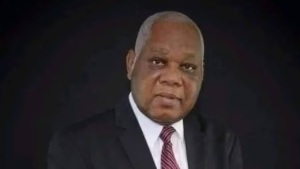
Former president of the Haiti Cassation Cour (Supreme Court), Joseph Mécène Jean-Louis, died at age 77. A towering figure in Haiti’s judicial landscape, he leaves behind a career spanning nearly half a century dedicated to law, teaching, and, briefly but intensely, national politics. A look back at the journey of a man whose name remains inseparable from the institutional crisis of February 2021.
Born on March 6, 1949, in Marchand Dessalines, in the Artibonite department, Joseph Mécène Jean-Louis was not, on the surface, destined for the magistracy. After obtaining his baccalauréat, he was first recruited as a microscopist at the national malaria eradication service, before working as a surveyor for a geometrician. At the same time, he taught in secondary schools to make ends meet. In 1971, he entered the School of Law and Economic Sciences of Gonaïves, where he earned his degree in 1975.
That same year, he was sworn in at the civil court of Gonaïves and became a member of the bar of that jurisdiction. His rise was then steady: deputy to the government commissioner at the civil court, then judge for more than twenty years. In 2007, he was appointed director of the School of Law and Economic Sciences of Gonaïves, where he taught civil law, rural law, and human rights. This dual role as magistrate and professor gave him a moral and intellectual authority that few Haitian jurists could claim.
In 2011, on the Senate’s proposal, he was appointed judge at the Court of Cassation. He was sworn in on November 3 of the same year and later rose to dean of the country’s highest court, a position he held until 2021.
In this context, his name rose to the forefront of political news. In February 2021, the country was divided over the end date of President Jovenel Moïse’s term. The opposition and parts of civil society, arguing that neither the Constitutional Court nor a permanent Electoral Council could arbitrate the dispute, designated Joseph Mécène Jean-Louis as provisional transition president for two years.

On February 7, 2021, hundreds of protesters and political figures symbolically elevated him to that office. The next day, in a widely circulated video message, the magistrate, then 72, accepted the charge and issued a solemn call to the nation: “Stand up, my compatriots, to fight corruption, impunity, and dictatorship.” He promised to lead a transition to free elections and constitutional reform.
The executive branch reacted lightning-fast. The Minister of Justice called the initiative “quasi-insane derangement.” The very next day, President Moïse signed an order forcibly retiring Joseph Mécène Jean-Louis along with two other Court of Cassation judges. Many jurists immediately challenged the decision, recalling that Article 177 of the Constitution protects Court of Cassation magistrates from arbitrary dismissal before age 70. However, Joseph Mécène Jean-Louis was already beyond that age, which fueled a lively legal debate over the legality of his retirement.
An end to his career far from the spotlight
A few days later, Judge Jean-Louis was also hit with a ban on leaving the country, with the Port-au-Prince prosecutor’s office citing a “serious presumption of conspiracy against the security of the State.” He was never prosecuted, and his provisional presidency never went beyond the symbolic stage. After the assassination of Jovenel Moïse in July 2021, his name gradually disappeared from public debate.
A father of eight children, Joseph Mécène Jean-Louis ended his days in relative discretion. His death is a reminder of how much the institutional crisis of 2021 remains, even today, an open wound in Haiti’s contemporary history.
https://ctninfo.com/haiti-joseph-mec…asses-away-at-77/
https://www.facebook.com/CaribbeanNewsMedia
AI Use Policy:
Some of CTN’s journalists are not native English speakers and draft their work in French or Haitian Creole. We then use AI-assisted translation software to produce the English versions, and traces of machine-generated phrasing may occasionally remain. Every article — in any language — is written, reviewed, and edited by CTN’s staff writers and editors, who remain responsible for its accuracy. CTN also uses AI to convert text into audio.