


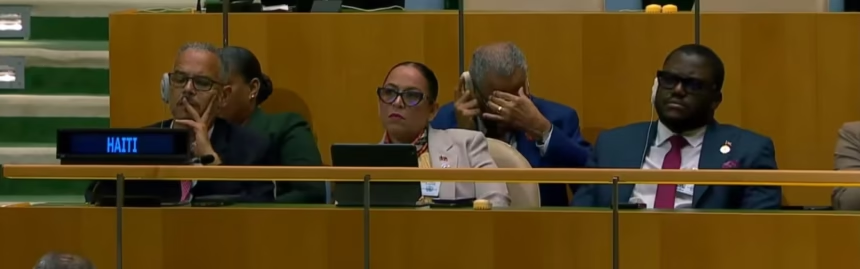
As gangs hold much of Port-au-Prince and 6.4 million Haitians need aid, a UN advisory group convenes foreign ministers Thursday during the General Assembly’s high-level week — with a humanitarian appeal not even half funded.
Foreign ministers and senior officials will convene at United Nations headquarters in New York on Thursday to press the international community for a stronger, better-coordinated response to Haiti’s deepening emergency, as armed groups continue to strangle daily life across much of the country.
The ministerial meeting, organized by the Economic and Social Council’s Ad Hoc Advisory Group on Haiti, is scheduled for 10 a.m. to noon Eastern in Conference Room 1, during the high-level week of the 81st session of the UN General Assembly, according to a UN media advisory. Its stated goal is to mobilize support for Haiti’s path toward stability and long-term development, and it will be streamed live on UN Web TV.
The gathering is set against numbers that describe a country in freefall.
About 6.4 million people, more than half of Haiti’s population, now require humanitarian assistance, up from six million a year earlier, according to the UN Office for the Coordination of Humanitarian Affairs. Roughly 1.4 to 1.5 million people have been driven from their homes by violence, and OCHA projects that about 5.9 million will face acute hunger in 2026, placing Haiti among the six worst hunger crises in the world. Armed gangs still control large parts of Port-au-Prince and key transport corridors, choking off access to essential services, aid and commerce.

Money is the recurring shortfall. As of September, Haiti’s 2026 Humanitarian Response Plan — an $880 million appeal to reach 4.2 million people — was only 47 percent funded, according to the advisory, leaving aid agencies to triage the most urgent needs. In April, the UN released more than $140 million in emergency funds to reach one million people, a stopgap against a crisis that keeps outpacing the resources sent to meet it.
The advisory group is expected to bring Haitian and international leaders to the same table. Prime Minister Alix Didier Fils-Aimé is listed to attend, alongside Haiti’s foreign minister, Raina Forbin, and defense minister, Mario Andresol. On the international side, the participants include UN Deputy Secretary-General Amina J. Mohammed; Carlos Ruiz Massieu, the Secretary-General’s special representative for Haiti and head of the UN Integrated Office there; Amar Bendjama of Algeria, the ECOSOC president; David Lametti, Canada’s ambassador to the UN and chair of the advisory group; and Canada’s secretary of state for international development, Randeep Sarai. Canada has chaired the group, which advises on long-term support for Haiti, for years, and Caribbean governments are also engaged — CARICOM’s secretary-general is slated to speak at the meeting, and the Dominican Republic is taking part in the week’s Haiti diplomacy.
The meeting also lands at a moment when the crisis is being deepened, not eased, by forces beyond the gangs.
More than 225,000 Haitians have been deported back to the country this year, the overwhelming majority from the neighboring Dominican Republic, according to OCHA — arrivals that are straining an aid system already stretched past capacity, as many return with no family, resources or documents. That figure does not fully capture the separate, growing wave of removals from the United States, which resumed deportation flights to Haiti after ending Temporary Protected Status this summer.
For the diaspora, CTN reports that Thursday’s meeting tests whether the pledges made in a New York conference room translate into anything felt in Cité Soleil, Kenscoff, or the displacement camps outside the capital. The advisory group has convened before, most recently during last year’s General Assembly, and issued calls for coordinated support; what has been missing is the funding and follow-through to match the scale of the collapse. Whether this session narrows that gap — or simply restates it — will be measured not at the UN, but on the roads and in the markets that Haitian families still cannot safely use.
https://ctninfo.com/?p=44721&preview=true
https://www.facebook.com/CaribbeanNewsMedia
AI Use Policy:

Some of CTN’s journalists are not native English speakers and draft their work in French or Haitian Creole. We then use AI-assisted translation software to produce the English versions, and traces of machine-generated phrasing may occasionally remain. Every article — in any language — is written, reviewed, and edited by CTN’s staff writers and editors, who remain responsible for its accuracy. CTN also uses AI to convert text into audio.

