
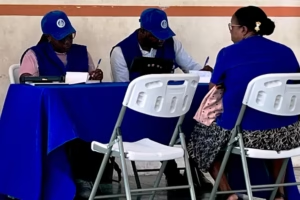
Less than three months before the December 13, 2026 vote, the Provisional Electoral Council (CEP) is moving ahead with deploying the electoral machinery. In a note published Monday, September 21, the institution announced 1,285 operational Registration and Voting Centers (CIVs) across the country’s ten departments, along with 628,755 voters already registered on the electoral roll. This figure represents just over 10% of the potential electorate, made up of holders of the National Identification Card (CIN).
But this is precisely what worries the International Observatory for Democracy and Governance (OIDG). At an average of 3,953 registrations per day, it would take about 980 days to reach the 4.5 million voters the CEP targets by the time the register closes on October 13, 2026. The organization describes the gap as “abysmal” and says it undermines the representativeness of the future electoral body.
The OIDG is not hiding its pessimism. Its president, Amboise Guillaume, has publicly called the holding of elections by the end of the year “technically impossible,” citing a security situation that makes vast portions of the territory inaccessible. For the Observatory, the problem is not limited to a logistical delay: it touches on the very legitimacy of the upcoming vote. An electoral register that covers only a fraction of the voting-age population would expose the country to an additional legitimacy crisis.
In a situation report published on August 18, 2026, the OIDG warned of the risk of a “de facto exclusion” of the Haitian diaspora from the electoral process, due to a lack of concrete measures to allow Haitians abroad to register and vote. An exclusion that, according to the organization, would deprive the future vote of a significant segment of the population and further weaken the credibility of institutions born of the ballot box.

Regional disparities remain pronounced. The Southeast leads with a registration rate of 16%, followed by Grand’Anse (15%) and Nippes (14.5%). Several departments also show an operational rate above 95% of their CIVs. The West department, the most populous and home to the capital, has only 148 operational centers, in an area where insecurity heavily conditions access to electoral services.
Candidacies Still in the Works
On the candidacy front, the electoral platform currently counts 7 presidential candidates, 162 for the Senate and 419 for the Chamber of Deputies, for a total of 588 candidacies. The CEP says 30 accredited political structures, including 18 parties and 12 groupings, have already submitted lists of their 30,000 members, adherents, or sympathizers. As of September 3, only 21 of the 105 accredited organizations had met this requirement, prompting the CEP to extend the deadlines.
Online candidate registration and document submissions remain open until October 9, 2026, following an extension decided by the electoral institution. The official electoral campaign is due to begin on October 5, according to the current calendar.
Meanwhile, the CEP continues preparing its staff. The institution says it has already recruited and trained 2,853 electoral register agents and 4,643 electoral security agents. More than a thousand electoral law commissioners and electoral judges have also been trained on electoral disputes in nine departments, with the West being the only one not yet to have benefited from this session.
The institution also opened a CIV on September 1 at the National Society of Industrial Parks (SONAPI), with three registration stations, to serve the population of Cité-Soleil, a historically hard-to-reach area. Teams have been deployed on Île de La Gonâve and in the Palmes region to strengthen access to services.

Despite these administrative advances, several major challenges remain. The Secretary General of the Organization of American States (OAS), Albert Ramdin, recently reminded the Permanent Council that gangs control between 80% and 90% of Port-au-Prince, making the holding of the vote particularly risky in the capital. In addition, Haiti faces a deficit of approximately one million identification cards, an essential prerequisite for registration on the electoral roll.
Controversies surrounding the electoral decree have also marked the process. In June 2026, the CEP denounced an initiative by the Prime Minister’s Office to adopt a text different from its technical proposal, a situation the OIDG and other civil society organizations described as a threat to the independence of the electoral institution.
Less than three months before the first round, the CEP officially maintained December 13, 2026, as the date for the presidential and legislative elections, with a second round planned for February 21, 2027. But between a still-skeletal electoral register, galloping insecurity, and candidacies still being validated, the road to the vote remains strewn with obstacles.
https://ctninfo.com/haiti-cep-at-midpoint-of-a-calendar-under-high-tension-oidg-concerned-about-still-skeletal-electoral-register/
https://www.facebook.com/CaribbeanNewsMedia
AI Use Policy:
Some of CTN’s journalists are not native English speakers and draft their work in French or Haitian Creole. We then use AI-assisted translation software to produce the English versions, and traces of machine-generated phrasing may occasionally remain. Every article, in any language, is written, reviewed, and edited by CTN’s staff writers and editors, who remain responsible for its accuracy. CTN also uses AI to convert text into audio.