



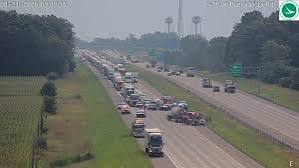
Pierre Damas Bel, a 20-year-old Haitian immigrant living in Springfield, Ohio, was struck and killed by a semi-truck on Interstate 70 on Monday morning, a death that has plunged the city’s Haitian community into grief.
As neighbors gathered to mourn him, community members and the outlet LSV Media described his death as a suicide — one they tied to the mounting pressure of a federal immigration crackdown that had recently placed him on an ICE electronic ankle monitor. The authorities investigating the crash have not characterized it that way, and the case remains open.
According to the Springfield News-Sun, citing the Ohio State Highway Patrol’s Springfield Post, troopers were called to the 66-mile marker of westbound I-70, near Ohio 54, at 8:45 a.m. Monday, Aug. 31. The patrol said Bel had been parked on the right shoulder of the highway in a 2006 Toyota Avalon, got out of the car, and entered the westbound lanes, where a tractor-trailer tanker struck him. He was pronounced dead at the scene. The westbound lanes were closed for about three hours, and the crash remains under investigation, the newspaper reported.
The Highway Patrol’s account does not address why Bel entered the highway, and officials have not publicly described his death as intentional. But within Springfield’s Haitian community, the loss is being mourned as a suicide.
LSV Media reported that Bel had recently been fitted with an ICE ankle monitor and that he had felt humiliated and had been bullied at school.
CTN has not independently confirmed LSV Media’s account of his state of mind or of the circumstances leading to his death, which authorities are still investigating.

The report has alarmed advocates.
According to LSV Media, community organizations have raised concerns that others in the community are in acute distress, with some expressing suicidal thoughts. Mental-health experts stress that suicide is preventable and that help is available — and that anyone who is struggling, or who is worried about someone else, can reach trained counselors at any hour through the 988 Suicide and Crisis Lifeline.
Bel’s death comes as Springfield’s Haitian community, one of the largest in the Midwest at roughly 15,000 people, endures a period of extraordinary strain.
The city was thrust into the national spotlight in 2024 by false claims, amplified during the presidential campaign, that Haitian residents were eating people’s pets. After the federal government ended Temporary Protected Status for Haiti — a termination that became enforceable in early August — ICE activity in Springfield surged. Haitian residents began receiving “call-in” letters ordering them to report to ICE offices near Cincinnati and Columbus, where, according to the Ohio Capital Journal, The Haitian Times and Religion News Service, many were fitted with GPS ankle monitors and had their passports collected, while others were detained.
Viles Dorsainvil, executive director of Springfield’s Haitian Support Center, has described the monitors as a “new humiliation” for the community, placed on people, he said, “like they’re criminals.” Faith leaders have been helping Haitian parents arrange temporary caregivers for their children in case they are detained. The pressure has fallen on a population with few safe options: the U.S. State Department continues to warn Americans not to travel to Haiti “for any reason,” citing gang violence, kidnapping and unrest, even as the government moves to return Haitians there.
For a community that has weathered years of hostility and now fears deportation to a homeland in crisis, Bel’s death has deepened an already heavy grief. As neighbors gathered to remember him, advocates urged anyone carrying similar pain not to carry it alone.

If you or someone you know needs help
- Call or text 988 to reach the 988 Suicide and Crisis Lifeline — free, confidential, and available 24 hours a day, seven days a week. Interpreters are available for Haitian Creole and other languages.
- You can also chat online at 988lifeline.org.
- In an immediate emergency, call 911.
Reaching out is a sign of strength, and support is available. Suicide is preventable, and no one has to face a crisis alone.
This article addresses suicide, which is a sensitive subject. CTN is sharing these resources because help is available and recovery is possible.
This article was originally written in English. Other language versions are produced using AI translation software, and errors are possible — the English version is authoritative. CTN also uses AI to convert text into audio.

https://ctninfo.com/?p=44440&preview=true
Source: LSV MEdia, https://www.springfieldnewssun.com