


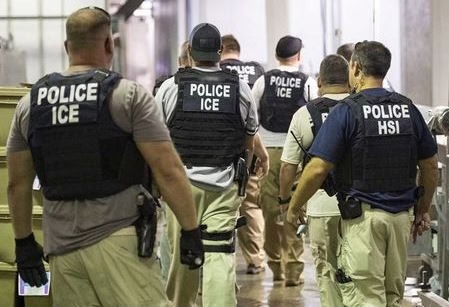
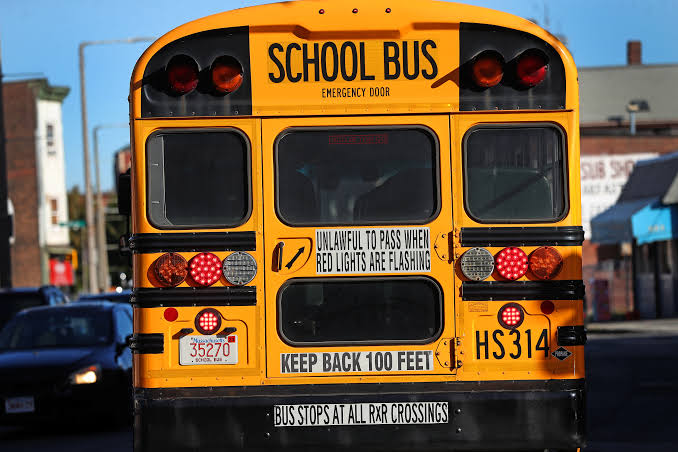
As Massachusetts children head back to class, the state’s top education officials used a back-to-school roundtable with immigrant and multicultural media to deliver a blunt message: federal immigration enforcement is likely to grow more aggressive, not less, and schools need to be ready.
In the same breath, they walked reporters through the protections the state has put in place to keep students and families safe from Immigration and Customs Enforcement, chief among them a new state law that treats schools as off-limits to federal agents without a warrant.
The gathering brought together Education Secretary Dr. Steve Zrike, Elementary and Secondary Education Commissioner Pedro Martinez, Early Education and Care Commissioner Amy Kershaw, Higher Education Commissioner Noe Ortega and Children’s Trust Executive Director Jen Valenzuela, before an audience of journalists from outlets serving the state’s Haitian, Latino, Brazilian and other immigrant communities.
Their questions kept returning to a single worry: whether it is safe for immigrant children and their parents to show up at school at all.
Pressed on how often ICE has actually entered Massachusetts schools, Martinez said such incidents have been “very isolated” and that the number inside school buildings is “closer to zero than anything.” But he warned against taking comfort in that. “They’re going to get more aggressive,” he said of federal authorities. “It’s not like they’re scaling back. It’s just the opposite.” He added that he was “very distrustful of what’s happening,” and argued that just because large-scale enforcement had not hit schools “doesn’t mean that it can’t,” which is why, he said, being proactive is critical.

The greater danger, officials said, is not agents walking into classrooms but parents being detained in the community. Martinez said the state has seen “parents getting picked up in the community as they’re going to school or away from school,” a pattern that has left districts scrambling to care for children whose guardians disappear during the day. Schools, he said, now have to keep lists of emergency caregivers because “a parent gets picked up, somebody has to pick up that child.” Fear alone, officials said, is already keeping families away. Zrike said that in his years as a superintendent he had watched children and parents grow afraid to come to school. “It means a lot to children and families who were scared to come to school,” he said of the new protections, recalling what he saw in Salem and in nearby Lynn and Chelsea. “We can’t have children missing school.”
The centerpiece of the state’s response is the PROTECT Act, the immigration-protection law Governor Maura Healey signed this month.
Zrike said the law sends a clear signal that Massachusetts schools “will not be engaging in working with ICE agents in school buildings” without a legal warrant, and that every district must now have a plan to support families, train staff, and spell out how it will respond if agents show up. The state, he said, has given districts model policies and is providing technical assistance, though each community sets the specifics because “every school and community is completely different.” Kershaw said the law’s shield extends to the youngest learners as well: early education and child-care programs, she noted, are treated as “sensitive places” under the PROTECT Act, and roughly 265,000 children are in licensed child care across the state on any given day.
Martinez said the law’s practical power is that it gives educators legal footing they lacked before. Unless a federal agent “actually has a legal warrant,” he said, “the school districts can say no. And I think that’s just a big deal.” Just as important, he added, is that teachers and principals now know the state stands behind them. Educators “need to know that if they stand up for the rights of their children, they’re going to be protected,” he said, describing the intimidation of a federal agent demanding to see a specific child. He also stressed consistency, so a family’s treatment doesn’t depend on its ZIP code: “We don’t want you to be treated a certain way if you’re in Chelsea versus if you’re in Framingham or if you’re in New Bedford.” Officials pointed reporters to a state portal where residents can report ICE activity, and acknowledged that data-sharing between federal agencies and the state remains limited.
The end of Temporary Protected Status also hung over the discussion.
Asked how many school employees Massachusetts districts have lost as TPS terminations take hold, and what help exists for families who lost jobs, officials said they did not have figures on hand but did not dispute the impact. Zrike acknowledged it “has an impact on school systems” and said the state’s Office of Refugees and Immigrants maintains a resource guide for affected families. The question landed pointedly given the room, which included Haitian media; Haitians were among the largest groups stripped of protection when the administration ended TPS for Haiti this summer.
Officials framed immigrant students not as a burden but as the backbone of the system. “Our system was built to support immigrant students,” Zrike said, arguing that successive waves of newcomers “made our schools a better place for everybody.” Martinez, himself an immigrant from Mexico who led districts in Texas, Nevada and Illinois before coming to Massachusetts, said the state’s education system is often the very reason immigrant families stay, working two jobs rather than move somewhere with weaker schools.

The roundtable ranged well beyond immigration, touching on record education spending, a coming overhaul of the K-12 funding formula, new graduation requirements, free community college and efforts to expand dual-language programs and recruit teachers from Brazil and other Portuguese- and Spanish-speaking countries. But for the immigrant-community journalists at the table, the through-line was safety. The officials’ bottom line: the state now has the law on its side in ways it did not before; schools are meant to be a trusted refuge, and yet, as Martinez put it, “we can’t control what happens in the streets” — the place where, for many families, the fear begins.
https://ctninfo.com/?p=44434&preview=true
https://www.facebook.com/CaribbeanNewsMedia
This article was originally written in English. Other language versions are produced using AI translation software, and errors are possible — the English version is authoritative. CTN also uses AI to convert text into audio.