

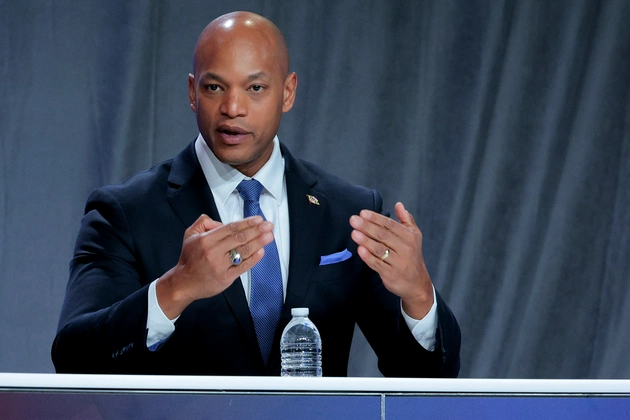
Maryland Governor Wes Moore has raised pointed concerns about a large federal immigration operation that swept through Maryland and Virginia this month, questioning the tactics used by ICE agents during the arrests.
The operation, carried out by U.S. Immigration and Customs Enforcement, arrested 1,328 people over two weeks, and it has opened a sharp dispute between state Democrats, the Trump administration and immigrant-advocacy groups over who was actually caught up in the sweep.
The Department of Homeland Security announced the results Monday, describing a 14-day campaign it called “Operation Safe Community” in Washington, D.C., that ran from Aug. 1 to Aug. 14 and concentrated on the capital’s Maryland and Virginia suburbs. According to DHS, agents arrested people whose criminal histories included convictions for sexual battery, kidnapping, driving while intoxicated, hit-and-run, identity theft, and robbery, along with others arrested on charges of murder, attempted murder, and rape. “Over the course of just two weeks in Virginia and Maryland, they arrested sexual assailants, kidnappers, drunk drivers, robbers, and gang members,” DHS Secretary Markwayne Mullin said in the agency’s announcement, adding that the administration would “always put American citizens first.”
But the government’s own figures show that most of those arrested had no such record.
Of the 1,328 people taken into custody, DHS said almost 400 had been convicted of or charged with crimes in the United States, roughly 30%, and the department did not release a complete breakdown of the remaining arrests, according to CBS Baltimore and other outlets that reviewed the release. Moore seized on that gap. By ICE’s own accounting, he said, “a mere fraction” of those arrested had ever been convicted of or charged with any crime. Colleen Putzel Kavanaugh, a policy analyst at the Migration Policy Institute, told the ABC affiliate 7News that the total arrest numbers deserve scrutiny alongside the individual cases the government chose to publicize.

Moore, a Democrat, was careful to say he supports removing violent offenders. “When federal law enforcement takes violent offenders off our streets and lawfully removes them from our country, that makes our communities safer,” he said in a statement, adding that Maryland would keep working with federal partners toward that end. His objection, he said, was to the breadth of the sweep and how it was conducted. His office said DHS launched what it called mass deportation operations in the state without notifying state officials in advance. Moore described what he called disturbing scenes, older women taken from their apartment buildings, workers chased through residential neighborhoods, and parents separated from their U.S.-citizen children — and said he was troubled by reports that a person suffered a broken neck during an ICE arrest. News outlets, including DC News Now, said they had not independently verified that account.
The governor was blunt about the methods.
“Deploying untrained, unqualified, and unaccountable agents to sweep through our communities and spread fear is not a public safety strategy,” he said, arguing that such operations erode trust between residents and law enforcement without making anyone safer. He also said the enforcement was hurting Maryland’s economy, citing accounts from business leaders that legal workers were being pulled from nursing homes, farmworkers were afraid to show up, and the cost of groceries and delivery services was rising. Maryland, he said, does not have to choose between holding violent offenders accountable and protecting the rights and dignity of its residents.
Republicans framed the operation very differently. Representative Andy Harris, a Maryland Republican, wrote on social media that “this is what enforcing our immigration laws looks like,” and accused Moore of standing behind sanctuary policies that limit cooperation with federal authorities and, he said, put communities at risk. The operation deliberately targeted so-called sanctuary jurisdictions: Maryland’s Community Trust Act, which Moore signed in the spring, restricts state and local law enforcement and correctional agencies from assisting ICE, and Virginia Governor Abigail Spanberger has issued an order barring state cooperation with federal immigration enforcement.
Immigrant-rights groups said the arrest data proved their point.
Ama Frimpong, chief of services at the advocacy organization CASA, said that when the government acknowledges that some 70% of those arrested had no contact with the criminal legal system, “it strips away their cover,” showing the sweep was not a set of targeted, high-level busts. Instead, she said, ICE is “sweeping up everyday parents, spouses, and neighbors who are just going to work.” CASA cited cases it said it had received, including a one-year-old whose father was detained on his way to a construction job and a seven-year-old with a chronic health condition whose mother was taken just outside her home.
The operation lands especially hard on Maryland’s immigrant communities, including its substantial Haitian population. Haitians have settled across the state, from the Washington suburbs of Prince George’s and Montgomery counties to the Eastern Shore, where the Salisbury area is home to a fast-growing Haitian community of roughly 2,000 people, many drawn by work in the region’s poultry plants. That community was already living in fear before this month’s sweep: the Trump administration’s decision to end Temporary Protected Status for Haiti in July stripped protection from about 350,000 Haitians nationwide, including an estimated 20,000 on Maryland’s Eastern Shore, according to reporting by The Associated Press and the Prism news outlet. In Salisbury, church attendance has plunged, and English classes and community events have been canceled as residents stay home, fearful of arrest — a climate the broader ICE operation has only deepened.

For now, the central question remains unresolved: whether an operation the administration cast as a strike against violent criminals in fact swept up far more people with no criminal record than with one. DHS has not published a full accounting of the 1,328 arrests, leaving the competing claims — the government’s, the governor’s and the advocates’ — to be argued over data that has only partly been made public.

https://ctninfo.com/?p=44374&preview=true
https://www.facebook.com/CaribbeanNewsMedia
This article was originally written in English. Other language versions are produced using AI translation software, and errors are possible — the English version is authoritative. CTN also uses AI to convert text into audio.