



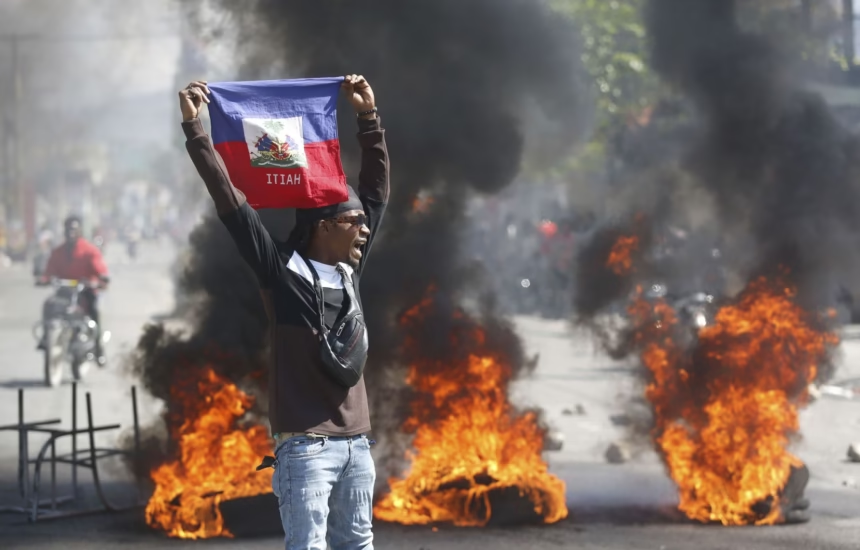
At least 1,408 people were killed and 656 injured in Haiti between April and June, the United Nations reported, a staggering three-month toll driven by rival-gang warfare in the capital, widespread sexual violence, and civilian deaths caused both by armed groups and by the operations meant to stop them. The figures, released by the United Nations Integrated Office in Haiti (BINUH), lay out a quarter in which some Port-au-Prince neighborhoods saw gangs pushed back even as others endured the worst bloodshed in more than two years.
“These figures show that the population continues to bear an unacceptable toll from violence,” said Carlos Ruiz Massieu, the Special Representative of the UN Secretary-General in Haiti and head of BINUH, who stressed that protecting civilians — especially children, women and others at heightened risk — must remain at the center of every effort to restore security.
The violence fell unevenly across the capital. Security operations curbed gang activity in some neighborhoods, such as Delmas and Tabarre, according to BINUH, while others were engulfed.
In Cité Soleil and the Plaine du Cul-de-Sac, rival gangs battled for territory and control of illicit revenue in clashes BINUH described as the most intense documented in those areas since at least early 2024. Those fights alone left 463 people dead and 256 injured, along with at least 176 victims of rape, and forced more than 18,000 people to flee their homes as all services, including health care and schooling, shut down.
Beyond Port-au-Prince, the report described gangs steadily widening their reach. In the Artibonite department, armed groups pressed their expansion with indiscriminate attacks on towns, targeting members of self-defense groups, residents in their homes and on the streets, and farmers in their fields. In the Centre, gangs kept their footholds in Mirebalais and Saut-d’Eau. And in the South-East, BINUH said, armed raids were documented for the first time in Séguin — a marker of how far the crisis has spread. Across the quarter, gang attacks accounted for 55% of everyone killed or injured.

Other forms of gang abuse remained pervasive.
At least 81 people were kidnapped nationwide, up from 57 the previous quarter, BINUH said. And at least 796 people were raped in gang-related attacks, among them 772 women and 23 girls, with 87% subjected to gang rape. The report said victims were met with extreme brutality — severe beatings, assaults carried out in front of their children or other relatives, and the burning of their homes — used as a way to “punish” communities and drive them out of areas contested by rival gangs.
The report was equally unsparing about the state’s response. More than 40% of all those killed or injured during the quarter were documented in the context of security-force operations against gangs, BINUH said, operations that at times involved a foreign private military company using explosive drones. The Haitian government has enlisted such a company in its counter-gang campaign, the UN human rights office has reported, and its drone and aerial operations have drawn repeated scrutiny. Of the people harmed in security operations, BINUH found at least 95 had no ties to gangs; among them, nine people, including six children, were killed or wounded in explosive drone strikes.
The report also documented 14 alleged cases of summary execution or attempted summary execution by members of the Haitian National Police — a significant drop from the same period in 2025 — and attributed roughly 5% of killings and injuries to self-defense groups targeting suspected gang members, alleged collaborators or people accused of crimes.
The quarter’s toll, while immense, was lower than the 1,642 deaths BINUH recorded in the first three months of 2026, and it remains among the deadliest stretches the office has documented since it began issuing quarterly counts.
Haiti has been spiraling since the 2021 assassination of President Jovenel Moïse, with gangs seizing control of much of the capital and, more recently, pushing into the countryside, adding to a displacement crisis that has uprooted well over a million people nationwide.
BINUH used the report to press for action on several fronts. It urged the international community to keep Haiti on its agenda and to accelerate the full deployment of the Gang Suppression Force, the UN-backed international force being stood up to help Haitian police confront the armed groups. It called on Haitian authorities to move quickly to open the first investigations by the newly established specialized judicial units — the pôles judiciaires spécialisés created to prosecute mass crimes, including sexual violence, and financial crimes — noting that their offices have been inaugurated and prosecutors assigned.

The report also insisted that any use of lethal force by police or others acting for the state comply with international human rights law and its principles of legality, necessity, proportionality, non-discrimination, precaution and accountability — a pointed reminder amid the civilian deaths in counter-gang operations. It called for the police vetting process to be carried out in full, for officers accused of serious human rights violations to be brought to justice, and for stronger programs to prevent children from being drawn into gangs and to help those already involved leave and rebuild their lives.
The bloodshed is also casting a shadow over the country’s fragile political calendar.
Haitian authorities, backed by the Organization of American States and CARICOM, are working toward presidential and legislative elections set for December 13, a vote meant to restore elected government for the first time since Moïse’s killing. Whether a credible election can be held while much of the population lives under gang rule — or flees it — remains one of the central questions hanging over Haiti as 2026 nears its close. Just last weekend, armed gangs conducted an attack in the town of Kenscoff in Port-au-Prince, killing 47 members of the civil population.
https://ctninfo.com/?p=44363&preview=true
This article was originally written in English. Other language versions are produced using AI translation software, and errors are possible — the English version is authoritative. CTN also uses AI to convert text into audio.https://www.facebook.com/CaribbeanNewsMedia
This article was originally written in English. Other language versions are produced using AI translation software, and errors are possible — the English version is authoritative. CTN also uses AI to convert text into audio.