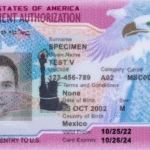



An in-person interview may no longer be part of every asylum case. Across more than a dozen affirmative asylum applications that CTN has been following, the U.S. Citizenship and Immigration Services (USCIS) case-status tracker no longer lists an interview as the next step. Each now reads: “The next step in your application is adjudication. If we schedule you for an interview, you will receive an interview notice.”
Our research online and the DHS website show that the status of ‘Next Step Is Adjudication’ means the case has moved beyond the initial background checks and biometrics and has entered the stage where an officer reviews the file. The use of conditional language – ‘If we schedule you for an interview’ – shows that an in-person interview is not guaranteed for every affirmative asylum application.
The change is minor in word count but significant in meaning; for many years, an applicant who reached this stage saw the following event in the case as a status indicating that an interview—that is, a face-to-face meeting with an asylum officer—would take place. The new message replaces that near-certainty with a condition: an interview may or may not be arranged.
CTN wrote to the USCIS to find out what the change entails and whether applicants whose cases have been flagged for adjudication will still have to be interviewed. At the time this article was published, the agency had not replied. We also contacted several immigration lawyers about the change. None received any formal communication from USCIS.
The phrasing follows a rule that the government introduced during the summer.
On 28 July 2026, the Department of Homeland Security issued an interim final rule entitled “Affirmative Asylum Referrals Without Interview”, which came into force on that same day. It enables a USCIS asylum officer to decide certain affirmative asylum cases solely on the written record—that is, on the application and the supporting evidence—and, if the applicant does not qualify, to refer the case to immigration court without having ever held an interview.
The practical difference between the old and the new procedure is that in the old system an interview consisted of an officer hearing the applicant before making a decision, whereas in the new system the officer may decide on the file as it currently stands.
It is important to note that a referral is not a denial. Under the rule, an applicant whose case is forwarded to immigration court is given a full hearing before an immigration judge as part of the removal proceedings, during which the asylum claim may still be made. The difference lies in the forum and the position: the applicant moves from the affirmative process, which is non-adversarial, to the court setting, where a government attorney will argue for removal.
The rule is not intended to cover all situations.
It applies to applicants who are ineligible to make an application—such as those who missed the one-year deadline for filing after arriving—because they are denied asylum, do not qualify for it in the discretion of the authorities, or are otherwise ineligible on the merits and have no lawful status permitting them to stay. USCIS states that it should not refer cases in which an applicant might be eligible or who has another form of lawful status without first having an interview.
The extent of the backlog is significant. The DHS has stated that the number of affirmative asylum cases in the backlog is over 1.4 million, and it has estimated that about 132,000 future applicants each year and as many as 444,000 of the applications currently pending—almost one-third of the backlog—could be considered under the new standard.
The department has presented the change as a way to clear the backlog and move ineligible cases through the system more quickly, while directing officers’ time toward claims more likely to succeed.
The department has presented the change as a way to clear the backlog and move ineligible cases through the system more quickly, while directing officers’ time toward claims more likely to succeed.
CTN will update this report whenever USCIS replies to our request for clarification.
The article provides general information only and should not be regarded as legal advice. Because asylum cases depend on specific facts and the rules are constantly changing, people with questions about their own cases should seek advice from a qualified immigration attorney or a representative accredited by the Department of Justice.
The information comes from case-status notices obtained from USCIS by CTN related to over ten affirmative asylum applications; the DHS/USCIS interim final rule entitled “Affirmative Asylum Referrals Without Interview” (Federal Register, effective 28 July 2026); and statements issued by DHS regarding the affirmative asylum backlog.
https://ctninfo.com/uscis-quietly-sh…-to-adjudication/
https://www.facebook.com/CaribbeanNewsMedia

https://ctninfo.com/uscis-quietly-sh…-to-adjudication/
https://www.facebook.com/CaribbeanNewsMedia
AI Use Policy:
Contents
Some of CTN’s journalists are not native English speakers and draft their work in French or Haitian Creole. We then use AI-assisted translation software to produce the English versions, and traces of machine-generated phrasing may occasionally remain. Every article — in any language — is written, reviewed, and edited by CTN’s staff writers and editors, who remain responsible for its accuracy. CTN also uses AI to convert text into audio.