

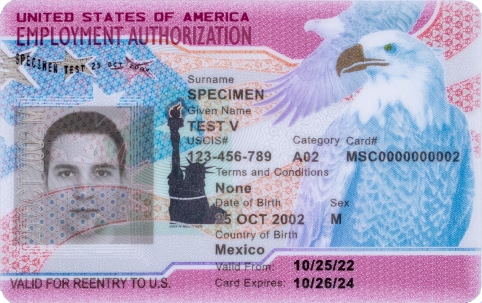
Immigrants whose work permits are nearing expiration should prepare to file their renewal applications on time to avoid a gap in their employment. The reason is a federal rule change: they can no longer count on the automatic extension that once kept them working while a renewal was still pending.
A Department of Homeland Security rule has removed one of the quiet protections that kept hundreds of thousands of immigrants employed while the government caught up on paperwork — the automatic extension of work permits for people who file to renew them. For anyone who submits a renewal on or after October 30, 2025, an expiring Employment Authorization Document no longer carries over automatically while U.S. Citizenship and Immigration Services decides the case.
The change matters most in the space between an old permit expiring and a new one arriving.
Until now, that gap was bridged automatically. Under a rule the previous administration put in place in December 2024, eligible renewal applicants kept their work authorization for up to 540 days past the printed expiration date while USCIS worked through its backlog — an extension that had itself grown from an earlier 180-day window. The new interim final rule ends that bridge for renewals filed on or after the October 30 effective date. If the agency has not finished processing by the time the card expires, the worker must stop working until the replacement arrives.
DHS has framed the rollback as a security measure. Ending automatic extensions, the department said, forces more frequent reviews of people with work authorization, which it argues will help USCIS “deter fraud and detect aliens with potentially harmful intent so they can be processed for removal.”
USCIS Director Joseph Edlow put it more sharply. “USCIS is placing a renewed emphasis on robust alien screening and vetting, eliminating policies the former administration implemented that prioritized aliens’ convenience ahead of Americans’ safety and security,” he said, calling the measure “a commonsense” step to ensure vetting is complete before a permit is extended. “All aliens must remember that working in the United States is a privilege, not a right.”
Who is affected — and the TPS exception
The rule reaches across a wide range of categories. According to analyses by immigration attorneys and the rule’s own text, it applies to asylum applicants and people granted asylum, refugees, applicants for green cards, spouses of certain work-visa holders, VAWA self-petitioners, and people seeking withholding of removal or cancellation of removal, among others.
There are limited carve-outs. DHS said extensions “provided by law or through a Federal Register notice for TPS-related employment documentation” are not eliminated — meaning some Temporary Protected Status holders whose extensions run through a government notice may still be covered. The picture for TPS is not simple, however: USCIS has separately moved to shorten some TPS-based extensions, and the administration terminated Haiti’s TPS designation over the summer. For many Haitian workers, whether a permit auto-extends and whether the underlying status survives are unfolding at the same time.
The practical risk is a lapse in the right to work — and, with it, a paycheck — even for people whose renewals are ultimately approved. USCIS processing times for work permits have run to many months in recent years, and without an automatic extension, any delay on the agency’s side now lands on the applicant. A missed stretch of work authorization can cost a job, since employers must reverify an employee’s authorization; it does not take a denial to do real damage, only a slow queue.
File early, USCIS advises
The agency recommends submitting a renewal up to 180 days before the current permit expires, and warns that the longer someone waits, the greater the chance of “a temporary lapse in their employment authorization.” The rule does not affect extensions already granted automatically before October 30, 2025.
The policy has not gone unchallenged. A lawsuit filed in 2026 seeks to overturn the rule, arguing DHS moved improperly in scrapping a protection that workers and employers had come to rely on. That case was still pending at the time this article was published.
For Caribbean and Haitian immigrant families, the effect is felt in the most ordinary terms — whether a nurse, a driver, a home health aide or a warehouse worker can stay on the schedule while a renewal sits in a federal queue. The safest course, immigration practitioners say, is to note the expiration date well ahead and file at the earliest allowed moment.
This article is for general information and is not legal advice. Immigration cases turn on individual facts, and work authorization rules are changing. Anyone with questions about their own EAD renewal should consult a licensed immigration attorney or a representative accredited by the Department of Justice.
https://ctninfo.com/dhs-ends-automat…newal-applicants/
https://www.facebook.com/CaribbeanNewsMedia
AI Use Policy:
Some of CTN’s journalists are not native English speakers and draft their work in French or Haitian Creole. We then use AI-assisted translation software to produce the English versions, and traces of machine-generated phrasing may occasionally remain. Every article — in any language — is written, reviewed, and edited by CTN’s staff writers and editors, who remain responsible for its accuracy. CTN also uses AI to convert text into audio.