

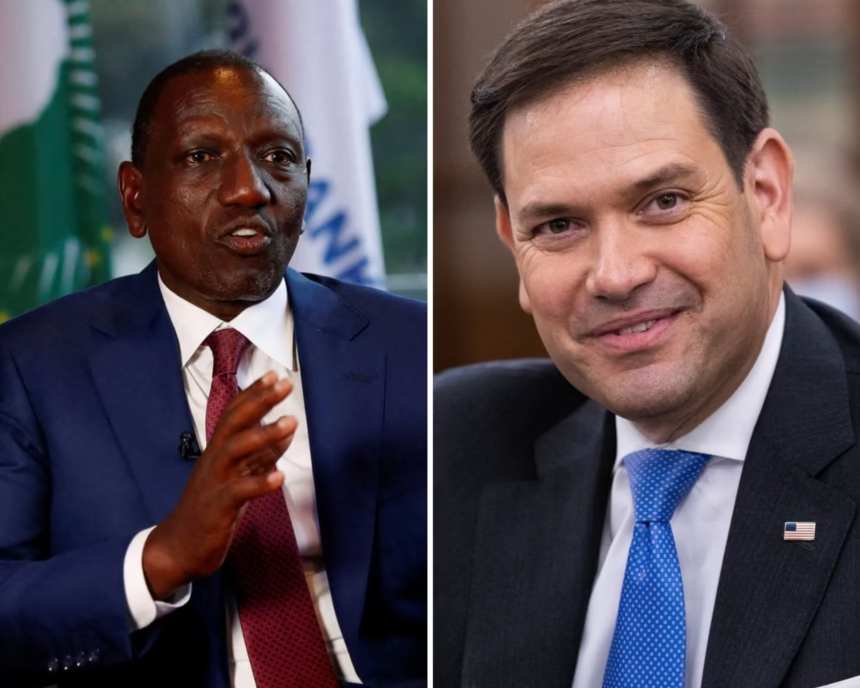
U.S. Secretary of State Marco Rubio and Kenyan President William Ruto held a virtual meeting on Tuesday, August 19, 2025, aimed at reinforcing their strategic alliance around Haiti’s ongoing security and political crisis. The discussion, set against a backdrop of heightened instability in the Caribbean, also opened the door to exploring economic opportunities to deepen bilateral cooperation.
According to U.S. State Department Deputy Spokesperson Tommy Pigott, the meeting allowed Secretary Rubio to commend Kenya’s active role in seeking durable solutions for Haiti. “President Ruto has demonstrated important leadership, and his country is a key partner in stabilizing the region,” Pigott said. Rubio also stressed the importance of international collaboration in addressing the security and political challenges Haiti has faced for several years.
For his part, President Ruto reiterated Nairobi’s commitment to supporting Haiti not only in the realm of security, but also through sustainable development and institutional strengthening. “Kenya is ready to share its experience in peacebuilding and security, while also supporting economic initiatives that can benefit both of our countries,” Ruto stated.
The meeting comes as the United States backs the creation of a United Nations support office to assist with logistics, equipment, and deployment of the Multinational Security Support Mission (MSS) in Haiti. Regional observers consider this multilateral approach essential to ensure that the Dominican Republic does not bear the financial and operational burden of the neighboring crisis alone. The proposed UN office would serve as a coordination hub for law enforcement operations and help facilitate the efficient deployment of troops and resources.

Meanwhile, American businessman Erik Prince, founder of the private military company Blackwater, announced that his firm, Vectus Global, has signed a ten-year contract with Haiti. The deal reportedly covers gang suppression operations and tax collection at the Haitian-Dominican border, with plans to deploy drones, helicopters, and foreign personnel—signaling a significant increase in private sector involvement in Haiti’s security landscape.
However, the initiative has raised serious questions and criticism. Experts warn of risks related to human rights, democratic oversight, and Haiti’s national sovereignty. The use of private companies in security operations remains a highly sensitive issue in the country, where local populations have long expressed distrust of foreign interference in internal affairs.
Analysts and human rights groups stress that any international intervention must be framed within transparent, multilateral mechanisms to prevent abuses and to ensure that foreign action contributes to genuine stabilization rather than the militarization of civilian areas.
As Haiti endures a profound crisis marked by the proliferation of armed gangs, paralysis of public administration, and deepening economic instability, the growing cooperation between Washington and Nairobi could prove crucial. Yet, the success of these initiatives will ultimately depend on the ability of international partners to work in concert with Haitian authorities and regional organizations, while upholding national sovereignty and the fundamental rights of the Haitian people.
https://ctninfo.com/?p=36338&preview=true