

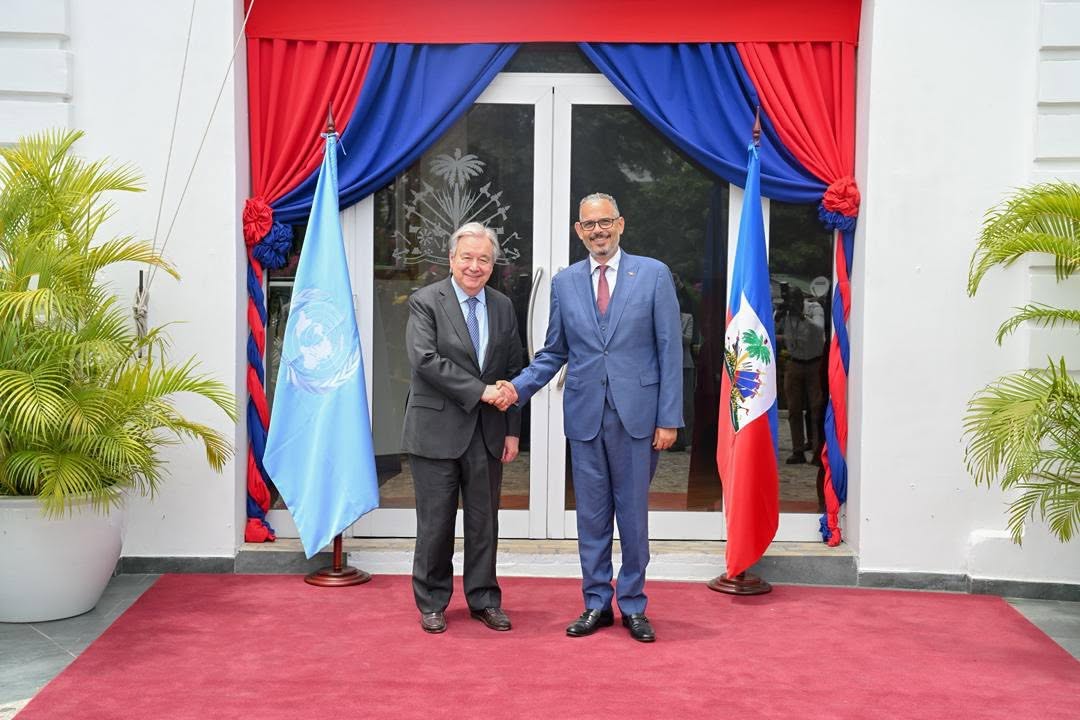
United Nations Secretary-General António Guterres made a visit to Haiti on Tuesday, June 16, 2026, marked by meetings with Haitian authorities, representatives of civil society, and displaced families. At the end of this intense day, he delivered a message filled with both hope and urgency, calling on the international community to fully assume its responsibilities in the face of the multidimensional crisis gripping the country.
Speaking to the press gathered late in the day at the BINUH headquarters at the Karibe Hotel in Pétion-Ville, António Guterres sought from the outset to reassure the Haitian people: “I came to Haiti with a simple message: you are not alone. The United Nations stands with you. And the world has no right to look away.”
These words resonate as the country has been plunged for several years into a security, humanitarian, and political crisis of unprecedented magnitude. The UN chief did not shy away from the gravity of the situation, citing alarming figures: 6.4 million people are in need of humanitarian aid, nearly 1.5 million are internally displaced, and more than 2,300 people have been killed since the beginning of 2026 due to gang violence.
An Unprecedented Humanitarian Crisis in the Western Hemisphere

“Haiti is experiencing the worst humanitarian crisis in the Western Hemisphere – and the one deteriorating the fastest,” the Secretary-General emphasized. He particularly stressed the devastating impact on women and children: in the first quarter of 2026, an average of more than 20 women and girls were assaulted every single day, while the recruitment of children by gangs has tripled in one year. Now, up to one in every two gang members is a child.
“Stolen childhoods – by violence, by exploitation, by hunger. That is the true nature of these groups, which thrive by exploiting the most vulnerable. This is absolutely intolerable. It must stop,” he insisted.
An Appeal to Donors
On the humanitarian front, the Secretary-General made an urgent appeal to international donors. The UN response plan, amounting to $880 million to help 4.2 million people, is barely funded at one-quarter of its target.
“I say it bluntly to donors: Haiti is not asking for charity. Haiti is asking the world to keep its word. And Haiti cannot wait,” he declared firmly.
Security, a Prerequisite for Everything
On the security front, António Guterres welcomed recent progress, including the recapture of certain neighborhoods in downtown Port-au-Prince and the resumption of Cabinet meetings at the National Palace after more than three years of interruption. He also met with members of the Gang Suppression Force (FRG), whose deployment offers, in his view, “a real chance to roll back violence and restore state authority.”

He nonetheless took care to remind that this force, although logistically supported by the UN, is not a United Nations operation. He thanked the governments of Haiti and the Dominican Republic for their cooperation, while saluting the courage of Haitian police officers and soldiers who “hold the line, day after day, often at the risk of their lives.”
The Secretary-General also insisted on the need to respect human rights in security operations: “Human rights and the fight against impunity are not an obstacle to security: they are its condition, and the foundation of public trust.”
A Political Process to Accelerate
Beyond the security emergency, António Guterres called for an acceleration of the political process. He met with Prime Minister Alix Didier Fils-Aimé as well as representatives of civil society, and advocated for credible and inclusive elections, the only legitimate path toward the restoration of constitutional order.
“The opportunity that presents itself today may not come again – I am counting on Haitian leaders to seize it,” he warned, while recalling that “it is for Haitians, and Haitians alone, to chart the way forward.”
A Robust International Force, but Still Insufficient Support
Questioned by journalists about the reasons for the delay in deploying a truly robust international force, the Secretary-General acknowledged that previous mandates were not up to the challenges. He welcomed the new Security Council authorization for a force of 5,500 men and women, with a strong mandate aimed at disarming and dismantling gangs.
However, he deplored the lack of engagement from developed countries in this force, noting the participation of Chadian, Jamaican, and soon Bangladeshi troops, but no contingents from wealthy nations. “It is time for developing countries to start engaging in this type of operation, because it is important to send the signal that we all matter in today’s world,” he stated.
Concrete Progress, But a Long Road Ahead
Haitian Prime Minister Alix Didier Fils-Aimé welcomed the visit as a sign of renewed trust between Haiti and the United Nations. He highlighted the encouraging results achieved on the ground, including the recapture of strategic areas of the capital and the gradual improvement of living conditions for displaced persons.
In a statement, the Prime Minister’s office affirmed that both parties agreed to strengthen their cooperation in a spirit of partnership, shared responsibility, and international solidarity, in order to pave the way for a Haiti that is “more stable, more serene, and more prosperous.”
A Glimmer of Hope
Despite the scale of the challenges, António Guterres concluded his press conference on a hopeful note. “For the first time in years, we can see the light at the end of the tunnel,” he said, recalling the resilience of the Haitian people and their history of struggle for freedom.
“More than two centuries ago, at Vertières, a people achieved what the world believed impossible: they broke their chains and liberated themselves. That same people will know, I am convinced, how to free themselves from the grip of the gangs – and reclaim their security, their institutions, their future.”
The UN chief left Haiti with a promise: “Our role is not to act in your place. Our place is by your side. And we will be there – until the very end.”