



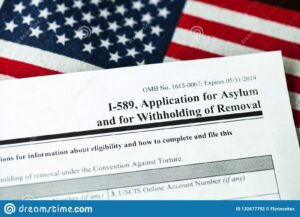
The Department of Homeland Security has issued a rule allowing asylum officers to send certain applications to immigration court without first interviewing the applicant, a change that takes effect immediately and that immigration advocates warn will cut hundreds of thousands of people out of a step they have long relied on to make their case.
The interim final rule was announced Monday, July 27, by U.S. Citizenship and Immigration Services and is scheduled for publication in the Federal Register this week. Unlike an ordinary regulation, it takes effect right away, though USCIS said it will accept public comments for 60 days before issuing a final version, according to Courthouse News Service and The Epoch Times.
Understanding what the rule does — and, just as important, what it does not do — matters for Haitian and Caribbean asylum seekers trying to gauge their own exposure.
The change applies to affirmative asylum: applications filed with USCIS by people who are not already in deportation proceedings. That is distinct from defensive asylum, which is raised by people already facing removal before an immigration judge.
Until now, USCIS generally interviewed affirmative applicants before deciding whether to grant asylum, deny it, or refer the case to an immigration judge. Under the new rule, officers may skip that interview and refer a case directly to the Executive Office for Immigration Review — the Justice Department’s immigration courts — when the existing record already shows the applicant is barred from asylum or ineligible, Newsweek and NOTUS reported.

The rule lists specific circumstances. According to NOTUS, they include cases in which an applicant is barred by the one-year filing deadline or in which the claim fails on its merits on the face of the record. Newsweek reported that DHS said interviews will still take place before the agency actually grants asylum.
DHS estimated the rule could affect more than 444,000 of the currently pending cases and, going forward, route more than 132,000 affirmative applicants a year to immigration court without an interview, Courthouse News reported. The agency said its affirmative asylum backlog exceeded 1.4 million cases at the end of the 2025 fiscal year.
What the government says
USCIS framed the change as a response to that backlog. Director Joseph Edlow said the asylum system had been “exploited for purposes of delay and work authorization, not legitimate claims of protection,” according to NOTUS.
“America’s asylum system exists to protect individuals who genuinely fear persecution, and this rule will help ensure that resources are directed to the timely adjudication of those claims instead of to those seeking to use the system as a loophole,” Edlow said in the agency’s announcement.
In the rule itself, USCIS wrote that the asylum system faces “an unprecedented crisis that is straining its adjudicatory capacity and undermining the timely protection of individuals seeking refuge,” as quoted by The Epoch Times.

Immigration advocates read the same rule as removing a stage of the process where an applicant can be heard.
Aaron Reichlin-Melnick, a senior fellow at the American Immigration Council, wrote that the practical result is that “many people will never get a chance to argue their case.” To be granted asylum, an applicant must show a well-founded fear of persecution in their home country.
The concern is sharpened by what awaits a referred case. NOTUS reported that the administration is funneling asylum applications toward immigration courts that are denying relief to nearly all applicants. Courthouse News reported that the Justice Department has reshaped those courts during the current administration, hiring more than 150 immigration judges in 2026 whose backgrounds skew toward former Immigration and Customs Enforcement attorneys, while firing more than 100 judges, many of whom had backgrounds in immigrant defense or granted asylum at higher-than-average rates.
Because the rule took effect without a prior comment period, it is expected to draw legal challenges under the Administrative Procedure Act, which generally requires public notice and comment before a rule takes effect.
A note on one widely shared claim
Some early coverage described the rule as eliminating a “right” to an asylum interview. The distinction matters. USCIS’s position is that it had offered interviews as a matter of practice despite, in its words, there being “no statutory right to an interview or requirement to conduct one,” and the rule removes language in DHS materials that referred to such a right, The New Republic reported.
Whether that practice amounted to a protected entitlement is precisely the kind of question the anticipated lawsuits will test. CTN will report the outcome of those challenges rather than predict them.
For Haitians, the rule lands on top of an already precarious week. Temporary Protected Status for Haiti is ending, and affirmative asylum has been one of the alternative avenues open to Haitians seeking to remain lawfully. A rule that lets USCIS move cases to immigration court without an interview narrows the margin for error at exactly the moment more Haitians may be turning to the asylum system.
Two points follow directly. First, the one-year filing deadline — one of the express triggers for a no-interview referral — is a trap for people who did not file within a year of their last arrival and do not qualify for an exception. Second, a case referred to immigration court is not automatically lost, but it is now far more likely to be decided by a judge without the applicant ever having sat for a USCIS interview. Both make competent legal representation more important, not less.
This article is for informational purposes and is not legal advice. Anyone with questions about their asylum application, TPS, or immigration status should consult a licensed immigration attorney or a representative accredited by the U.S. Department of Justice.
https://ctninfo.com/new-rule-lets-as…mmigration-court/
https://www.facebook.com/CaribbeanNewsMedia
Editorial Disclaimer: This article was originally written in English. Other language versions are produced using AI translation software, and errors are possible — the English version is authoritative. CTN also uses AI to convert text into audio.