


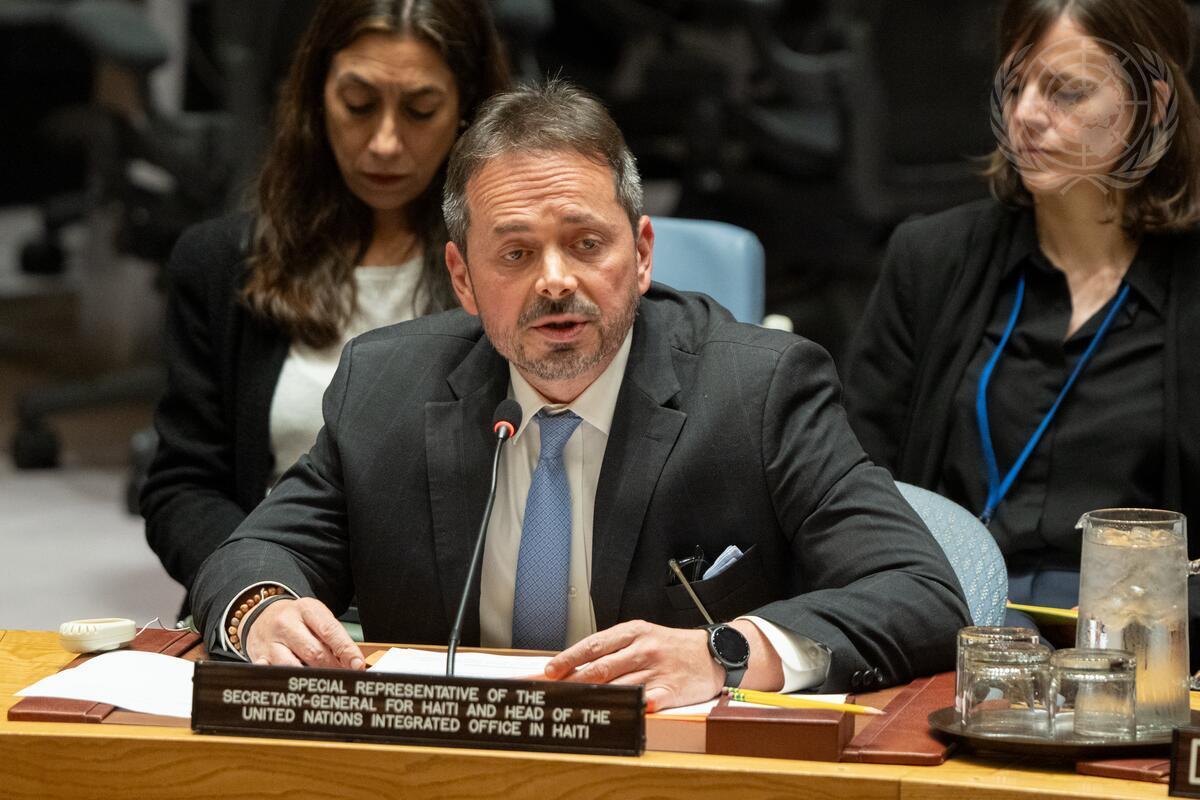
The top United Nations official in Haiti told the Security Council on Monday that the country has reached “a critical moment.” Political progress and a newly operational anti-gang force have opened a genuine path out of crisis. Yet the official warned, with urgency, that these gains remain precarious, bloodshed persists, and, most heartbreakingly, children now make up as much as half of the gangs’ fighting ranks.
“The transition stands at a critical moment,” Carlos Ruiz Massieu, Special Representative of the Secretary-General and head of the UN Integrated Office in Haiti (BINUH), told the 15-member Council in New York. The briefing marked the Council’s periodic review of a country that has not held a national election in a decade and has been without an elected president since the 2021 assassination of Jovenel Moïse.
For the Haitian diaspora watching from Boston, Miami, and Montreal, the briefing sent mixed messages. For the first time in years, there are signs of progress. However, the data on the violence affecting children is among the bleakest yet.
A registration drive, and a force that has started moving
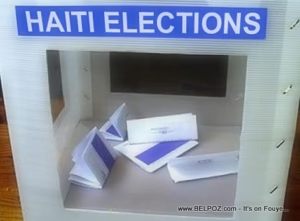
The headline development is procedural, but real. Ruiz Massieu confirmed that voter registration opened in Haiti on Monday. This step had been postponed in April when the electoral council said it needed to align its rules with a national political pact, leaving no firm date in place.
“The launch of voter registration today marks another important step forward,” Ruiz Massieu said, adding that it followed “the adoption of the revised electoral decree and the consensus reached on an electoral budget earlier this month.” He described those as “significant achievements that provide a basis for renewed momentum,” and named the next hurdle plainly: “The next priority is clear: the adoption of a credible and realistic electoral calendar.”
That calendar has slipped before. Haitian authorities have at various points targeted a first-round vote in late August and a runoff in December, but security and political disputes have repeatedly pushed the timeline back.
Alongside the political movement, the second major development is in security. The Gang Suppression Force — the militarized, UN-authorized body created under Security Council Resolution 2793 to replace the underfunded Kenya-led mission that preceded it — has begun operations.
“Against this backdrop, the launch of operations by the GSF represents an important milestone,” Ruiz Massieu said. “Together with the continued strengthening of the Haitian National Police and the Armed Forces of Haiti, it marks a transition from planning to implementation.”
He was careful not to oversell it. The force’s “progressive deployment and scaling up,” he said, along with “successful, targeted anti-gang operations will be critical to strengthening national efforts to address insecurity and restore public confidence. The GSF is projected to reach roughly 5,500 personnel, but has been assembling in staggered deployments and is not yet at full strength.

“Security remains Haiti’s most pressing challenge”
Whatever optimism the registration launch offered, Ruiz Massieu did not soften the underlying picture.
“Security remains Haiti’s most pressing challenge,” he told the Council. Gang violence continues to exact a heavy toll on a beleaguered population. Millions of Haitians remain displaced or food insecure. Women and children continue to suffer most from the violence.
He named specific fronts where gangs remain on the offensive: “Recent attacks in Cité Soleil, Kenscoff, as well as in the South-east and Artibonite departments demonstrate the continued reach of gangs and the imperative need to step up efforts to break their influence and strengthen the protection of populations.”
The scale of displacement is staggering. UN figures cited in recent months put the number of people driven from their homes by gang violence at over 1.4 million. Over half are children. Gangs control an estimated 85 percent of the capital, Port-au-Prince.
The envoy also flagged a risk that worries human rights monitors: The anti-gang campaign itself can harm civilians. Ensuring operations “fully comply with international human rights law and relevant international standards” is essential to sustaining legitimacy, strengthening public trust, and achieving lasting security gains. Earlier UN reports this year showed that most casualties in one period occurred during security-force operations against gangs. This is a reminder that, for ordinary Haitians, the fighting is dangerous from more than one direction.
The line that should stop the diaspora cold
The most devastating moment focused on children—an agonizing truth for families desperately trying to protect their sons from gang life.
“Haiti’s children are at a grave risk,” Ruiz Massieu said. “Alarmingly, as many as one in every two gang members today is a child. Children are being exploited, coerced into violence, and deprived of the opportunity to build a future. Averting a lost generation must therefore be at the heart of Haiti’s stabilization and recovery efforts.”
That figure is not new to those tracking Haiti closely, but it is worth stating clearly. Vanessa Frazier, the UN Special Representative for Children and Armed Conflict, spoke alongside Ruiz Massieu at Monday’s briefing. In May, after her first fact-finding mission to Haiti, she told reporters that children now make up around half of the gang members controlling large swaths of the country. UNICEF has separately reported that child recruitment tripled in a single year, with children as young as nine drawn in. International estimates place the share of minors among gang members between 30 and 50 percent. Experts caution that the number is hard to verify precisely.
The mechanics of that recruitment make it a story of persecution, not just a statistic. UN and human rights reports show that in gang-controlled neighborhoods, recruitment is now relentless—driven by poverty, hunger, the collapse of schooling, and coercion. Children become lookouts and informants because they’re “invisible” and not seen as a threat. Those who resist are met with violence and fear for their lives. Thousands of Haitian families have fled to escape this danger, and many in the diaspora share these traumas in their asylum claims.
Ruiz Massieu pointed to a response now being built. The National Commission on Disarmament, Dismantlement and Reintegration is creating “viable alternatives to gang membership, particularly for children and young people at risk.” Two new specialized judicial units will “strengthen accountability for serious crimes.” He called these units “an important step towards delivering justice for victims and breaking the cycle of violence and impunity.”
“Security operations alone will not produce lasting peace”
The envoy’s central argument was that guns alone cannot fix Haiti.
“Security operations alone will not produce lasting peace,” he said. Achieving peace “requires a broader strategy.” This means reducing the appeal and capacity of armed gangs, strengthening justice and state institutions, and providing opportunities for communities affected by violence, especially for women and children.
He tied security and politics together. He relayed a consistent message from his consultations with Haitian civil society, youth, and women’s organizations: “security is indispensable for credible elections.” But he warned against using insecurity as a reason to stall. He insisted that “electoral preparations and security improvements must advance together to sustain the momentum.”
Ruiz Massieu appeared before the Council alongside Jack Christofides, the Special Representative for the Gang Suppression Force; Monica Juma, Executive Director of the UN Office on Drugs and Crime; and Frazier. Haiti’s Minister of Foreign Affairs and Worship, Raina Forbin, attended, as did the Dominican Republic’s foreign minister, Roberto Álvarez.
Why Haitians abroad should read this carefully
For CTN’s audience, Monday’s briefing cuts two ways, and both matter.
The optimistic read is that, for the first time in years, the machinery of a Haitian election is actually turning — registration is open, a budget has been agreed, a decree has been revised, and an international force is finally in the field rather than on paper. Ruiz Massieu framed it as a chance that must not be squandered: “The window of opportunity before Haiti must now be seized.”
The sober view is in everything he said leading up to that sentence. The violence has not receded; it has spread into new departments. Displacement remains in the millions. The country’s children are being consumed by the very gangs the transition is meant to dismantle. The envoy concluded in French with a plea addressed to Haiti’s leaders and the Council.
“Le peuple haïtien attend depuis trop longtemps” — the Haitian people have waited too long — and they deserve, he said, for the progress made to translate into concrete improvements in their daily lives and new prospects for the future.
For families in the diaspora deciding whether relatives can safely remain in or return to Haiti, this is the key message: the UN’s own senior official emphasizes that there is a fragile opportunity, not a full resolution. At the same time, the threat to Haiti’s children is so grave that averting “a lost generation” must remain a national priority. The path ahead demands both caution and hope.

https://ctninfo.com/?p=43837&preview=true
https://www.facebook.com/CaribbeanNewsMedia
https://ctninfo.com/?p=43837&preview=true
https://www.facebook.com/CaribbeanNewsMedia
This article was originally written in English. Other language versions are produced using AI translation software, so errors may occur. The English version is authoritative. CTN also produces audio versions using AI. Please refer to the English text for the most accurate representation of this crucial update, as ensuring understanding of the delicate situation is vital for those making decisions abroad.