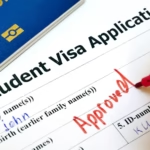



The U.S. authorities have reopened access to visas for foreign students, but have introduced new, controversial requirements. According to The Associated Press, each applicant will now be required to make their social media accounts visible to consular officers or risk being denied entry into the country.
In a statement released Wednesday, the State Department confirmed the end of the student visa suspension that had been in effect since May. However, new guidelines mandate that applicants’ social media profiles be set to “public” to allow for enhanced screening of their online activity.
“Officers will look for any signs of hostility toward the United States, its citizens, or its institutions,” the official note specifies. A refusal to comply will be interpreted as an attempt to conceal information.
The announcement comes as thousands of international students, notably from China, India, Mexico, and the Philippines, were awaiting the resumption of visa interviews to prepare for the upcoming academic year.

On Wednesday, a Chinese Ph.D. student living in Canada secured an appointment at the U.S. Embassy. “I was relieved. I had been checking the website several times a day,” he told The Associated Press, requesting anonymity.
This tightening of policy is part of a broader immigration strategy led by the Trump administration.
In the spring, the government had temporarily revoked visas for thousands of students, including some who had committed only minor offenses. The decision was partially reversed following public backlash.
At the same time, President Trump expressed his desire to limit access to major American universities. He notably suggested capping the number of international students at Harvard at 15%, although the university currently counts foreign students as about a quarter of its student body.
Critics have spoken out against the new policy. Jameel Jaffer, director of the Knight First Amendment Institute at Columbia University, said, “This measure echoes Cold War-era practices.” According to him, it could stifle freedom of expression: “It turns consular officers into censors, to the detriment of democratic debate,” The Associated Press reported.

The United States has also issued an ultimatum to 36 countries, giving them two months to improve their traveler screening systems. If not, their citizens could face entry restrictions, joining a blacklist that already includes twelve nations.
Source: The Associated Press