

Venezuela’s new interim president may face the same consequences as her predecessor if she does not comply with U.S. demands.
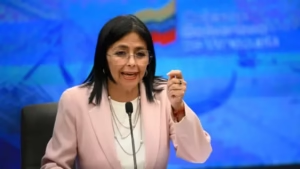
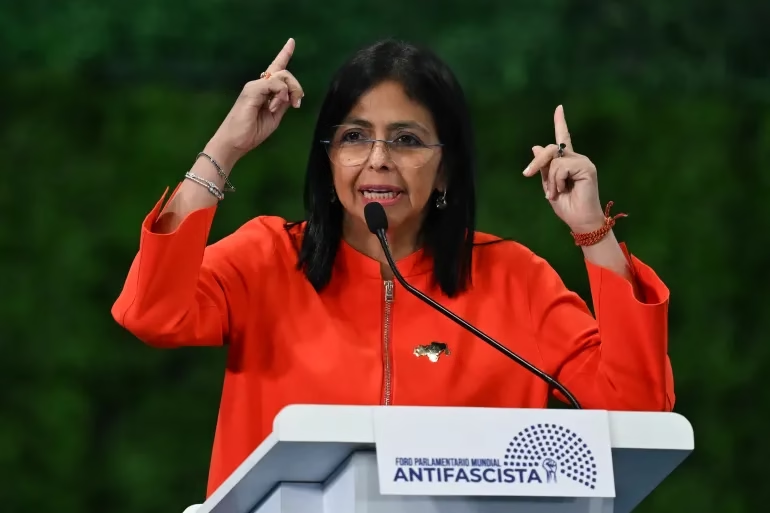
This was an unequivocal threat from President Donald Trump, suggesting that Delcy Rodríguez’s political and personal future will depend entirely on her level of cooperation with Washington.
In an interview with The Atlantic on Sunday, Donald Trump stated that the United States would not hesitate to go further if the new Venezuelan leader opposed the American presence and decisions in her country.
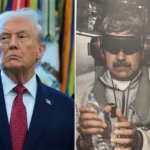
According to him, any resistance could result in consequences even more severe than those suffered by former President Nicolás Maduro, currently detained in New York following a U.S. military operation in Caracas.
President Maduro is accused by the United States of alleged ties to drug traffickers in the region.
The new Venezuelan leader does not face drug trafficking charges. Nevertheless, President Trump threatened her with the same consequences as those faced by her predecessor.
A Calculated Message, Delivered on Familiar Ground
The interview was conducted by phone as Donald Trump arrived at his golf club in West Palm Beach, Florida. The relaxed setting did not soften the message. The president insisted that Washington’s patience would be limited and that Venezuela’s new leadership would have no margin for error.
This tone contrasts sharply with typical State Department communications and reflects a deliberate White House strategy of direct pressure.
Trump’s firm stance differs from his statements the previous day. At an earlier press conference, he indicated that Delcy Rodríguez had privately expressed willingness to collaborate with the United States during the transition following Maduro’s removal.
This swift change suggests worsening relations between Washington and Caracas, possibly due to the new leader’s negative response to the U.S. military intervention, which Trump views as necessary for stabilization.
An Intervention Embraced, a Doctrine Abandoned
More broadly, this episode marks an ideological shift for Donald Trump. Previously critical of reconstruction wars and foreign regime change, he now supports direct intervention when a country’s situation is considered untenable or contrary to U.S. interests.
In the interview, Trump dismissed criticism from within his party, stating that Venezuela’s condition under Maduro justified external action, including temporary U.S. administration.
This position departs from the traditional interpretation of the “America First” slogan, which has typically meant avoiding prolonged military engagements abroad.
The arrest of Nicolás Maduro and his wife, Cilia Flores, after a U.S. operation in Caracas, has triggered significant international diplomatic reactions. Detaining the former Venezuelan president on American soil sets a notable legal and political precedent.
In this context, appointing Delcy Rodríguez to lead the interim administration appears less a sovereign transition and more a solution imposed under close U.S. supervision.
Venezuela as a Signal to the Rest of the World
Donald Trump also indicated that the Venezuelan case could serve as a precedent. He reaffirmed that the United States reserves the right to intervene elsewhere if its strategic interests are threatened.
He specifically mentioned Greenland, the autonomous Danish territory, which he considers important amid increasing competition with Russia and China in the Arctic. This statement reflects a more assertive vision of America’s global role.
Through these positions, Donald Trump is outlining a foreign policy based on direct deterrence, public pressure, and the open use of force. For Delcy Rodríguez, the message is clear: any deviation from Washington’s direction could prompt an immediate response.
Venezuela now enters a period of significant uncertainty, with domestic political decisions appearing closely linked to the White House’s direction.