


The discharge petition for Haitian Temporary Protected Status, House Resolution 965, has reached the 218 signatures needed for a House floor vote.
Representative Ayanna Pressley of Massachusetts introduced the resolution on December 18, 2025, in the 119th Congress.
The resolution seeks to force consideration of H.R. 1689, which would require the Secretary of Homeland Security to designate Haiti for TPS until three months after January 20, 2029.
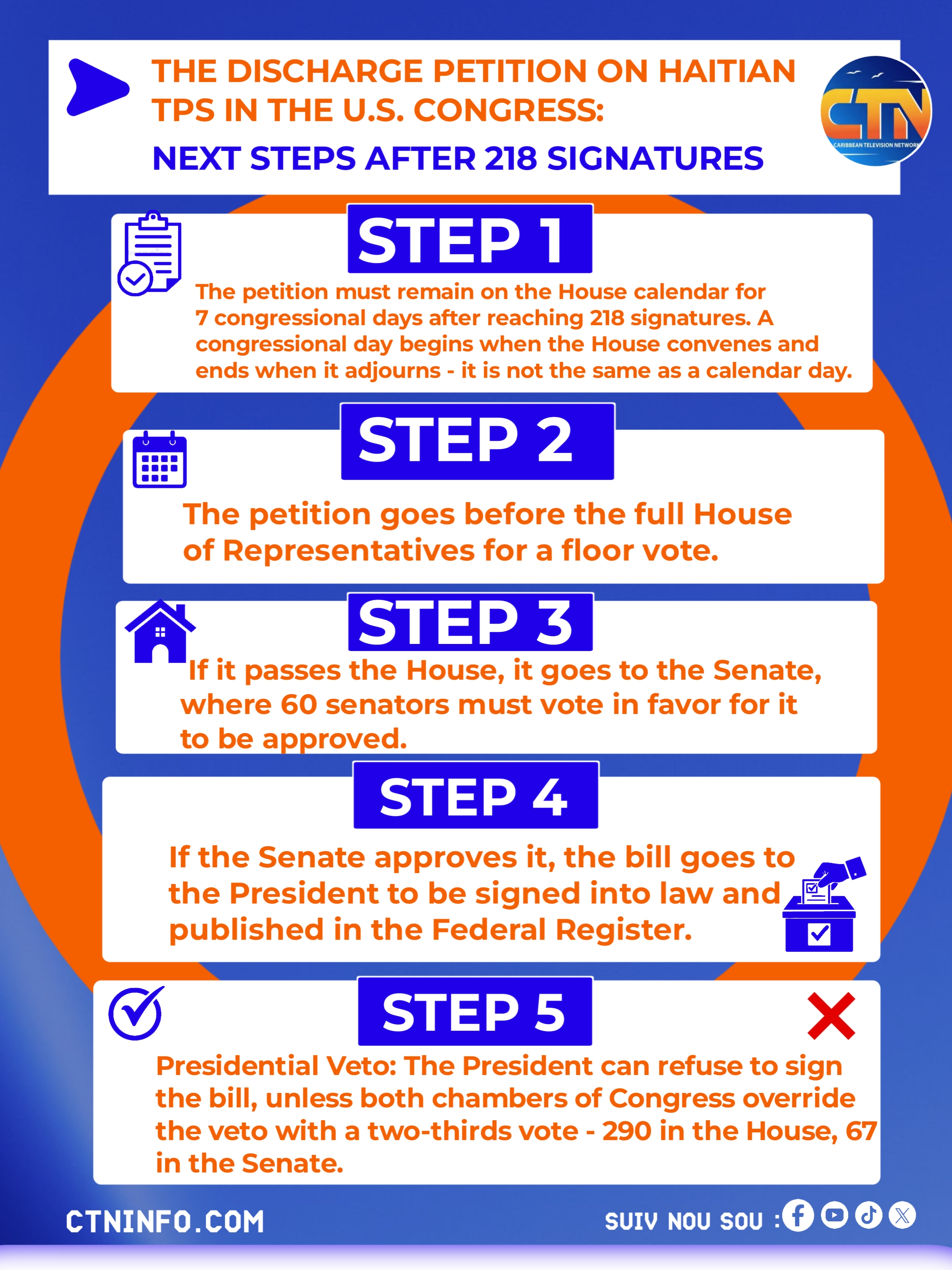
Securing 218 signatures is a key procedural step, but just the first in a multi-step legislative process. The bill still faces several distinct steps, each with its own procedures and requirements, before it can become law.
Below, each step is explained in accordance with United States Congress rules and procedures.

Below, each step is explained in accordance with United States Congress rules and procedures.

Step 1: The Seven-Day Legislative Waiting Period
After a discharge petition collects 218 signatures, it does not go straight to the House floor for a vote. House rules require the petition to stay on the House calendar for 7 legislative days before it can be considered.
Here’s a key question for understanding Congress: What is a legislative day?
A legislative day begins when the House opens session and ends on formal adjournment. If the House only recesses, the same legislative day continues. So, a legislative day can span multiple calendar days, or the House can complete several legislative days quickly by adjourning and reconvening.
The distinction matters because the seven-day legislative waiting period often lasts longer than a week, depending on the House’s schedule.
During recesses—like district work periods, holidays, or other breaks—no legislative days pass, as the House is not in session. If the petition hits 218 signatures during a recess, the clock starts only when the House reconvenes and legislative days resume. Typically, when the House is in session, one legislative day equals one calendar day, since the House usually adjourns after each sitting.
This waiting period is intentional. It gives House leaders, committee chairs, and members notice that the discharge petition has succeeded and that the bill will come to the floor. It also gives time to prepare procedures, schedule debates, and organize floor action.
House Resolution 965 requires the House to consider H.R. 1689 immediately after adoption. The resolution waives all points of order, allows one hour of debate—split between the majority and minority leaders or their designees—and permits one motion to recommit. These procedures ensure that after the waiting period, the resolution moves directly to a clearly defined vote, preventing procedural objections.
Step 2: Full House Floor Vote
After seven legislative days, any petition signer may move to bring the resolution to the floor. If a simple majority agrees, the House considers H.R. 1689 under the terms set by House Resolution 965.
The debate is limited to one hour, split between the majority and minority leadership or their designees.
After debate, the House votes on the bill with the included substitute language, which directs the Secretary of Homeland Security to designate Haiti for TPS until three months after January 20, 2029.
Passage requires a simple majority of members present and voting. If more votes favor the bill than oppose it, it passes the House. The resolution requires the Clerk to send the approved bill to the Senate within one week. However, 218 signatures on the discharge petition do not guarantee passage. A member may sign the petition but still vote against the bill. The petition forces consideration; the final vote decides if the bill advances.
Step 3: Senate Consideration and the 60-Vote Threshold
If H.R. 1689 passes the House, it goes to the Senate, where different and stricter rules apply.
Senate rules give the minority more power. The majority does not always control the floor or limit debate. The filibuster allows extended debate. Ending debate (cloture) needs 60 out of 100 senators.
Even if a majority supports H.R. 1689, 60 senators must vote for cloture to end debate. Democrats would need all in their caucus plus 13 Republicans for cloture, a higher bar than in the House. Key takeaway: the Senate’s rules make passing the bill significantly harder than in the House.
If 60 senators back cloture, debate is limited to 30 more hours. Then the bill needs a simple majority (51 votes, or 50 plus the Vice President).
The Senate might amend the bill. If its version differs from the House’s, both chambers must agree on one version—either through a conference committee or by adopting amendments. Any changes need new votes, adding time and complexity.
Step 4: Presidential Action
If both the House and Senate pass the same version of H.R. 1689, the bill goes to the President.
Under Article I, Section 7 of the U.S. Constitution, the president has three options when presented with a bill passed by both chambers of Congress.
The first option is to sign the bill into law. Once signed, the legislation takes legal effect according to its terms. In this case, the Secretary of Homeland Security must designate Haiti for TPS until three months after January 20, 2029. The signed law is published in the Federal Register, the official public record for executive and statutory actions.
The President can veto the bill, returning it to the original chamber with objections. Congress can override a veto only with a two-thirds majority in both chambers (290 in the House and 67 in the Senate). Overrides are rare.
If the President does nothing for 10 days (excluding Sundays) and Congress adjourns, the bill is dead (pocket veto) and cannot be overridden. If Congress stays in session, the bill becomes law without the President’s signature.
The administration’s stated stance on TPS terminations means a possible veto is a risk advocates and lawmakers must consider as the bill moves forward. In short, the administration’s position could be a decisive hurdle at the final stage.

The Broader Context
This legislative process occurs alongside a separate court case.
The Supreme Court will hear arguments in April about whether the administration can end TPS for Haitians and Syrians. The administration says over 350,000 Haitians and 6,000 Syrians could lose TPS, but U.S. District Judge Ana C. Reyes cites over 560,000 Haitians who currently have or are eligible for TPS.
Key takeaway: The outcome of the legislative process is affected by simultaneous developments in the courts.
The two tracks — legislative and judicial — operate independently but intersect in their consequences. If the Supreme Court rules that the administration has the authority to terminate TPS, the only remaining protection for affected individuals would be a congressional statute. If Congress enacts H.R. 1689 before or after such a ruling, the statutory mandate would supersede any executive action to end the designation, because a law passed by Congress and signed by the president — or enacted over a veto — carries greater legal authority than an administrative decision.

Understanding the TPS Designation
Temporary Protected Status is a form of humanitarian relief established by Congress through the Immigration Act of 1990. It allows the Secretary of Homeland Security to designate countries whose nationals in the United States cannot safely return due to armed conflict, environmental disaster, or other extraordinary and temporary conditions.
TPS holders are authorized to live and work in the United States for the duration of their designation, but the status does not provide a path to permanent residency or citizenship.
Haiti has received TPS designations repeatedly since 2010, following the January 12 earthquake that devastated the country, and subsequent redesignations have reflected continued instability, including political crisis, natural disasters, and the collapse of security conditions in Port-au-Prince and other regions.
The discharge petition on Haitian TPS represents an uncommon use of a procedural mechanism that most members of Congress encounter rarely in their careers. It reflects both the urgency that supporters attach to the issue and the political reality that the legislation could not advance through the normal committee process under the current House leadership.
The 218 signatures mark the beginning of the legislative path, not its conclusion. Each subsequent step carries its own requirements, risks, and political calculations. What is certain is that the rules governing each stage are well established, and the process will follow the constitutional and procedural framework that has governed American lawmaking since the founding of the republic.
https://ctninfo.com/?p=41485&preview=true
https://x.com/CtNinfo
https://ctninfo.com/?p=41485&preview=true
https://x.com/CtNinfo
Disclaimer:
This article was originally written and published in English by the Caribbean Television Network (CTN). Versions in other languages have been produced through automated translation using artificial intelligence software.
While every effort is made to ensure quality, automated translations may contain inaccuracies, awkward phrasing, or errors that do not reflect the original text’s intent.
Readers are encouraged to consult the original English version for the most accurate and authoritative account.
CTN assumes no responsibility for misinterpretations arising from automated translations.
While every effort is made to ensure quality, automated translations may contain inaccuracies, awkward phrasing, or errors that do not reflect the original text’s intent.
Readers are encouraged to consult the original English version for the most accurate and authoritative account.
CTN assumes no responsibility for misinterpretations arising from automated translations.
All articles are written by CTN staff, with artificial intelligence used to assist with grammar, translation, and minor corrections.
Pressley Secures Key House Breakthrough on Haiti TPS, Calls Vote ‘Critical Step to Saving Lives