


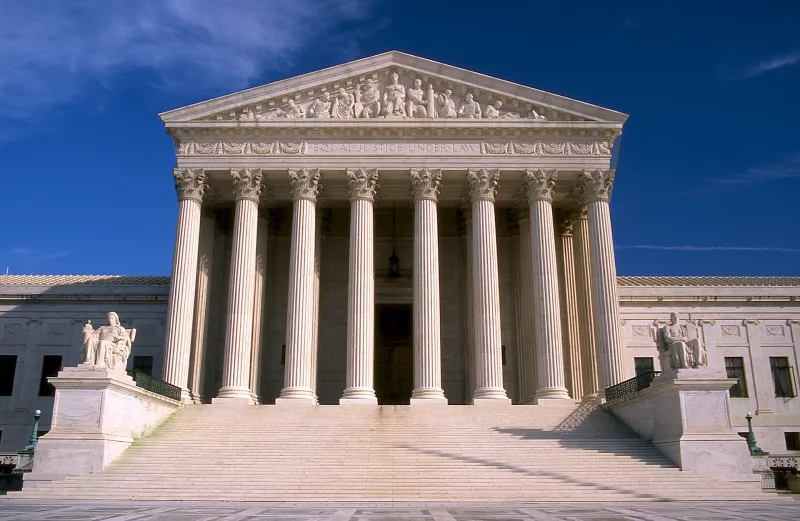
The U.S. Supreme Court on Tuesday preserved the broad understanding of birthright citizenship that has held for more than a century, striking down President Donald Trump’s attempt to deny citizenship to children born in the United States to parents who are in the country illegally or on a temporary basis.
For the Haitian diaspora, the decision lands as rare, reassuring news in a punishing season. Even as the same Court cleared the way last week to end Temporary Protected Status for hundreds of thousands of Haitians, Tuesday’s ruling guarantees that the U.S.-born children of those families remain American citizens — regardless of their parents’ immigration status. Community leaders in Massachusetts had warned in recent days that tens of thousands of citizen children of TPS holders were caught in the uncertainty.
The justices grounded their decision in the text and history of the 14th Amendment, ratified after the Civil War, and in federal citizenship laws Congress later enacted. Writing for the Court, Chief Justice John Roberts traced the amendment’s promise to its origins. “Citizenship, then and now, was the right to have rights — to freely participate in our political community. The Framers of the Fourteenth Amendment extended that promise to ‘every free-born person in this land,'” he wrote. “We keep that promise today.”
How the justices divided
The outcome carried two different margins, and both matter.

On the central question — whether Trump’s executive order was lawful — the Court ruled against the president 6 to 3. But on the deeper constitutional question of whether birthright citizenship is guaranteed by the 14th Amendment itself, beyond the reach of any future Congress, the justices split 5 to 4.
Five members of the Court held that the Constitution itself secures birthright citizenship: Chief Justice Roberts, who wrote the opinion, joined by Justices Sonia Sotomayor, Elena Kagan, Amy Coney Barrett, and Ketanji Brown Jackson. Notably, Barrett — one of Trump’s three appointees — sided with the majority. Jackson filed a concurring opinion, joined in part by Sotomayor, that pointedly answered the dissent.
Justice Brett Kavanaugh occupied the middle. He agreed the executive order was unlawful, concurring in the judgment, but dissented in part: in his view, the Constitution does not by itself compel birthright citizenship, and Congress could narrow it by statute — it simply has not, which is why the president could not do so on his own. His position produced the 6-3 result on the order, while leaving the constitutional holding at 5-4.
Three justices would have let Trump’s restrictions take effect. Justice Clarence Thomas wrote the principal dissent, joined by Justice Neil Gorsuch, and Justices Gorsuch and Samuel Alito each filed dissents of their own. Thomas argued the majority had stretched the 14th Amendment beyond its text, and maintained the Citizenship Clause was aimed primarily at formerly enslaved Black Americans. In her concurrence, Jackson took direct aim at that reasoning, noting the tension between Thomas’s long-stated belief in a “colorblind” Constitution and his reading of the clause as a race-conscious measure.
What the order would have done
Trump signed the birthright citizenship order on the first day of his second term, casting it as a pillar of his immigration crackdown. It sought to limit citizenship to children with at least one parent who is a U.S. citizen or lawful permanent resident, excluding babies born to people in the country unlawfully — and, significantly, also those born to people here legally on temporary terms, such as students and green-card applicants.

According to the Associated Press, which reported on the decision, research by the Migration Policy Institute and Pennsylvania State University’s Population Research Institute estimated that more than 250,000 babies born in the United States each year would have been affected.
The order never took effect. A series of lower courts had blocked it as unconstitutional, repeatedly invoking the Supreme Court’s 1898 decision in United States v. Wong Kim Ark, which recognized the U.S.-born child of Chinese immigrants as a citizen. The case the justices decided, Trump v. Barbara, arose from a New Hampshire ruling that struck down the order. The Trump administration had argued that children of noncitizens are not “subject to the jurisdiction” of the United States — the qualifying phrase in the Citizenship Clause — and so fall outside its guarantee, a reading the Court rejected.
The amendment’s language is sweeping: “All persons born or naturalized in the United States, and subject to the jurisdiction thereof, are citizens of the United States and of the State wherein they reside.” Courts have long read its only exceptions to be the children of foreign diplomats and of an occupying enemy force.
The ruling marked another instance of a conservative-majority Court declining to endorse Trump’s expansive claims of executive power. The Associated Press noted that the president attended oral arguments in person in April — an unusual move for a sitting president — and that he had publicly disparaged judges and justices in the run-up to the decision, much as he lashed out after the Court struck down his emergency-powers tariffs earlier this year. Birthright citizenship was the first of Trump’s immigration policies to reach the justices for a final ruling.
For CTN’s audience, the practical meaning is direct and immediate. A child born on U.S. soil to Haitian parents is a U.S. citizen, full stop — whether those parents hold TPS, a visa, a pending application, or no status at all. That guarantee now stands reaffirmed by the nation’s highest court, even as the broader fight over the parents’ own protections continues in Congress and the lower courts.
Editorial Disclaimer:
This article was originally written in English. The French and Haitian Creole versions are produced using AI translation, and errors are possible — the English version is authoritative. CTN also uses AI to convert text into audio. Readers and listeners should rely on the English text where any discrepancy arises.
https://ctninfo.com/supreme-court-up…ing-trumps-order/
Source: Associated Press.