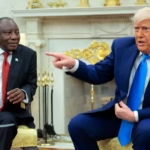



If the American president hoped to find a compliant leader accepting all blame and reprimands by inviting his South African counterpart to the White House, he would need to revise his expectations.
During a particularly tense interview with Donald Trump this Wednesday, Cyril Ramaphosa remained unintimidated. He presented a dignified and firm refusal to the unfounded attacks and accusations from the far-right American president regarding an alleged “white genocide” in South Africa.
Everything began when Trump stated to Ramaphosa that white farmers were being killed and their lands were being confiscated.
“Nothing is happening to them,” added the American president. Ramaphosa immediately corrected and contradicted these statements, while acknowledging the existence of crime in his country. He specified: “People are unfortunately killed in criminal acts, but it’s not only white people — the majority are black people.”

Trump promptly interrupted him by declaring: “Farmers are not black. I’m not saying it’s good or bad, but they’re not Black. People are being killed in large numbers, you’ve seen all those cemeteries.”
Trump then turned to journalist Peter Alexander, one of his regular targets, to accuse the “fake news” of refusing to cover what he describes as genocide in South Africa, preferring, according to him, to talk about the “gift” of a Boeing 747 given to the American president by Qatar. That’s when Ramaphosa, visibly exasperated, responded:
“I’m sorry, I don’t have a plane to give you,” referencing an aircraft worth 400 million dollars given to Trump by Qatari authorities. Trump replied that he would take one if he received it.
Later in the exchange, Ramaphosa quoted Nelson Mandela, telling Trump: “We learned from Nelson Mandela that wherever there are disagreements, people need to sit around a table to discuss them.”
The meeting was held in the presence of several Trump collaborators, including billionaire Elon Musk, who originated the genocide allegations against South Africa, his native country.

On social media, many users praised the courage of the South African head of state, who refused to engage in the same exercise as the Ukrainian president during his last visit to Washington. Some highlighted the hypocrisy of the American president, who grandly welcomed the Israeli Prime Minister, despite facing an international warrant for genocide in Gaza, where thousands of civilians have been killed in daily bombardments conducted by the Israeli army.