

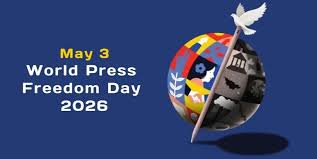
On May 3, 2026, the world celebrated World Press Freedom Day. But this year, the alarms are ringing louder than ever. Between a historic decline in freedom of expression, record impunity for crimes against journalists, mass surveillance, manipulation through artificial intelligence, and targeted warfare against field reporters, the democratic edifice is crumbling. From Port-au-Prince to Lusaka, via Paris and Oslo, media actors are sounding the alarm.
In his message published for this occasion, United Nations Secretary-General António Guterres recalled a cruel adage: “It is often said that in times of war, truth is the first casualty. But all too often, the first casualties are the journalists who risk everything to reveal the truth.”
The UN chief denounced the increase in attacks against media professionals, “not only where war rages, but everywhere the powerful fear being held accountable.” Censorship, surveillance, judicial harassment, assassinations: the threats are multiplying. He particularly emphasized the “sharp” rise in the number of journalists killed in war zones, often deliberately targeted.”
Guterres also decried the shocking impunity surrounding these crimes: “85% of crimes committed against journalists are neither investigated nor punished. Such a level of impunity is unacceptable.

For him, press freedom is also being tested by economic pressures, new technologies, and deliberate manipulations. “When access to reliable information erodes, mistrust sets in. When public debate is distorted, social cohesion weakens.” He concluded: “All other freedoms flow from press freedom. Without it, there can be no human rights, no sustainable development, no peace.”
UNESCO, which coordinates this day globally, placed the 2026 edition under the main theme: “Shaping a Future of Peace.” The world conference is being held on May 4 and 5 in Lusaka, Zambia, bringing together journalism actors, digital rights defenders, and artificial intelligence experts.
In its World Trends Report on Freedom of Expression and Media Development (2022-2025), UNESCO presents damning figures:
Since 2012, freedom of expression worldwide has declined by 10%, a deterioration comparable to the most troubled periods of the 20th century (World Wars, Cold War).
Journalist self-censorship has increased by 63%, due to fear of reprisals, online harassment, judicial intimidation, and economic pressures.
Information manipulation, particularly through AI used by malicious actors, weakens trust and national security.

Faced with this picture, UNESCO insists: “Free, reliable, and verified information strengthens accountability, dialogue, and human rights. Journalism shapes peace.”
IFJ: 128 journalists killed in 2025, widespread surveillance
The International Federation of Journalists (IFJ) painted an equally grim picture. According to its figures, 128 journalists were killed while carrying out their duties in 2025, and 9 others have already lost their lives in 2026.
The IFJ particularly denounces armed conflicts in which “press” status has become a reason to be targeted rather than protected. In Ukraine, Palestine, Lebanon, and Sudan, reporters are being arrested, killed, and sometimes forced into exile because of their work.
But beyond war zones, it is the new forms of repression that are worrying. In its latest World Surveillance Report published on April 28, the IFJ highlights systematic and unprecedented surveillance against journalists: state-level spyware, advanced phishing, fake websites, all without real legislative control. Source protection is seriously compromised.
The IFJ is also concerned about the rise of artificial intelligence, which enables large-scale disinformation, identity theft, and the replacement of journalists by automated tools, without respect for ethics or remuneration for the use of their work.
“Every attack on a media professional is an attack designed to silence a story. The deplorable state of press freedom must mobilize all of us. It is time to act. Together,” said IFJ General Secretary Anthony Bellanger.
For its part, Reporters Without Borders (RSF) published its 2026 World Press Freedom Index, and the finding is historic: for the first time in 25 years, more than half of the world’s countries are in a “difficult” or “serious” situation. The global average score has never been so low.
Among the five indicators measured (economic, legal, security, political, social), the legal framework is the one declining the most, a sign of the growing criminalization of journalism. National security laws, in particular, are increasingly being used to silence critical investigations.
Key trends in the 2026 Index
Norway remains at the top for the tenth consecutive year.
Eritrea still closes the ranking.
Syria (141st) makes the largest upward jump (+36 places) after the fall of the Assad regime.
The United States (64th) drops seven places.
In Latin America, Ecuador and Peru plunge into violence and repression.
“Passivity becomes a form of endorsement. It is no longer enough to affirm principles: active protection policies are essential. This begins with ending the criminalization of journalism. The ball is in the court of democracies and their citizens,” RSF concludes.
Haiti: A multi-voiced alarm over insecurity and impunity
In Haiti, World Press Freedom Day was marked by a series of converging statements from the main journalist and media associations.
The Association of Haitian Journalists (AJH)
The AJH alerts to the deterioration of working conditions: assassinations, kidnappings, and forced exile. It calls for concrete measures to protect journalists and fight impunity. “Without safety for journalists, neither lasting peace nor the rule of law can be guaranteed,” the organization insists.
The Haitian Association of Online Media (AHML)
The AHML describes a climate marked by insecurity and violence, which limits the work of professionals. It calls for a rapid response from the authorities and condemns any attack on press freedom. “Without security progress, press freedom will remain under pressure in Haiti,” it warns.
The National Network of Online Media (RENAMEL)
RENAMEL strongly denounced the disappearance of two journalists – Osnel Espérance (Uni FM) and Junior Célestin (Megastar) – who have been missing since March 13, 2026, while reporting on the security situation in downtown Port-au-Prince.
The organization severely criticizes the lack of investigation: “The Government Commissioner can initiate proceedings. The Haitian National Police, via the Central Directorate of Judicial Police, has not opened an investigation for lack of a complaint.” RENAMEL calls on the government led by Alix Didier Fils-Aimé to take urgent measures.
The National Network of Haitian Journalists (RENAJOUH)
RENAJOUH wished “good continuity in the struggle” to all journalists worldwide. The association recalls that May 3 originates from the Windhoek Declaration (May 3, 1991, Namibia), a founding text that underscores the importance of a free, independent, and pluralistic press for democracy. RENAJOUH calls for collective mobilization to protect imprisoned or persecuted journalists.
World Press Freedom Day 2026 is no ordinary commemoration. The figures are undeniable: the decline is historic, impunity is the norm, and new technologies are increasing the vulnerability of journalists.
As António Guterres reminded us: “Let us protect the rights of journalists and make this world a haven for truth, and for those who reveal it.”
https://ctninfo.com/press-freedom-in-peril-a-historic-setback-threatened-journalists-and-a-global-call-to-action/
https://www.facebook.com/CaribbeanNewsMedia