

The Haitian National Police (PNH) has announced the seizure of a significant quantity of drugs during two major operations conducted on April 30 and May 3, 2026, against drug trafficking. The most spectacular operation, carried out off the coast of Môle Saint-Nicolas by the US Coast Guard, resulted in the seizure of more than 1.3 tons of Marijuana. In the South, a fourth cocaine seizure in one month confirms the intensification of land-based operations.
A Joint Operation at Sea: 1,376 kg of Marijuana Seized
On Sunday, May 3, 2026, in the early afternoon, Haitian authorities officially received a large drug shipment seized in territorial waters. The operation, conducted by the US Coast Guard, took place on April 30, 2026, around 7:00 PM (Haitian time), off the coast of Môle Saint-Nicolas, in the extreme northwest of Haiti.
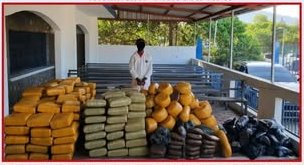
According to a press release from the Police Communication Directorate (DICOP) published on May 4, a US vessel intercepted a suspicious boat navigating in an area near Haitian territorial waters. On board, officers discovered 66 white bags, carefully sealed and containing dried vegetable matter. Preliminary tests confirmed it was Marijuana, with a total weight of 1,376 kilograms.
The arrested suspect is a Jamaican national, Aldane Anderson, alias “Ali,” aged 25. After his apprehension, he was handed over to Haitian authorities along with the shipment.

The official handover of the drugs and the suspected trafficker took place on May 3, 2026, around noon, in Cap-Haïtien. The ceremony, held in the presence of the Justice of the Peace of Cap-Haïtien, Maître Samuel Philippaux, and his clerk, brought together representatives of the US Coast Guard, the Haitian Coast Guard of the North, and the Anti-Drug Trafficking Brigade (BLTS/North).
All evidence and the suspect have been handed over to BLTS North for judicial proceedings. The PNH welcomes in its press release “the effectiveness of the collaboration” between the US Coast Guard and Haitian units.
“The PNH reaffirms its commitment to combating drug trafficking throughout the national territory and salutes the cooperation between the US Coast Guard and the BLTS/DCPJ, as well as with the PNH Coast Guard,” reads the document.
In the South: Peterson Lavajesse Arrested for Cocaine Possession
The same weekend, but in the Southern Department, another operation took place. On Saturday, May 2, 2026, around 7:00 AM, in the locality of Grand Bouchiet, commune of Torbeck, law enforcement officers (BLTS and South Coast Guard) arrested Peterson Lavajesse.
The suspect was apprehended in possession of two packets of white powder. Rapid tests conducted on-site tested positive for cocaine.

What makes this arrest particularly notable is its context: this is the fourth drug seizure recorded in the South in less than one month. According to the PNH, this unusual pace reflects intensified patrols and better collaboration with the population.
“This intervention constitutes the fourth drug seizure recorded in less than a month in the region, which demonstrates the determination of law enforcement to combat drug trafficking throughout the national territory,” emphasizes another communiqué from the police institution.
A Message of Firmness and an Appeal to the Population
In both communiqués, the Haitian National Police repeats its signature message: “The PNH is for you, the PNH is closer to you.” The institution renews its commitment to pursue and dismantle criminal networks, while inviting the population to continue cooperating.
Both cases are now in the hands of the judicial system. For Aldane Anderson, the Jamaican national arrested at sea, the proceedings could lead to prosecution for international drug trafficking, a crime punishable by severe penalties under Haitian law. Peterson Lavajesse, arrested in Torbeck, will be tried for possession and trafficking of cocaine.
These seizures illustrate the porosity of Haiti’s coasts to illicit flows. Môle Saint-Nicolas, the westernmost point of the island, is historically monitored for its potential role in drug transit between Colombia, Jamaica, and the United States. The increase in interceptions in the South (Torbeck) also suggests that local and transnational networks are actively using land and coastal routes in the department.
https://ctninfo.com/major-drug-seizure-in-haiti-1376-kg-of-marijuana-intercepted-by-us-coast-guard-suspected-trafficker-arrested-in-the-south/
https://www.facebook.com/CaribbeanNewsMedia