


As institutional tensions continue to rise between the government and the Provisional Electoral Council (CEP), a broad coalition of political and social forces of the Republic published a solemn declaration this Friday denouncing what they call an “authoritarian drift” of the executive branch. In this text, the signatories denounce the desire of Prime Minister Alix Didier Fils-Aimé to “take control of the electoral process” and reject in advance “any electoral charade orchestrated in contempt of the law.”
The statement, a copy of which has reached our newsroom, affirms that Haiti is going through one of the most critical moments in its contemporary history. The signatory forces believe that the exclusive and fundamental mission of the current executive branch was to restore a climate of security allowing a return to constitutional order through the organization of free, honest, and inclusive elections in 2026. However, according to them, by moving away from this objective, the government is abdicating its primary responsibility toward the Haitian people.
“While the nation legitimately aspires to the renewal of the political class, the executive branch has deliberately provoked an open conflict with the CEP in the sixth month of 2026. This unprecedented crisis does not result from an act of fate, but from a planned political strategy,” write the signatories.
For the first time in the country’s recent history, the text emphasizes, Haiti is experiencing a pre-electoral crisis. This crisis reveals, without ambiguity, Prime Minister Fils-Aimé’s desire to take control of the electoral process to favor “a partisan movement.”

An “unconstitutional” decree denounced
At the heart of the controversy lies the publication of an electoral decree that the government adopted in the Council of Ministers last June 2. The political and social forces consider this decree “unconstitutional” because it transfers the CEP’s prerogatives to a director general, thus neutralizing the electoral body and reducing it to the role of a “mere spectator.”
They recall, referring to Article 191 of the Constitution, that the CEP is the constitutional body responsible, in complete independence, for the management and direction of electoral operations. The CEP has the exclusive constitutional responsibility for drafting the electoral decree. This independence, they insist, is “not an option, but the very foundation of the legitimacy and credibility of the results to come.”
“This act constitutes a brutal rupture of the democratic order,” the statement stresses.
Faced with this situation, the signatory forces say “NO to the capture of the electoral process by Prime Minister Fils-Aimé.” They reject in advance any electoral charade orchestrated in contempt of the law and demand the immediate restoration of the CEP’s independence as well as the establishment of real conditions for credible, transparent, and sovereign elections.

The text also calls on the nation’s living forces — trade unions, civil society organizations, the private sector, social forces, and citizens — to “rise up with dignity.”
“The time of submission is over. The time for vigilance and citizen resistance to save Haitian democracy has arrived,” conclude the signatories.
An appeal to the international community
The political and social forces also call on the international community. They emphasize the need to continue supporting the Provisional Electoral Council in its struggle to defend its constitutional prerogatives. This appeal comes as several of the country’s technical and financial partners have already expressed their support for the electoral process as conducted by the government, but without clearly taking a position on the current institutional dispute.
The joint statement is signed by several political and social organizations of the Republic. Among the structures that have affixed their signatures are notably RDNP, EDE, SDP, Debout Citoyen, INITE, INIFOS, PALMIS, KORE-N, Plateforme Solidarité, AHTM, SSH, Grand Bloc du peuple, MUTH, and CSH.
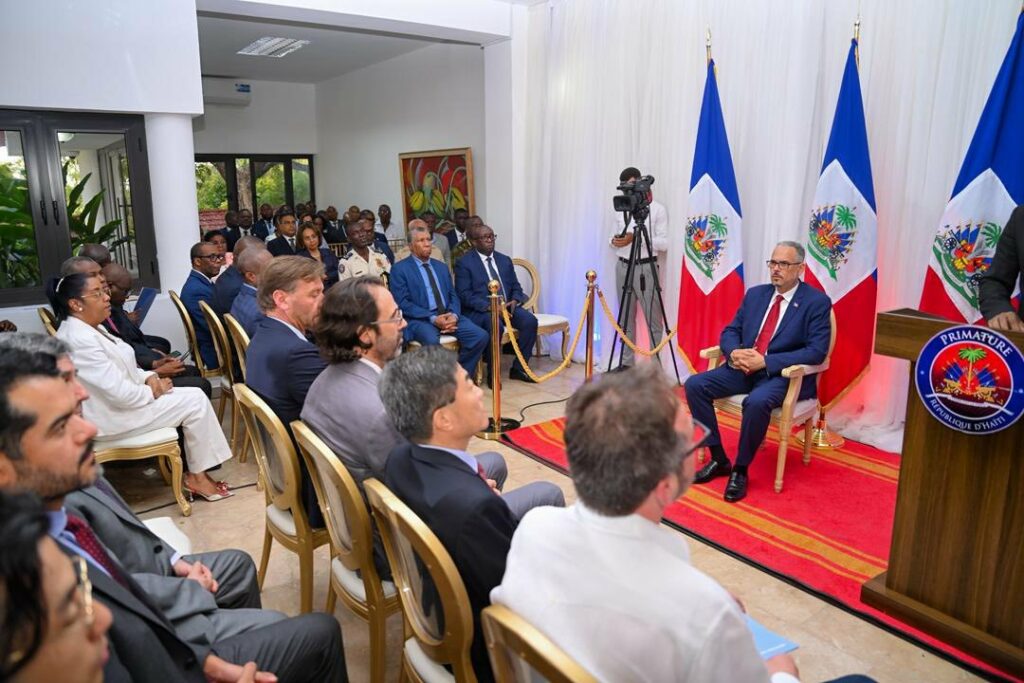
This solemn declaration comes the day after the controversial installation of Uder Antoine as Director General of the CEP, a ceremony marked by the absence of nearly all the electoral advisors and an open rift between the Electoral Council and the government.
While the government reaffirms its determination to organize elections on schedule, a growing segment of the political class and civil society is meeting it with a flat refusal. The meeting that CEP President Jacques Desrosiers requested from the Prime Minister to find a consensual solution to the crisis has not, at this stage, taken place.