

Haiti is experiencing a humanitarian crisis of unprecedented magnitude. According to the latest report from the International Organization for Migration (IOM) published this Friday, June 5, 2026, nearly 1.5 million people are currently displaced within the country. Among them, more than half are women and girls, a figure that bears witness to the growing distress of a population caught in a vice between the violence of armed groups and the collapse of protection structures.
“The displacement crisis in Haiti is entering an even more alarming phase,” declared Grégoire Goodstein, IOM Chief of Mission in Haiti, in a statement from the UN agency. “The crisis is no longer confined to specific neighborhoods or regions. As violence spreads to areas once considered safe, more and more people are forced to flee repeatedly, often with nowhere to go.”
Violence spreading
The figures recorded by the IOM’s Displacement Tracking Matrix (DTM) reveal a situation deteriorating at an alarming speed. Unlike previous months when displacements remained confined to a few hotspots in the capital, violence has now spread to entire regions.

Last May, the resurgence of violence in Cité Soleil forced more than 18,000 people to flee within just a few days. This single episode was enough to cross a symbolic and tragic threshold: for the first time, the number of internally displaced persons (IDPs) in the Port-au-Prince metropolitan area exceeded 300,000.
A few weeks earlier, the Sud-Est department was hit. Armed attacks in this region, until then considered a refuge zone for those fleeing insecurity elsewhere in the country, displaced more than 5,000 people. This movement illustrates a worrying shift: communities that once offered shelter are themselves becoming displacement epicenters.
Forced returns aggravating the crisis
Alongside these internal displacements, Haiti is facing a massive influx of returnees. Since the beginning of 2026, more than 110,000 Haitians have been forcibly returned to their country. Among them are women, children and other vulnerable groups.
Upon their return, these people often arrive without resources and with limited support. Many are sent back to communities already struggling to absorb new arrivals, or even to areas directly affected by the activity of armed groups. Vulnerable profiles remain very present among these returnees: unaccompanied children, pregnant women and postpartum women continue to be received in precarious and often dangerous conditions, with very limited access to basic services and protection.

Dire humanitarian needs
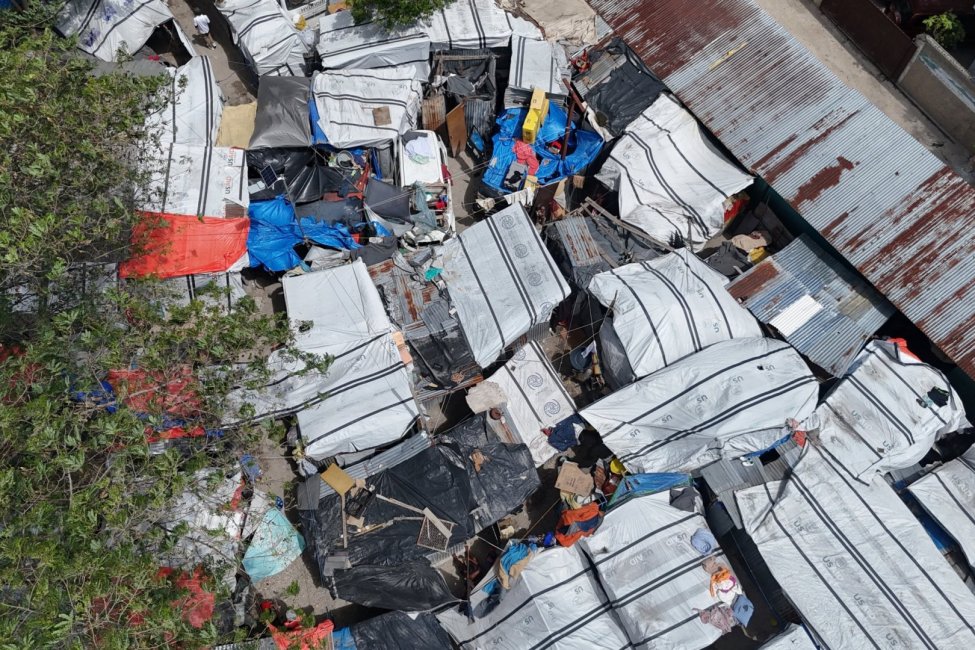
In displacement sites as well as in host communities, the picture is uniformly bleak. People interviewed by IOM teams report critical shortages:
Shelter: many families sleep on the ground, exposed to bad weather and pests;
Food: hunger is omnipresent, especially among children;
Drinking water: the lack of clean water encourages the spread of diseases such as cholera;
Healthcare: medical structures are either non-existent or inaccessible due to insecurity;
Psychosocial support: trauma linked to violence and repeated displacement is not being addressed.
Children, pregnant women, people with disabilities and female-headed households are among the most vulnerable. Overcrowding in displacement sites and limited access to services significantly increase protection risks, including exploitation and sexual abuse. Thousands of people are thus exposed to a continuous deterioration of their humanitarian conditions.
Hurricane season: an additional threat
As the Atlantic hurricane season has now officially begun, humanitarian concerns are intensifying even further. Flooding and severe weather events could worsen already fragile living conditions, particularly in overcrowded displacement sites where many lack adequate emergency shelter.
Climate models predict a particularly active season this year. For displaced Haitians, already facing insecurity, hunger and lack of care, a hurricane could transform a critical situation into a major humanitarian catastrophe.
IOM maintains operations despite insecurity
Despite a context of widespread insecurity and extremely difficult operational conditions, the IOM continues to provide vital humanitarian assistance in some of the hardest-hit areas of Haiti.
In collaboration with national authorities and humanitarian partners, the organization says it is providing emergency shelter, basic healthcare, psychosocial support, water, sanitation and hygiene (WASH) services, essential relief items and site management assistance for displaced communities.
Call for sustained investment
The needs of Haitian communities are clear and urgent: security, access to essential services, legal identity and livelihoods enabling people to support themselves and their families.
As violence spreads inexorably and the number of displacements continues to rise, the IOM is advocating for sustained investment in humanitarian aid, recovery efforts and community resilience.
“Sustained investment remains indispensable to help vulnerable communities rebuild their lives and reduce the risk of repeated displacement,” insist the organization’s officials.
A country at the crossroads of crises
Haiti thus finds itself at the crossroads of several simultaneous crises: chronic insecurity, institutional collapse, acute economic crisis and now a humanitarian catastrophe linked to mass displacement. The 1.5 million displaced people represent more than 10% of the country’s total population, one of the highest ratios in the world for a crisis not officially classified as an armed conflict.
As electoral deadlines approach that the government says it wants to organize, the humanitarian issue risks being relegated to the background. Yet, as the IOM reminds us, it is impossible to hold credible elections in a country where more than a million citizens have been torn from their homes, live in unworthy conditions and have no access to basic services.
Photo credit/OIM