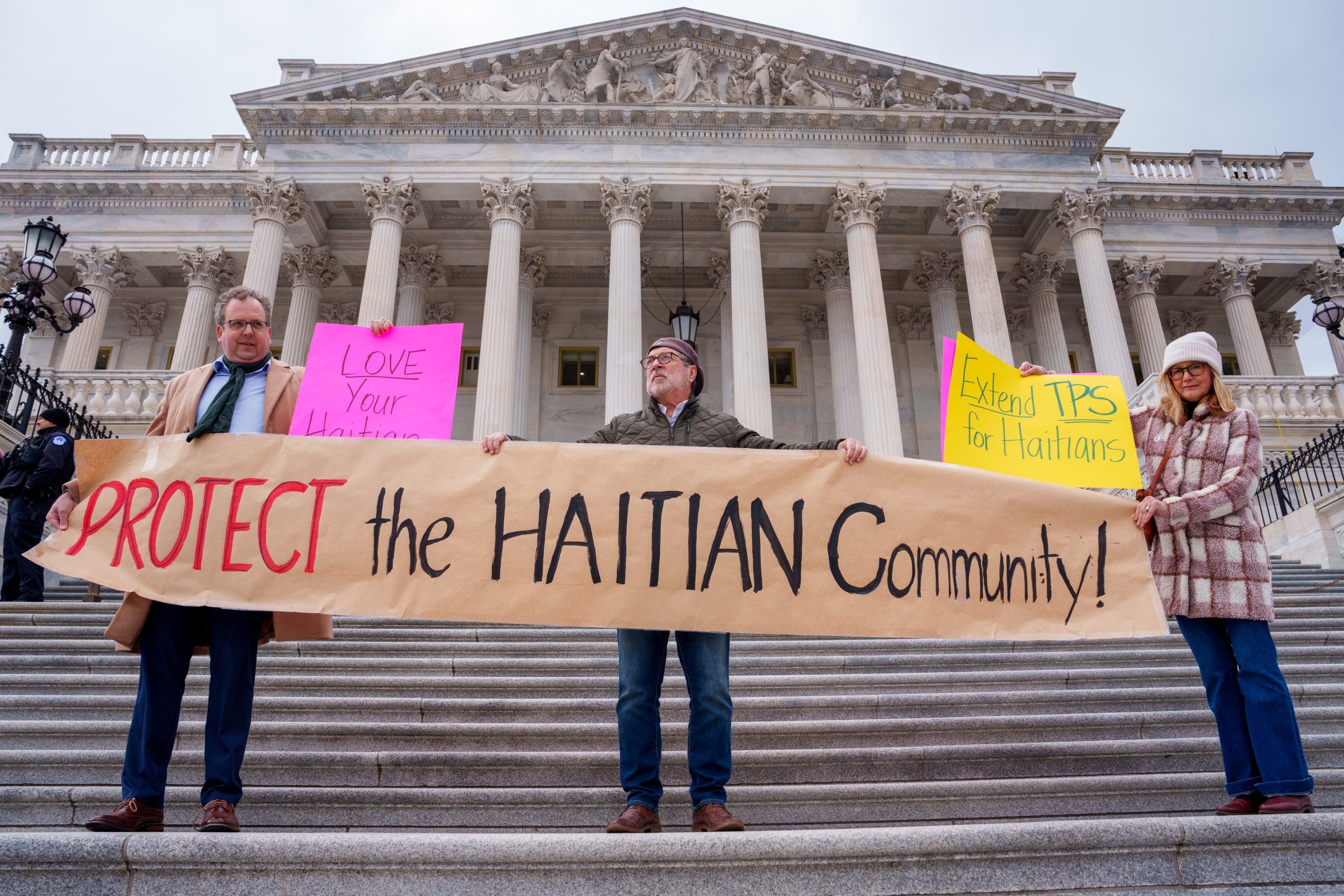



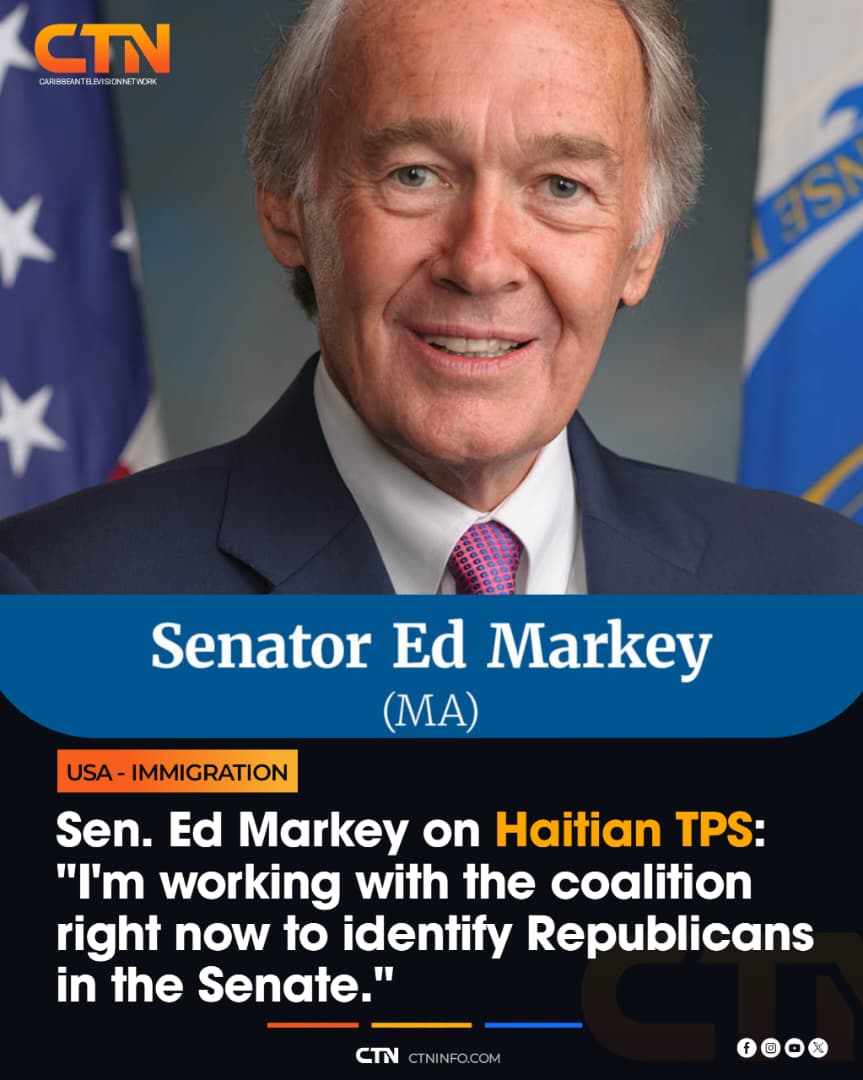
In an exclusive interview with Emmanuel Paul of Caribbean Television Network, the Massachusetts senator credited Pressley’s House breakthrough, warned of a “polarized” Senate environment, and tied the fight to nursing-home staffing and his own immigrant roots in Malden.
DORCHESTER, Mass. — Sen. Edward J. Markey (D-Mass.) said in an exclusive interview with Caribbean Television Network that a coalition of immigration and Temporary Protected Status advocates is working to identify Republican senators who could be persuaded to back an extension of TPS for Haiti, calling the effort “more urgent now than ever” as the U.S. Supreme Court heard oral arguments the same day on the Trump administration’s bid to terminate the program.
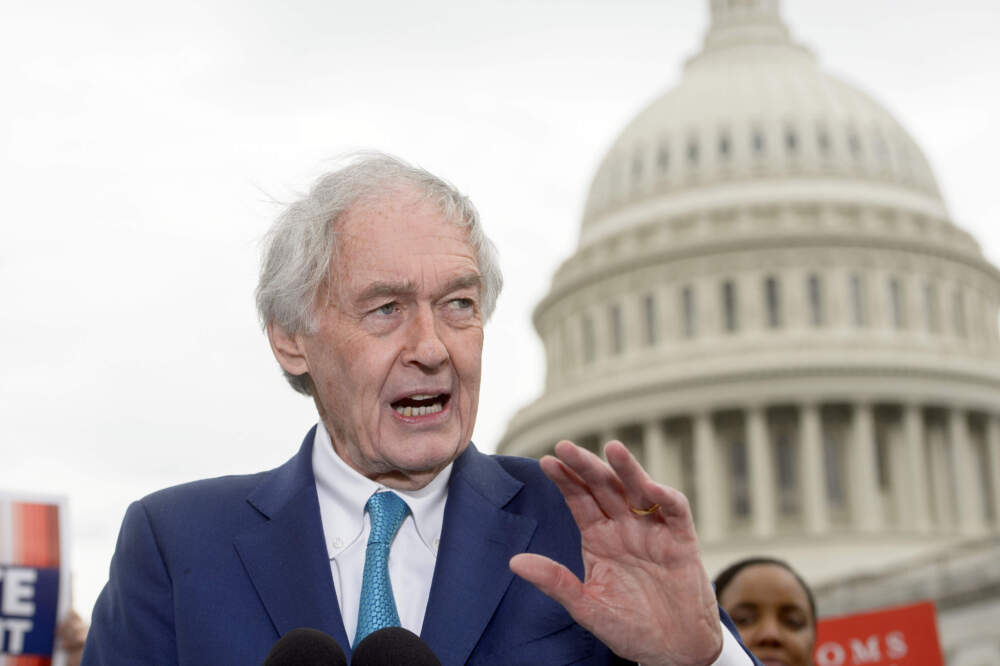
The interview with CTN editor-in-chief Emmanuel Paul came one day after Markey co-headlined a press conference at the U.S. Capitol with Rep. Ayanna Pressley (D-Mass.) and Sen. Lisa Blunt Rochester (D-Del.), demanding that the high court preserve TPS, and as the justices took up a case that could determine the legal status of more than one million people across the country.
Markey told CTN that the legislative momentum from the House — where Pressley’s discharge petition cleared the chamber on April 16, forcing a vote on a three-year extension of Haitian TPS — must now be replicated in a Senate where the political math is significantly steeper.

“It’s a huge step,” Markey said of the House passage, attributing the breakthrough to what he called Pressley’s “historically great leadership.”
The senator was direct about the source of the momentum.
“All credit to Congresswoman Ayanna Pressley,” he said, noting that her efforts persuaded a “small number, but sufficient number” of House Republicans to release the bill from committee and move it to a floor vote.
A Steeper Climb in the Senate
Markey acknowledged the Senate path is harder. Supporters need to flip more than a dozen Republican senators to overcome a likely filibuster — a lift he described as challenging but not impossible.
“We need to do the same thing in the Senate,” Markey told CTN. “I’m working with the coalition right now in order to identify Republicans in the Senate.”

He framed the legislative effort in moral rather than partisan terms, calling Haitian TPS “a human rights, humanitarian cause.”
Pressed on whether the petition has a realistic path through a Republican-controlled chamber, Markey did not minimize the obstacles. He pointed to a “very polarized political environment” and said many Republican senators are reluctant to break with President Donald Trump.
“Republicans are afraid of Donald Trump in the United States Senate,” Markey said.
He went further, casting the administration’s posture toward Haitian immigrants as part of a broader pattern of demonization.
“He wants to make America great again by making America hate again,” Markey said, adding that Trump “constantly references Haiti.”
Despite that, the senator said he refuses to write off the bill’s chances.
“I’m not giving up hope,” he told CTN. “What Congresswoman Pressley did is what we have to try to achieve.”
Markey said the coalition’s strategy involves direct outreach to every Republican senator, with no assumptions about who is and is not persuadable.
“We’re not going to assume that people are going to say no,” he said. “We’re going to be working on every single Republican senator.”
He pledged to continue the canvass until “every single remedy” available has been exhausted.
No Floor Date Yet
Asked whether the Senate has scheduled the bill for a vote, Markey said no — and made clear that the timing decision will be made jointly with affected communities and the broader TPS coalition rather than unilaterally.
“They want to ensure that we bring a vote when we are confident that we can be successful,” he said.
That decision-making process, the senator stressed, includes Haitian, Venezuelan, and other communities whose TPS designations are at stake in both the legislative fight and the parallel Supreme Court case. Markey said his office is “talking to them right now” about the path forward.
Amicus Brief and Supreme Court Hopes
Markey confirmed he co-signed an amicus brief filed with the Supreme Court urging the justices to preserve TPS. The case before the high court could affect the legal status of approximately 1.2 million people currently protected under the program — including hundreds of thousands of Haitians, as well as nationals of Venezuela, Syria, and other countries previously deemed unsafe for return.
“Our hope is that the 1.2 million individuals who are now covered by TPS are given a fair hearing,” Markey said.
He urged the justices to bring “their hearts to this” alongside their legal analysis.
In one of his sharpest critiques of the federal government’s posture, Markey highlighted what he described as a basic contradiction in the administration’s stance on Haiti.
“You can’t say on the one hand that a Haitian community deeply rooted in Massachusetts of 40,000 to 50,000 individuals should be sent back to Haiti,” he told CTN, “even as the Trump administration is saying it’s too dangerous for Americans to go to Haiti.”
The U.S. State Department maintains a Level 4 — Do Not Travel — advisory for Haiti, citing kidnapping, violent crime, civil unrest, and the collapse of essential services. Federal challenges to the administration’s termination of TPS for Haiti have been consolidated under Miot v. Trump, the case now before the Supreme Court.
The Care Economy at Risk
Beyond the courtroom and legislative stakes, Markey emphasized the practical impact of any TPS termination on Massachusetts and the country’s elder-care infrastructure. He described Haitian TPS holders as essential to the long-term care system, particularly nursing homes.
“There are no nursing homes,” Markey said, “if we don’t have Haitian TPS holders working in the nursing homes of Massachusetts.”
He warned of “a collapse of the nursing care system” if those workers lost work authorization, and said the same dynamic plays out across the country.
The argument echoed Tuesday’s Capitol Hill press conference, where Markey, Pressley, and Blunt Rochester appeared alongside care workers, faith leaders, and senior-services administrators. Roughly 28 percent of the U.S. direct care workforce is foreign-born, according to research from LeadingAge and KFF, and as many as one in three home-care workers nationwide are immigrants.
A Senator from Malden
Asked about his ongoing engagement with the Haitian community in Massachusetts beyond the TPS fight, Markey grounded his answer in geography.
“I live in Malden,” he said.
After Boston, Cambridge, and Brockton, Malden hosts the largest Haitian community in the Commonwealth, the senator told CTN, adding that he sees Haitian families daily in his own neighborhood.
“They’re my neighbors,” Markey said. “Families I can see in my community.”
He framed his advocacy as a defense of those neighbors against what he called sustained demonization by the Trump administration.
“Trump is bringing out the Malden in me,” Markey said, “to fight for those families.”
He extended that pledge beyond his hometown to “Boston, Brockton, and all across the Commonwealth.”
A Personal Story
Pressed by Paul on why he has invested significant political capital in a community that — while substantial — does not on its own determine his electoral prospects, Markey grounded his answer in his own family history.
His grandparents arrived in Malden as immigrants, the senator said, and raised five daughters, including his mother. His father drove a truck for the Hood Milk Company. Markey himself, he said, lived at home through both college and law school because the family could not afford otherwise.
“We didn’t have any money,” he said. “I understand that struggle.”
He noted that 75 percent of last year’s graduates from Malden High School were Black, Hispanic, or Asian, with only 25 percent white.
“That’s our future,” Markey said.
He said his 2026 reelection campaign is, at its core, about ensuring that today’s immigrant families have access to the same path his own family walked.
“In one generation, I became a United States senator,” Markey told CTN. “Each of those families should be able to realize their American dream.”
He said the goal should be no longer than two generations for any immigrant family in the country.
Hurricane Matthew, 2016
Markey closed the interview by recalling his trip to Haiti in October 2016, days after Hurricane Matthew devastated the country’s southern peninsula and killed more than 500 people.
“I flew down three days later,” he said. “No other senator went there.”
The senator said he traveled to assess the damage firsthand and to help mobilize health care and food assistance for affected communities. He cited the trip as evidence of his long-running engagement with Haiti, not only at moments of legislative urgency.
“That’s an indication of the concern which I have,” Markey said, “the care which I have for the Haitian community.”
He framed his commitment as part of a broader politics of empathy, drawing again on his working-class upbringing.
“We just have to keep that ladder there,” he said, “that ladder of opportunity, for every family, including the Haitian families.”
What Comes Next
The Supreme Court’s decision in the consolidated TPS cases is expected later this term. A ruling could either preserve current protections, allow the administration’s terminations to take effect, or send the matter back to the lower courts for further proceedings. Pressley’s three-year extension bill, meanwhile, awaits action in the Senate, where it has not yet been scheduled for a vote.
Markey, who is running for reelection in 2026, told CTN he intends to remain a central voice in the upper-chamber effort.
“I’m not giving up,” he said.
For Haitian TPS holders watching from Massachusetts, Florida, New York, and across the country, the outcome of both the court case and the Senate vote could determine whether they remain legally authorized to live and work in the United States, a country where many have built lives and raised U.S.-citizen children for more than a decade.
The Haiti TPS designation, first issued after the catastrophic 2010 earthquake, was renewed by every administration in the years that followed, until the Trump administration moved to terminate it earlier this year.
Note: This article was originally written in English. Translations into other languages are produced with the assistance of AI. Only the English version is authoritative; CTN assumes sole responsibility for the original English text.
https://ctninfo.com/?p=42461&preview=true
https://www.linkedin.com/company/100253760/admin/dashboard/