


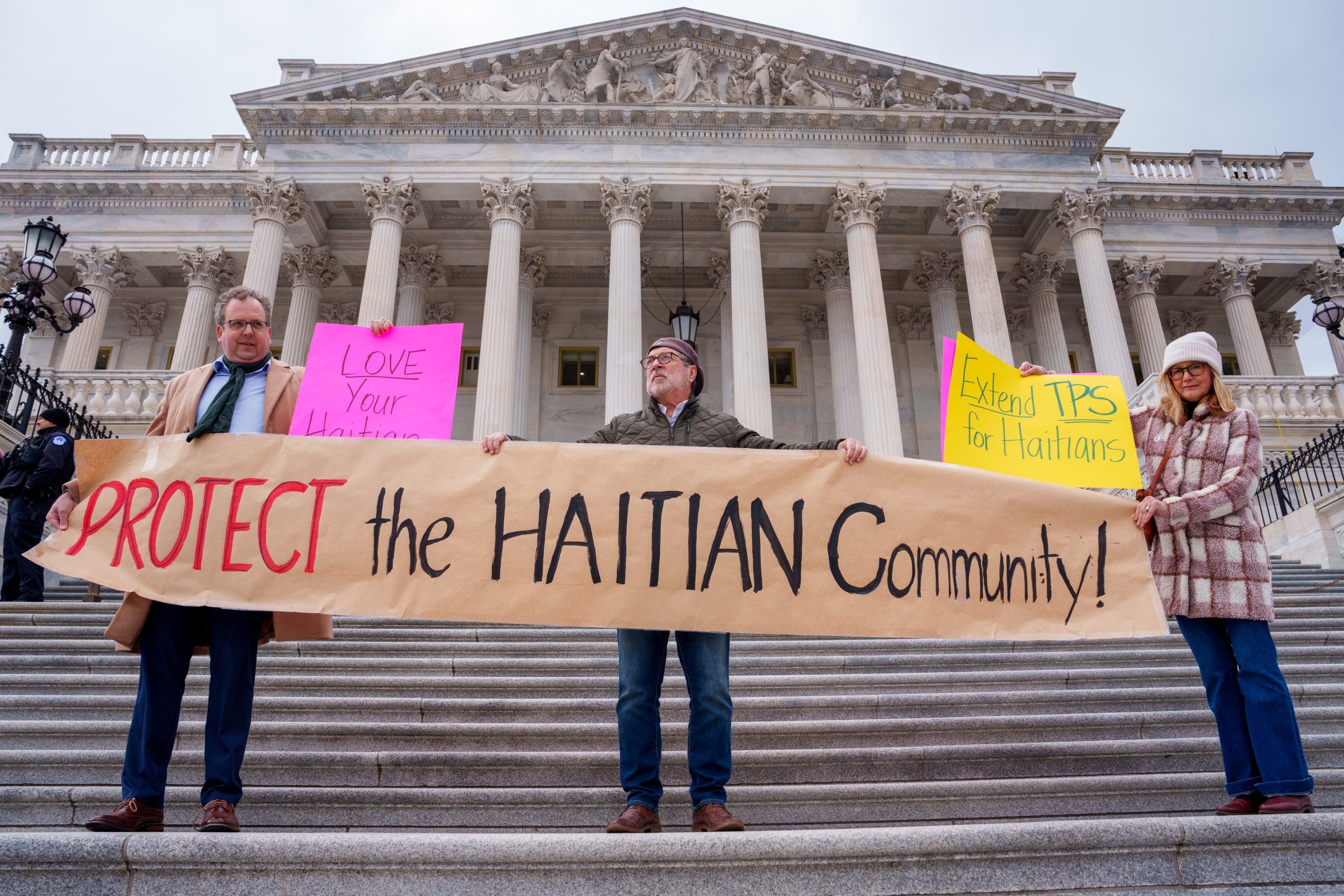
Lawyers for a group of Haitian Temporary Protected Status holders have asked a federal appeals court to reject the Trump administration’s latest effort to clear the way for their immediate deportation, arguing that the government is trying to sidestep the Supreme Court and that the court has no authority to act on the request in the first place.
The filing, submitted July 13 to the U.S. Court of Appeals for the District of Columbia Circuit, is the plaintiffs’ opposition to what they describe as the government’s fourth request for a stay in the case of Miot v. Trump. The court has yet to respond to the lawyers representing Haitian TPS holders’ request.
Understanding what is being argued, and what is not, matters for the roughly 350,000 Haitians whose protected status hangs in the balance.
How the case got here
The dispute dates back to February 2, 2026, when a federal district court in Washington temporarily postponed the effective date of Haiti’s TPS termination. That order is what has kept Haitian TPS holders protected from deportation while the litigation proceeds.

The government has repeatedly tried to lift that postponement. According to the filing, both the district court and the D.C. Circuit denied the government’s earlier motions to stay the order. The government then went to the Supreme Court, which, on June 25, 2026, reversed the district court’s order in Mullin v. Doe and remanded the case for further proceedings.
But the Supreme Court’s decision did not take immediate effect — and that timing is the heart of the current dispute.
When an appeals court or the Supreme Court decides a case, its ruling does not become operative the instant it is announced. It becomes operative when the court issues its “mandate” — the formal order that returns authority over the case to the lower courts. Until that mandate is issued, the lower court’s existing order generally stays in place.
According to the filing, the Supreme Court told the D.C. Circuit that its mandate in Mullin v. Doe “will not issue for at least thirty-two days” from June 25 — meaning not before July 27, 2026. The plaintiffs’ central argument is straightforward: because the mandate has not yet issued, the appeals court “does not regain jurisdiction” over the case and therefore lacks legal authority to grant the government’s request. In their words, “jurisdiction follows the mandate.”
In plain terms, the plaintiffs are telling the court: you cannot lift this order right now even if you wanted to, because the case is not yet back in your hands.

‘An end-run around Supreme Court procedure’
The plaintiffs’ second argument is that the government is seeking from the appeals court what the Supreme Court already refused to grant.
According to the filing, five days after deciding the case — on June 30, 2026 — the Supreme Court denied the government’s application to stay the district court order. The government did not ask the Supreme Court to reconsider, and the plaintiffs argue that it has not pointed to any change since then. Asking the lower appeals court to grant the same relief the Supreme Court just denied, they write, “inverts the judicial hierarchy” and amounts to “an end-run around Supreme Court procedure.”
The plaintiffs also note that if the government truly faced an emergency, it could have asked the Supreme Court to speed up its mandate, a step the high court has taken in urgent cases before, but chose not to.
The government’s stated justification, quoted in the filing, is that allowing Haitian TPS holders to remain even briefly is “contrary to the national interest,” citing the Secretary’s November 2025 termination determination and assertions about gang activity and screening difficulties.
The plaintiffs counter that the government cannot show it would suffer any irreparable harm from waiting the roughly two weeks until the mandate issues in the normal course. They point out that Haitian TPS holders have lived and worked in the United States for years “without incident,” and that the government did not treat their presence as an emergency during earlier stages of the litigation. The plaintiffs also argue that the government’s claim of harm is, apart from two added words, “word-for-word identical” to the argument the Supreme Court already rejected on June 30.
On the other side, the plaintiffs describe severe and in some cases irreversible harm to Haitian families if the order is lifted prematurely. The brief states that deportation to Haiti “could prove fatal,” and — in a footnote citing news reporting — references the case of four Haitian women deported from Puerto Rico who were later found dead. It notes that the Supreme Court itself acknowledged conditions in Haiti are “unquestionably difficult,” and that the State Department considers Haiti unsafe due to kidnapping, crime, terrorist activity, civil unrest, and limited health care.
The economic stakes in the record
The filing also folds in the economic argument that has featured throughout the TPS litigation. Citing a friend-of-the-court brief from senior-care providers, it argues that Haitian TPS holders are an “indispensable” and “core part of the caregiving workforce” in settings including assisted living, memory care, and skilled nursing. Because such workers “cannot be replaced at scale on short notice” in an already understaffed sector, the brief warns, the immediate loss of their work authorization would disrupt care for elderly and medically vulnerable residents — and the disruption “would not be limited to the healthcare industry,” given that Haitian TPS holders are essential workers across the economy.
Stripped to its essentials, this filing is a request to let the ordinary legal process run its course rather than accelerate deportations by roughly two weeks. The plaintiffs are asking the D.C. Circuit to deny the government’s motion and allow the case to “proceed in the ordinary course on remand” once the Supreme Court issues its mandate.
That timeline is the practical takeaway for the Haitian community. By the plaintiffs’ own account, the Supreme Court could issue its mandate as early as July 27, after which the case will be returned to the appeals court and then the district court, and the termination of Haiti’s TPS designation “will take effect soon thereafter.” In other words, even if this particular motion is denied, the underlying protection is nearing its end unless something changes — whether through the courts or through the legislation currently pending in Congress.
For now, the immediate question before the D.C. Circuit is narrow: whether to lift the protective order now, or to wait for the Supreme Court’s mandate. The plaintiffs have made their case for waiting. The court has not yet ruled.
This article explains a legal brief filed in ongoing litigation. It is not legal advice. Haitian TPS holders with questions about their individual situations should consult a licensed immigration attorney or a representative accredited by the U.S. Department of Justice.
https://ctninfo.com/lawyers-for-hait…ack-deportations/
https://www.facebook.com/CaribbeanNewsMedia
Editorial Disclaimer: This article was originally written in English. The French and Haitian Creole versions are produced using AI translation, and errors are possible — the English version is authoritative. CTN also uses AI to convert text into audio. Readers and listeners should rely on the English text where any discrepancy arises.