



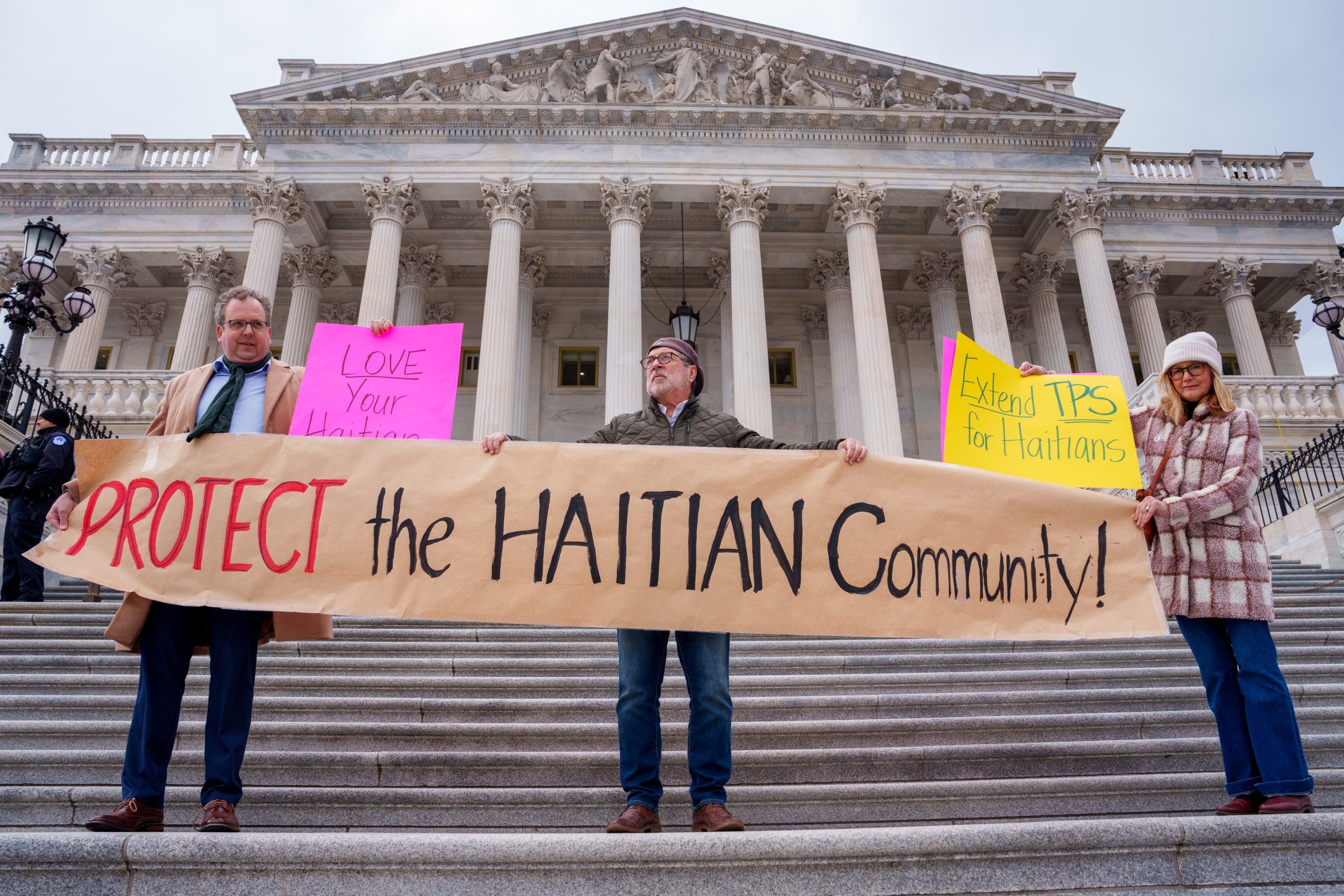
The federal appeals court in Washington on Tuesday handed the legal fight over Haiti’s Temporary Protected Status back to the district judge who first blocked the program’s shutdown — a short, procedural step that formally ends the appeal and returns the case to a lower court now bound by a Supreme Court ruling that went against roughly 352,000 Haitian TPS holders. For most of them, the protection is already gone: their status and work permits lapsed on July 27.
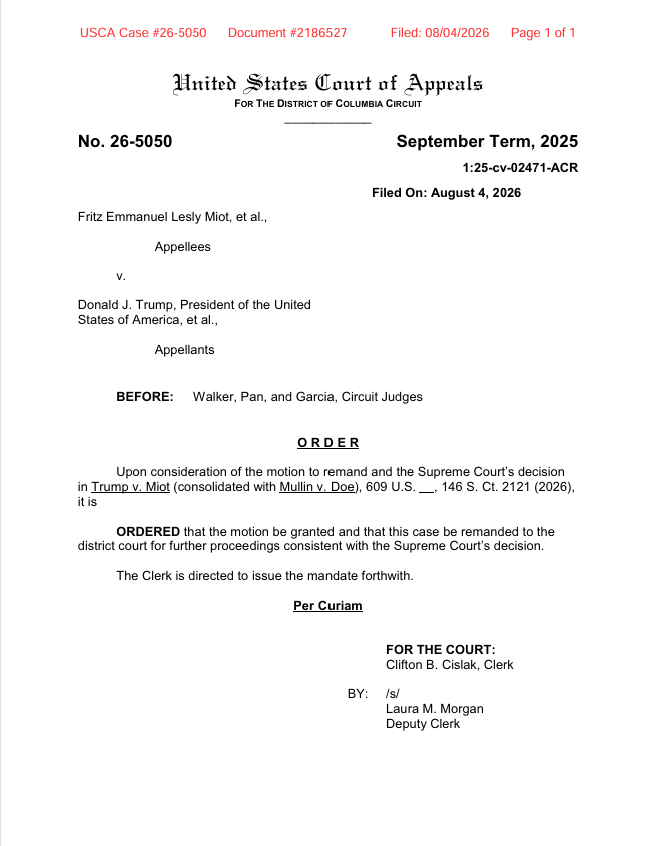
The document, filed Aug. 4 in Miot v. Trump, is a single-page order from a three-judge panel of the U.S. Court of Appeals for the D.C. Circuit — Judges Justin Walker, Florence Pan, and Bradley Garcia. Issued per curiam, meaning jointly and without a named author, it grants the government’s motion to remand — that is, to send the case back down — to the U.S. District Court for the District of Columbia “for further proceedings consistent with” the Supreme Court’s decision. The panel directed its clerk to issue the mandate “forthwith,” so the transfer takes effect immediately. The order, by itself, does not decide whether Haitians keep TPS. That question was answered elsewhere, and earlier.
It was answered on June 25, when the Supreme Court ruled 6-3 in favor of the Trump administration in Trump v. Miot, consolidated with the Syrian TPS case, Mullin v. Doe.
The majority held that federal courts could not review the TPS holders’ statutory challenge and that their constitutional equal protection claim was unlikely to succeed, clearing the way for the terminations to proceed. The ACLU of Northern California, which represents Syrian plaintiffs in the consolidated case, said the ruling meant “the loss of legal status and the right to work” for more than 350,000 people. The Court’s three liberal justices dissented, noting that Haiti was first designated for TPS in 2010 after a catastrophic earthquake and Syria in 2012 amid its government’s violent repression of civilians.
The consequences landed fast. The Department of Homeland Security terminated Haiti’s TPS designation effective July 27, and U.S. Citizenship and Immigration Services now tells employers that the Haitian TPS work permits — Employment Authorization Documents in the A12 and C19 categories — are no longer valid. For the roughly 352,000 Haitian nationals who held the status when the termination was announced, a figure cited in advisories from firms including Morgan Lewis, the legal right to work has evaporated, leaving those without another form of protection exposed to detention and removal. The blow falls hard on communities like Greater Boston, home to one of the nation’s largest Haitian populations, where TPS holders anchor households, staff hospital and nursing-home shifts, and run small businesses.

The case now returns to U.S. District Judge Ana C. Reyes, the same judge who halted the termination one day before it was set to take effect in February. In that order, Reyes found it substantially likely that DHS’s move violated federal administrative law and the Constitution’s equal protection guarantee, and that the agency had failed to conduct a legally required consultation with other federal agencies. During her stay, she wrote, the termination was “null, void, and of no legal effect.” The termination itself was signed by then-Homeland Security Secretary Kristi Noem in November 2025; the consolidated case now carries the name of her successor, Secretary Markwayne Mullin.
What remains for Reyes is narrow. Bound by the Supreme Court’s decision, she is expected to dissolve the block she imposed in February — a step that events have already overtaken — while the plaintiffs’ statutory claims face dismissal for lack of jurisdiction. Some claims could still be litigated in her courtroom, but after June 25, they face long odds. In practical terms, the case that kept Haiti’s TPS alive for nearly six months past its original February deadline has run out of room, even as the paperwork moves through one last court.
https://ctninfo.com/?p=44015&preview=true
https://www.facebook.com/CaribbeanNewsMedia
This article is for general information and is not legal advice. Haitian nationals affected by the end of TPS should speak with a licensed immigration attorney or a representative accredited by the U.S. Department of Justice about their individual options, which may include asylum, adjustment of status, or other forms of relief.