


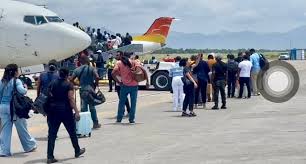
Two years after the complete closure of its airspace to flights to and from Haiti, Santo Domingo announces a partial, conditional, and strictly controlled reopening effective May 30, 2026. While the decision is seen as a first diplomatic step, it formally excludes Port-au-Prince and does not lift the deep security tensions that motivated the initial closure.
An air thaw under unprecedented constraints
The Dominican Junta de Aviación Civil (JAC) formalized on May 20, 2026, through Resolution 141-2026, the authorized resumption of commercial passenger and cargo flights between the Dominican Republic and Haiti. A set of mandatory protocols, unveiled on May 27, specifies the drastic modalities.
From May 30, airlines will again be able to operate between the two countries, but exclusively from Cap-Haïtien International Airport. All other points on Haitian territory — including and especially Toussaint Louverture Airport in Port-au-Prince — remain strictly prohibited for Dominican commercial aviation.

This reopening comes two years after a unilateral closure decided by Santo Domingo, which at the time denounced the lack of reliable security controls at Haitian airports and the risks associated with connections to cross-border criminal networks.
Enhanced surveillance: APIS, PNR, and single form
The system imposed by the JAC sets a very high bar for intelligence and immigration filtering. Airlines are now required to transmit, before each flight, APIS (Advanced Passenger Information System) and PNR (Passenger Name Record) data to the Dominican National Department of Investigations (DNI).
These files, which include identity, travel coordinates, baggage, payment methods, and booking history, will be systematically analyzed.
Passengers must also complete, prior to boarding, an electronic migration form accessible via eticket.migracion.gob.do, as well as a health declaration validated by the Dominican Ministry of Public Health. Without these documents, boarding is refused.

Visa flexibility for select travelers
One of the most notable provisions of Resolution 141-2026 concerns the paradoxical easing of visa conditions. Foreigners — including Haitians who do not hold a Dominican visa — may enter the Dominican Republic if they possess a valid visa from the United States, Canada, the Schengen Area, or the United Kingdom, subject to three imperative conditions:
The visa must have a remaining validity of at least six months.
It must have already been used at least once in the issuing country (evidencing a prior trip).
The passenger must present a return ticket to their country of origin.
This measure, already partially tested by Santo Domingo for other nationalities, is extended to travelers originating from Haiti. It aims to attract a business and diaspora clientele already possessing proven international mobility.
Exception flights: humanitarian, medical, and emergency
The JAC simultaneously maintains a special regime for non-commercial flights. Aircraft chartered for medical evacuation, humanitarian emergency, or natural disaster missions must obtain direct authorization from the Dominican Ministry of Foreign Affairs, bypassing standard air circuits. These flights retain the possibility of using other airports, subject to case-by-case validation.
Diplomatic context
The Dominican decision echoes the diplomatic meeting of April 17, 2026, between the Haitian Minister of Foreign Affairs and Worship, Raina Forbin, and her Dominican counterpart, Roberto Álvarez. This meeting, the first of its kind since the air closure, allowed the reopening of discussion channels on border security, trade, transport, and bilateral cooperation mechanisms.
Following these exchanges, both parties affirmed their common desire to prioritize dialogue, consultation, and good neighborliness.
The Haitian Ministry of Foreign Affairs (MAEC) welcomed the Dominican decision, seeing it as “a positive step forward in relations between the two countries sharing the island of Haiti.” The MAEC stresses that this reopening “follows the resumption of bilateral dialogue on matters of common interest.”
Cap-Haïtien gains, Port-au-Prince sanctioned
The exclusion of Toussaint Louverture Airport is perceived by observers as an indirect sanction against the Haitian authorities, accused of failing to guarantee the security of the facilities and of being unable to filter at-risk passenger flows.
What specifically changes as of May 30, 2026
Authorized flights: Only between Cap-Haïtien International Airport (CAP) and Dominican airports (Santo Domingo, Punta Cana, Santiago, etc.).
Prohibited flights: Any departure or arrival from Port-au-Prince, Jérémie, Les Cayes, Jacmel, or any other Haitian airport or airstrip.
Formalities: Transmission of APIS/PNR data to the DNI + mandatory eticket + health declaration.
Dominican visa waiver: Possible with a US, Canadian, Schengen, or UK visa (valid 6 months + already used + return ticket).
Humanitarian flights: Authorization required from the Dominican Ministry of Foreign Affairs.