


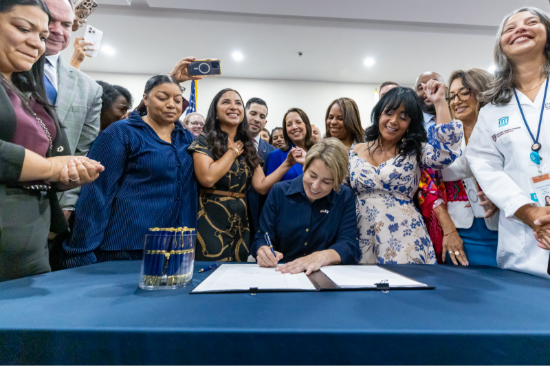
Governor Maura Healey signed the PROTECT Act into law on Wednesday, August 5, before a packed and cheering room at La Colaborativa, surrounded by immigrants, advocates, teachers, nurses, doctors, clergy, law enforcement, and elected officials who had pushed the bill for more than a year. The state describes it as the strongest protection against federal immigration enforcement of any in the country.
The law keeps ICE out of courthouses, schools, child care centers, hospitals, and other health care facilities; strengthens protections for parents who are detained or deported; bans new 287(g) agreements that deputize state agencies for immigration work; and creates a state civil rights claim that can be brought against government officials, including ICE agents, who violate a person’s federal constitutional rights.
“Today, Massachusetts is standing up for what’s right and taking action to keep our people and our communities safe,” Healey said. “No one should be afraid to send their child to school, seek medical care, or fear reporting a crime or appearing in court.” She called the bill “a testament to the hard work and advocacy of so many people across our state.”
What the law does
At its core, the PROTECT Act prohibits warrantless civil immigration arrests at courthouses, schools, child care centers, and health care facilities, including hospitals, community health centers, and nursing homes. It lets parents pre-arrange guardianship for their children in case they are detained or removed. And it codifies an executive order Healey issued earlier this year, limiting civil immigration enforcement in nonpublic areas of state buildings and requiring multilingual guidance on enforcement procedures and individual rights.

It also defines the limits of state and local cooperation with federal immigration enforcement, adds oversight and notification requirements for correctional facilities and employers, and strengthens protections for crime victims seeking immigration relief. One provision requires that immigrant workers be notified before ICE reviews their private I-9 employment files — a process, advocates say, that ICE has used to reach personal records without a warrant.
Lieutenant Governor Kim Driscoll framed the bill as a matter of trust as much as rights. “This bill is about standing up for our immigrant communities, standing up for public safety, education, and health care, and standing up for people’s rights and freedoms,” she said.
The case from public safety, schools, and hospitals
Members of the Healey administration cast the law as protecting the institutions they run, not weakening them.
Public Safety Secretary Gina Kwon said strong enforcement depends on community trust. “The PROTECT Act helps preserve the trust that law enforcement, prosecutors, and community organizations rely on to protect victims, investigate crimes, and keep neighborhoods safe,” she said.
Education Secretary Steve Zrike spoke as a former superintendent and teacher. “I’ve seen how deeply a child’s sense of safety and belonging shapes their ability to learn,” he said, adding that the law helps keep schools “welcoming places where every child can feel safe, build confidence, and thrive.”

Health and Human Services Secretary Kiame Mahaniah, a physician, said the goal was to keep fear out of the exam room.
“Keeping ICE out of hospitals, as well as our courthouses and schools, means we also keep fear out of these places,” he said.
Senate President Karen Spilka said the signing was “the culmination of our efforts to do everything in our state’s power to protect hardworking residents who have done nothing wrong.” House Speaker Ronald Mariano said ICE tactics had left “immigrants in Massachusetts living in fear as they go to work or bring their children to school,” and credited the Black and Latino Legislative Caucus for incorporating feedback from both immigrant communities and police.
Attorney General Andrea Joy Campbell, who has repeatedly gone to court against the administration, said the tactics the law addresses “do not enhance public safety and instead spread fear among families and our communities.”
She pledged to “continue to use every tool available to defend their rights.”
Representative Andy Vargas, who chairs the Black and Latino Legislative Caucus, said the bill was the product of “over 18 months of speaking to impacted families, advocates, and law enforcement, including Chiefs of Police and DAs,” and stressed it was written to be “constitutionally sound” with bipartisan support. Senator Pavel Payano, who immigrated from the Dominican Republic as a child, said no family “should have to choose between taking a child to school, seeking medical care, or appearing in court because they are afraid.” Senator Cindy Friedman, a lead negotiator, said the law reaffirms “our values of respect, dignity, and justice for ALL our residents.”
Representative Judith Garcia, who represents Chelsea, said there could be “no more meaningful place for this bill to become law,” pointing to the fear immigrant families in the city had lived through. Senator Sal DiDomenico called Chelsea “a beautiful city filled with people from all over the world.”
Prosecutors in the courthouse provision
Several district attorneys backed the ban on courthouse arrests, arguing it protects both victims and the integrity of prosecutions. Berkshire District Attorney Timothy Shugrue said that when ICE deports defendants before trial, it “absolves them of their actions” and lets them leave “without a criminal record.” Middlesex District Attorney Marian Ryan said federal activity around courthouses “has made it more difficult to ensure that victims, witnesses, and defendants can safely access the justice system.” Suffolk District Attorney Kevin Hayden invoked the state’s history: “Our state sent a resounding message about liberty 250 years ago, and we’re doing it again today.”
The bill was drafted by the Black and Latino Legislative Caucus and carried by a coalition of immigrant, labor, faith, health, and legal organizations — many of whom filled the room in Chelsea, the host organization’s home.
Gladys Vega, president of La Colaborativa, called the law “a testament to our Commonwealth’s commitment to upholding human rights and dignity for all,” recalling “years of witnessing workers deprived of employment, families residing in fear, and children missing school because of immigration enforcement.” Liz Sweet of the MIRA Coalition called it “a historic victory,” and Lenita Reason of the Brazilian Worker Center, a coalition co-chair, called it “a crucial step forward in ensuring safety, dignity, and basic rights for all immigrant families.”
For CTN’s audience, two voices in the room spoke directly to the Haitian community.
The Rev. Dr. Dieufort Fleurissaint said the law “strengthens our commitment to justice, due process, and human dignity, bringing renewed hope and stronger protections for immigrant families during a time of uncertainty.” And Dr. Geralde Gabeau, founder of the Immigrant Family Services Institute in Mattapan, welcomed the law while cautioning that it is not the end of the fight. “It does not end the threat facing immigrant families or replace the urgent need for federal action,” she said. “We must continue fighting until every immigrant family can live, work, worship, learn, and contribute to our Commonwealth without fear.”
Doris Landaverde of the National TPS Alliance tied the moment to families losing Temporary Protected Status. “Families from Venezuela, Nepal, Honduras, Nicaragua, Haiti, Syria, and other countries are facing tremendous uncertainty, along with the heartbreaking threat of family separation,” she said, calling the law “a meaningful step toward a more just, inclusive, and compassionate Commonwealth.”
Labor, faith, and health care
Union leaders described members already taken by ICE. Jorge Rivera of the Painters Union District Council 35 said five of its members had been detained: “Every one of them deserved to go to work, drop their kids at school, or see a doctor without fear of being hunted to fill a federal quota.” Carlos Aramayo of UNITE HERE Local 26 called the law “a monumental victory for human dignity and workplace justice,” and Chrissy Lynch of the Massachusetts AFL-CIO said the administration was “scapegoating immigrants.”
Health leaders echoed the point. Michael Curry of the Massachusetts League of Community Health Centers said the law ensures “the sacred relationship between patients and health care providers cannot be undermined by immigration enforcement.” Katie Murphy of the Massachusetts Nurses Association said hospitals would “remain safe havens of healing for all.” From the ACLU of Massachusetts, Carol Rose said the state had sent “a powerful message to the Trump administration,” establishing “a firewall between Massachusetts law enforcement and federal immigration officials.”
The administration presented the law as one piece of a broader strategy that has included an executive order restricting 287(g) agreements, a portal to report alleged ICE misconduct, opposition to ICE flights at Hanscom Airport and to new detention centers in New England, and calls to extend TPS for Haitians and others.
Several speakers made a point CTN’s readers know well: state law can shield people inside Massachusetts, but it cannot restore a federal status that Washington has taken away. As Gabeau put it, the law is “an important step toward restoring trust, dignity, and hope” — and, she said, the work is not finished.
https://ctninfo.com/healey-signs-pro…spitals-from-ice/
https://www.facebook.com/CaribbeanNewsMedia
Editorial Disclaimer:
This article was originally written in English. The French and Haitian Creole versions are produced using AI translation software, and errors are possible — the English version is authoritative. CTN also uses AI to convert text into audio.