

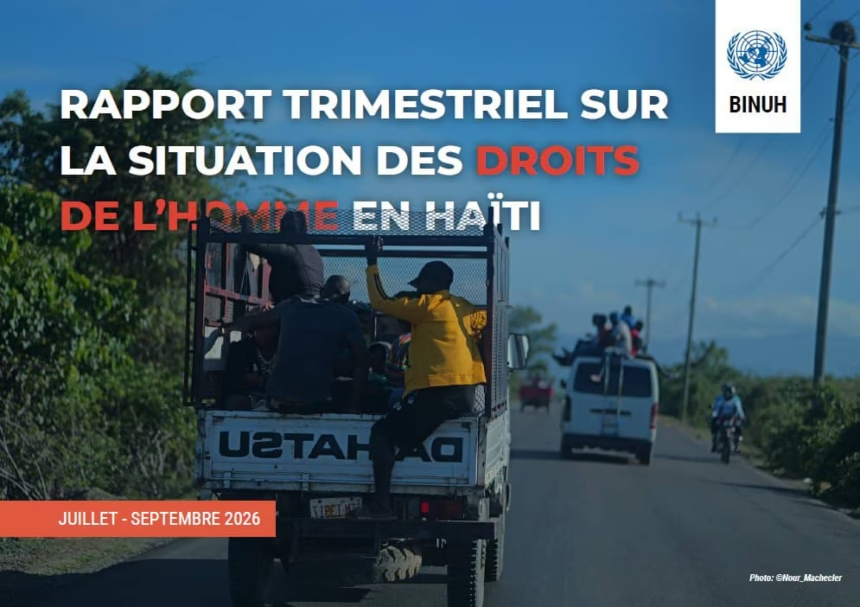
The United Nations Integrated Office in Haiti (BINUH) has just published its quarterly report covering the period from July 1 to September 30, 2026. The findings are damning: at least 1,167 people lost their lives and 459 others were injured, bringing the number of victims of violence to more than 1,600 in just three months. Grave human rights violations and abuses continue to multiply, not only in the Port-au-Prince metropolitan area but also in the Artibonite and Sud-Est departments, regions long spared by the armed conflict.
“The scale of the massacres recorded during this period, particularly in Kenscoff and several other hitherto spared localities, reminds us of the absolute need to strengthen both population protection mechanisms and the State’s presence in newly liberated areas,” said Carlos Ruiz Massieu, Special Representative of the UN Secretary-General in Haiti and Head of BINUH. A warning that resonates as a call for urgent action in the face of a crisis that continues to worsen.
Gangs, Primary Perpetrators of Violence
The report establishes that during the quarter, gang members were responsible for more than 45% of those killed or injured. In Port-au-Prince, they maintained their criminal grip on neighborhoods under their control, carrying out targeted killings in retaliation for security operations, but also against people refusing to submit to extortion or accused of having violated their rules. A few people were also killed for denouncing attempts by gang leaders to interfere in the electoral process, a worrying sign of armed groups’ determination to influence the country’s political life.

More concerning still: gang members who had been driven out of neighborhoods such as Bel Air and La Saline by security force operations earlier in the year have gradually regained a foothold in these areas and committed new abuses there. This comeback illustrates the inability of law enforcement to durably consolidate security gains and prevent armed groups from reinfiltrating recaptured areas.
Cité Soleil and Kenscoff: Massacres of Unprecedented Barbarity
Violent attacks linked to territorial struggles have also been documented. In Cité Soleil, gang members decapitated at least 19 people, including 12 elderly women, in early August. In Kenscoff, two attacks carried out in July and August killed at least 105 residents, including 19 children. Among the victims, more than 36 were shot in the courtyard of a Protestant church, a place of worship that should have constituted an inviolable sanctuary. These massacres, of extreme violence, testify to the brutality with which gangs exercise their domination over civilian populations.
Attacks were also recorded in the commune of Saint-Michel-de-l’Attalaye (Artibonite) and that of Marigot (Sud-Est), areas hitherto largely spared by gang infiltration. This geographic expansion of violence confirms armed groups’ ability to extend their influence well beyond the capital’s traditional strongholds, now threatening entire regions of the country.
Kidnappings and Sexual Violence: An Alarming Rise

Kidnappings and sexual violence have also remained particularly concerning. During the quarter, at least 137 people were kidnapped for ransom, compared with 81 between April and June, an increase of nearly 70% in a single quarter. Children represent 10% of the victims, a figure that underscores the growing vulnerability of the youngest to predation by armed groups.
Furthermore, BINUH documented 344 victims of sexual violence perpetrated by gang members. The victims ranged in age from 8 to 75. Among the documented cases, 77% involved gang rape, a practice that reflects the particularly barbaric dimension of these abuses and the use of rape as a weapon of war.
The report also highlights the persistence of child recruitment and exploitation by gangs, while prevention and protection measures remain insufficient, despite efforts undertaken by Haitian authorities with the support of civil society actors and international partners. Thus, during the month of August, at least 32 children, all boys aged 14 to 16 and forcibly recruited by a gang, were killed during exchanges of fire with security forces in the commune of Gressier. A tragedy that tragically illustrates the failure of child protection mechanisms in the face of armed groups’ grip.
Alongside gang violence, BINUH estimates that 5% of killings and injuries are attributable to self-defense groups targeting gang members and individuals suspected of collaborating with them. A phenomenon that reflects growing distrust of state institutions among the population and the temptation of self-defense in the face of perceived inaction by the authorities.
Finally, more than 50% of those killed or injured during the quarter were victims of ground or air operations conducted by security forces against gangs, sometimes with the support of a private military company using drones. Among the victims of these operations, more than 16% were not associated with gangs, a figure that raises questions about proportionality and discrimination in the conduct of operations. At least four people, including two children, were also killed, and 10 others injured, in attacks carried out using explosive drones.
Moreover, BINUH documented 44 cases of extrajudicial executions and attempted extrajudicial executions involving elements of the Haitian National Police (PNH), compared with 14 in the previous quarter, more than a threefold increase in a single quarter. Despite this increase, the number of people victims of extrajudicial executions or attempted executions during the first nine months of 2026 remains nearly twice lower than that recorded during the same period in 2025. BINUH recalls that gang-fighting operations must be conducted in compliance with international human rights law and that alleged violations must be investigated.
Judicial Progress Still Fragile
On the judicial front, progress has been recorded in the operationalization of two specialized units responsible for mass crimes, including sexual violence, and financial crimes. BINUH nevertheless stresses the need to make these units fully operational and to begin the first trials without delay so that these institutional advances translate into concrete results in the fight against impunity.
Finally, the report calls on Haitian authorities to strengthen protection and assistance mechanisms for people affected by violence, particularly survivors of sexual violence, and to accelerate recruitment prevention and disarmament, demobilization and reintegration programs, especially for children involved in gangs.
It also urges the international community to maintain its commitment to Haiti, to accelerate the full deployment and operationalization of the Gang Suppression Force in compliance with international human rights standards, and to intensify efforts to prevent illicit trafficking of arms and ammunition into the country. A call that comes as the security crisis continues to expand geographically and intensify, testing the capacity of the Haitian State and the international community to protect civilians and stem the spiral of violence.