



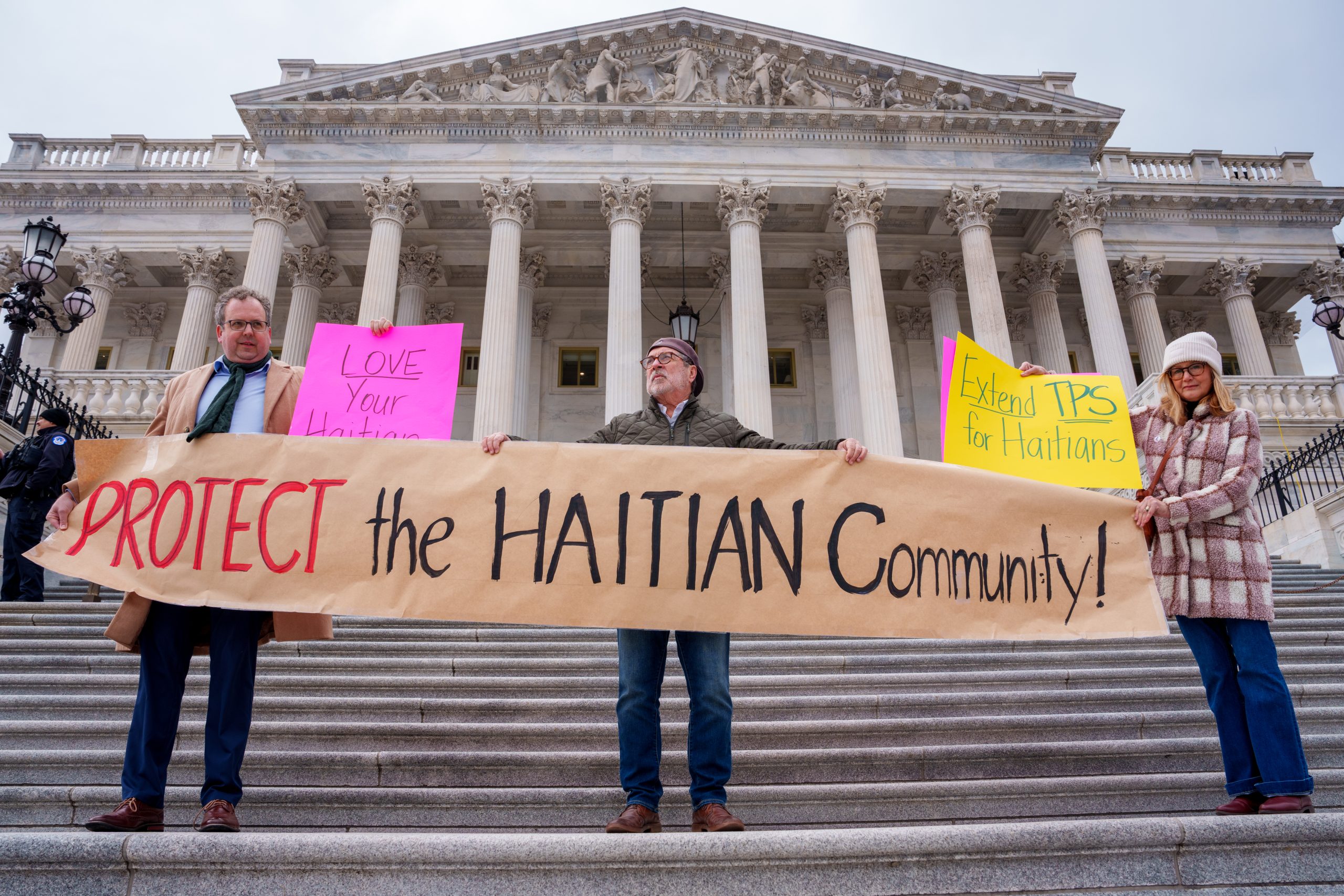
President Donald Trump said Friday he expects to veto the first bills a Democratic Congress sends him, and then bargain toward compromises on health care, immigration, film production and college athletics. How those talks go will shape what happens next for immigrants, including the roughly 350,000 Haitians whose Temporary Protected Status the administration ended this summer.
Trump spoke at a White House news conference after returning from a trip to Asia, and he presented the veto as his opening move, not his last word. “They’re going to send things my way, and I’m going to veto them,” he said, according to USA Today. After about a month, he predicted, the vetoes would start coming with terms attached, telling lawmakers what he would sign instead.
He called House Democratic Leader Hakeem Jeffries and Senate Democratic Leader Chuck Schumer, both of New York, “smart,” and said he could negotiate with both. “If they want to get things done, I want to get things done, too,” Trump said.
He has been making the same point since the midterms. The day after the Nov. 3 election, he told reporters he would probably get along with Democrats, then added, “But I have the power of the veto,” States Newsroom reported.
Democrats flipped both chambers on Nov. 3. On Wednesday, House Democrats nominated Jeffries for speaker in a 251-11 closed-door vote, the Associated Press reported. The whole House votes when the new Congress convenes Jan. 3, and if he wins, as it is widely expected, Jeffries will be the first Black speaker.

In the Senate, Democrats will hold 56 of 100 seats after Mary Peltola’s win in Alaska. Schumer is being challenged for the caucus’s top job by Sen. Chris Van Hollen of Maryland, and senators will vote by secret ballot on Dec. 1, according to the AP. Democrats do not have the two-thirds majority in either chamber that they would need to override a veto, States Newsroom reported.
Immigration: sympathy, but no amnesty
Trump spoke Friday warmly about immigrants who have lived and worked in the country for years. “What are we going to do?” he said, according to USA Today. “They work well, and they work hard.” He offered no specific proposal.
This tone is new. In a “60 Minutes” interview after the election, Trump said his deportation policy might have been “too tough” and that he would like to work with Democrats on immigration, The National News Desk reported. Homeland Security Secretary Markwayne Mullin said on Nov. 9 that Trump had told him to engage with Democrats who called him. But Mullin set a firm limit: “We’re never going to allow amnesty to happen,” he told reporters, according to Fox News. He also said he was open to permanent legal status for recipients of Deferred Action for Childhood Arrivals (DACA).
Jeffries wants the American Dream and Promise Act, sponsored by Rep. Sylvia Garcia, D-Texas, and the Temporary Protected Status (TPS), to be two of the first bills the new House takes up. “We should actually move that bill immediately,” he said at a Nov. 17 news conference, Roll Call reported. A discharge petition to force a vote in the current Congress is one signature short. (A discharge petition is a way for a House majority to bring a bill to the floor without leadership’s consent.)
USA Today described the bill as requiring immigrants to have been in the country since 2021.
That date applies to only one group of applicants. According to a July 2026 summary of the bill by the Presidents’ Alliance on Higher Education and Immigration, Dreamers must have arrived at age 18 or younger and been continuously present since Jan. 1, 2021. They would first receive conditional status, and they could make it permanent through higher education, military service, or work.
TPS and Deferred Enforced Departure holders face a different test: at least three years of continuous presence, and eligibility for TPS as of July 1, 2024. Applicants in both groups must pass background checks.

Haiti’s TPS designation was in force on July 1, 2024. It ended this summer. After the Supreme Court’s June 25 ruling in Mullin v. Doe, federal E-Verify guidance stated that Haiti’s designation was terminated effective July 27, 2026, and that work permits issued under it are no longer valid. A separate bill to restore Haiti’s TPS, H.R. 1689, passed the House 224-204 in April with 10 Republican votes. Missouri Senator Eric Schmitt blocked a tentative effort to bring the bill to the Senate floor. The White House said in a formal policy statement that Trump’s advisers would recommend he veto it.
For Haitians whose TPS work permits are no longer valid, the path runs through the bills described above.
A Dream and Promise Act would have to pass both chambers and then win the signature of a president whose Homeland Security secretary says amnesty will not happen.
The American Dream and Promise Act, reintroduced in February 2025 by Representative Sylvia Garcia of Texas with Republican Representative María Elvira Salazar of Florida as a co-lead, folds two long-sought measures into a single bill. Its Dream Act title would grant conditional permanent residence for up to ten years to immigrants who arrived in the United States as children, current DACA recipients among them, with a route to a green card through college, military or other uniformed service, or steady employment. Its Promise Act title speaks more directly to the Haitian community: it would allow certain holders of Temporary Protected Status and Deferred Enforced Departure to apply for lawful permanent residence outright. To qualify under that section, a TPS holder would generally need to have held the status by the bill’s cutoff date — July 1, 2024, in the current version — show at least three years of continuous physical presence in the country, and file within three years of the law taking effect. Because Haiti has long been designated for TPS, Haitians who meet those conditions would be among the roughly 1.3 million TPS holders the measure could reach.
https://ctninfo.com/trump-says-a-dea…-and-health-care/
Source: USAToday
AI Use Policy
Some of CTN’s journalists are not native English speakers and draft their work in French or Haitian Creole. We then use AI-assisted translation software to produce the English versions, and traces of machine-generated phrasing may occasionally remain. Every article — in any language — is written, reviewed, and edited by CTN’s staff writers and editors, who remain responsible for its accuracy. CTN also uses AI to convert text into audio.
All CTN articles are written, edited, and published in English, which is the official and authoritative version of record. Versions appearing in other languages are generated automatically by GTranslate and are provided for the reader’s convenience only. Because these translations are produced by machine and are not reviewed by our editorial staff, they may contain errors, omissions, or discrepancies. In the event of any inconsistency between the English article and a translated version, the English version shall prevail.
