

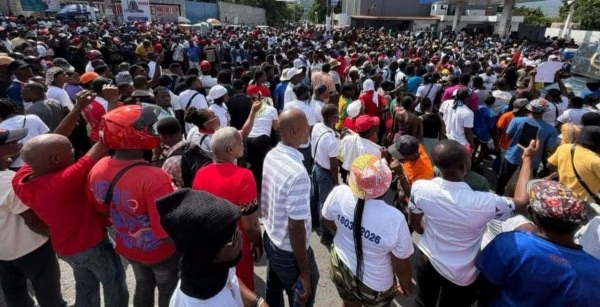
A vast mobilization swept through Haiti’s major cities this Thursday, November 17. Several thousand citizens flooded the streets of the capital, Port-au-Prince, as well as Cap-Haïtien, Saint-Marc, Jacmel, and Jérémie, to express their unwavering support for El Salvador’s military intervention against the criminal gangs crippling the country. An event that marks a turning point in Haitian public opinion, traditionally wary of foreign interventions.
A Sea of Humanity for Bukele
In Port-au-Prince, the atmosphere was one of celebration and determination. Thousands of protesters, some wearing t-shirts in the colors of El Salvador and Haiti, marched along several of the city’s main arteries. Brandishing signs bearing the image of Salvadoran President Nayib Bukele, they chanted slogans that rang out from all sides. The most heard sounded like a cry of distress and hope: “Bay yo dwon, ba yo dwon!” (Give them drones!), or “Mèsi Prezidan Bukele!” (Thank you, President Bukele!).
This popular fervor spread to other major cities across the country. In Cap-Haïtien, the country’s second-largest city, the procession gathered hundreds of people, while in Saint-Marc, Jacmel, and Jérémie, local populations also made a point of expressing their gratitude to the Salvadoran troops. A rare phenomenon that reflects deep weariness with insecurity and a newfound hope sparked by San Salvador’s actions.

Protesters did not hesitate to target those who oppose this intervention. Hostile slogans were directed at critics of the Salvadoran offensive, urging them to stop their criticism. Participants explicitly pleaded with President Nayib Bukele to continue his offensive against the gangs, believing that the country’s salvation depends on it.
The Context of an Unprecedented Intervention
To understand the scale of this mobilization, one must recall the singular context in which this intervention is taking place. For several years, Haiti has been plagued by endemic violence orchestrated by heavily armed gang coalitions that control much of the capital and the country’s strategic corridors.
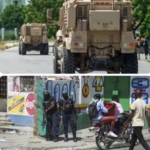
El Salvador’s massive deployment came under dramatic circumstances. It follows the disappearance of four technicians from the Salvadoran contingent, composed of approximately 120 soldiers integrated into the Rapid Reaction Force (FRG). These soldiers had been caught in a violent ambush set by gangs in an area under their control, north of Port-au-Prince. This incident clearly acted as a trigger for San Salvador, which decided to escalate its response.
This military intervention, carried out directly by the Salvadoran armed forces, is a first in relations between the two countries. It is in line with Nayib Bukele’s “iron fist” policy, which successfully pacified his own country by neutralizing the gangs. Building on this experience, El Salvador has deployed troops and technological assets, including combat helicopters and drones, to support Haitian security forces in their operations to clear areas controlled by criminals.

Tangible Security Improvements but Persistent Concerns
On the ground, initial results appear encouraging. During the protest, many participants testified to the improvement in the security situation since the Salvadoran troops entered the scene. Gangs are losing ground in certain areas where they once reigned as absolute masters, and the balance of power is beginning to shift in favor of the security forces. Neighborhoods once reduced to ghost towns are coming back to life, and businesses are cautiously beginning to reopen.
However, behind the prevailing euphoria, dissenting voices can be heard. Some informed observers, as well as ordinary citizens, are questioning the sustainability of this intervention. The main concern lies in the financing of the operation. Unlike traditional UN missions, this intervention is funded directly by San Salvador, without major financial support from the international community.
Critics fear that this situation may not be sustainable in the long term. “How long can El Salvador bear alone the financial and human cost of such an operation?” wonders a well-informed protester. “If the funds run out, the offensive could lose momentum, leaving Haiti once again vulnerable to a gang resurgence.” This concern is all the more palpable given that the country’s reconstruction will require colossal investments, well beyond security aspects alone.
Despite the scale of the mobilization and the fervor of the participants, the protest unfolded without major incident in Port-au-Prince as well as in the provincial cities, according to information gathered. Haitian law enforcement ensured security along the route, overseeing the processions to prevent any overflow.
This massive gathering sends a clear message to Haitian authorities and the international community: the population yearns for peace and supports any initiative capable of restoring security. The question remains whether this outpouring of solidarity will be enough to guarantee the sustainability of an intervention whose outcome remains, for now, uncertain.