

With the Transitional Presidential Council’s mandate set to end on February 7, Haiti enters a new political phase.
The Inter-American Commission on Human Rights (IACHR) warns, in its March 9 release, that lasting success depends on making security, human rights, and rule of law central to governance.
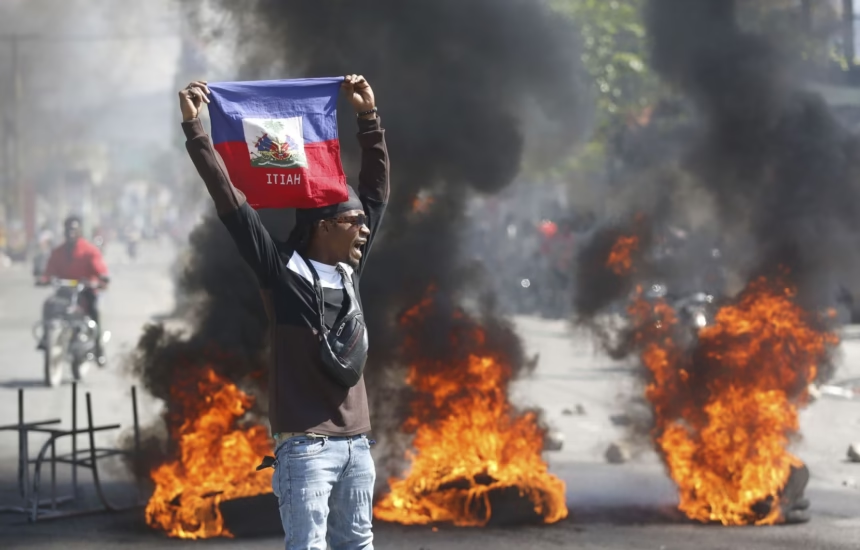
After leading the transition for two years, the TPC has handed over power to an interim government. This government is led by Prime Minister Didier Fils-Aimé, who, together with his Council of Ministers, is tasked with maintaining state continuity and preparing for national elections. The IACHR points out that this responsibility is substantial, given the persistent armed violence affecting institutions and daily life.
In its statement from Washington, D.C., the IACHR emphasizes that restoring security remains the primary means of protecting the fundamental rights of the Haitian population. Without rapidly improving the security situation, the Commission cautions that any attempt at political stabilization faces being undermined.
The Commission stresses that security operations—especially those under UN Security Council Resolution 2793—must uphold international human rights standards.
A Political Pact to Lay the Groundwork for Elections
On February 23, Prime Minister Fils-Aimé presented the National Pact for Stability and the Organization of Elections, an agreement signed by several political and civil society figures. The IACHR notes that the pact affirms the Prime Minister’s interim executive authority and reaffirms the government’s commitment to organizing elections.
The Commission views the pact as a step toward normalcy but notes that its success will depend on how well institutions essential to credible elections—such as the National Police and the National Identification Office—function.
The General Secretariat of the Organization of American States (OAS) has already expressed its commitment, in a February 9 statement, to support the Haitian people through the next phase of their national transition toward an elected government under improved security conditions.
A Humanitarian Emergency That Cannot Be Separated from Politics
Beyond the political transition, a large portion of the Haitian population continues facing urgent humanitarian needs, including severely limited access to food, healthcare, and housing, the IACHR notes.
“Security and dignity must go hand in hand,” the Commission states, urging Haitian authorities to prioritize the needs of the most vulnerable populations. In a context marked by persistent insecurity and forced displacement, the IACHR observes that women and girls remain particularly exposed to violence. It urges authorities to implement UN Security Council Resolution 1325, which mandates the participation of women in peace processes and decision-making, and to take concrete measures to protect them.
A Call for Inclusive Dialogue and International Support
The IACHR urges Haitian authorities to initiate an inclusive national dialogue to build unity and a stable political process. It calls for international support focused on protecting civilians and strengthening democratic institutions, while emphasizing that the transition must remain Haitian-led.
The Commission reiterates its commitment to closely monitor the human rights situation in Haiti and to mobilize all available mechanisms to support the OAS Roadmap for Stability and Peace in Haiti and other international community initiatives.