Explosive drone operations by Haitian security forces have killed over 1,200 people in less than a year, including at least 60 civilians, according to a damning Human Rights Watch (HRW) report published Tuesday. While these numbers raise serious concerns about international law, a portion of the population, exasperated by chronic insecurity, continues to support these radical methods.
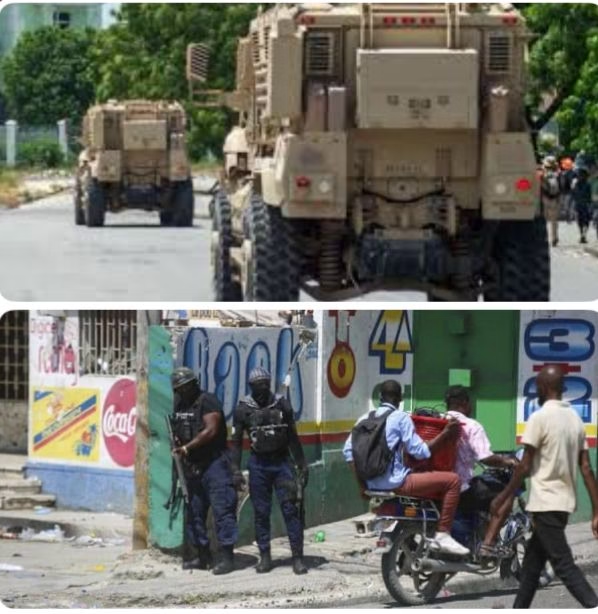
Since March, Haitian security forces, with support from American private military company Vectus Global, have increased their use of explosive quadcopter drones to target gangs in Port-au-Prince.
The HRW investigation, based on interviews and video evidence, found that 1,243 people were killed in drone strikes from March 2024 to January 21, 2025. This includes 43 adult civilians and 17 children. The airstrikes intensified from November to January, nearly doubling compared to the previous three months. There were at least 738 wounded, of whom 49 are believed to be civilians.
The methods used are at the heart of the criticism. The drones, capable of maneuvering between buildings and following vehicles, are frequently deployed in densely populated neighborhoods. The United Nations Integrated Office in Haiti (BINUH) has documented several tragic cases, such as that of a mother of three killed while selling goods on the street, or a woman who died in her own home, targeted while gang members had taken refuge there.
A notable example is the September attack on a sports center during a gang-led gift distribution. Of the child victims recorded by HRW who were killed that day, over half—children aged 3 to 12—died in this single incident.
For Juanita Goebertus, director of the Americas division at HRW, this constitutes an “unlawful use of lethal force.” She called on Haiti’s international partners to cease collaboration with its security forces until safeguards to protect civilians are implemented. “Haitian authorities must urgently control the security forces and the private companies working for them before more children die,” she told Reuters.
This position aligns with that of the UN Human Rights Office, which, as early as October described these strikes as “disproportionate and probably unlawful.” BINUH also reported a total lack of known investigations into these deaths.
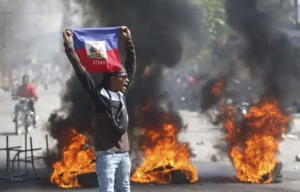
Despite serious accusations, these are set against the backdrop of a population facing both gang violence and a weak state. Armed gangs have reportedly killed thousands, displaced over one million people, and severely disrupted the economy. Despite international support, Haitian security forces have yet to capture any major gang leaders.
In this situation, some degree of public support for the drone strikes is observed. While HRW reports that some residents are afraid to leave their homes due to the presence of drones, others view the operations as a sign of state action against the violence.
For these citizens, the sporadic threat posed by drones is seen as less severe than the regular violence perpetrated by gangs that control neighborhoods. While operations have resulted in civilian casualties, some perceive them as a necessary measure to address crime that authorities and the multinational force have not yet contained.
Contacted by Reuters, the office of the Haitian Prime Minister, the Ministry of Defense, the national police, Vectus Global, and the US State Department did not respond to requests for comment. It is only known that the US Chargé d’Affaires in Haiti stated before a Senate committee last month that the State Department had authorized Vectus to export its services to the country.
The spokesperson for the UN-backed gang crackdown force, for their part, refused to comment.
Credit: Odelyn Joseph, Associated Press