


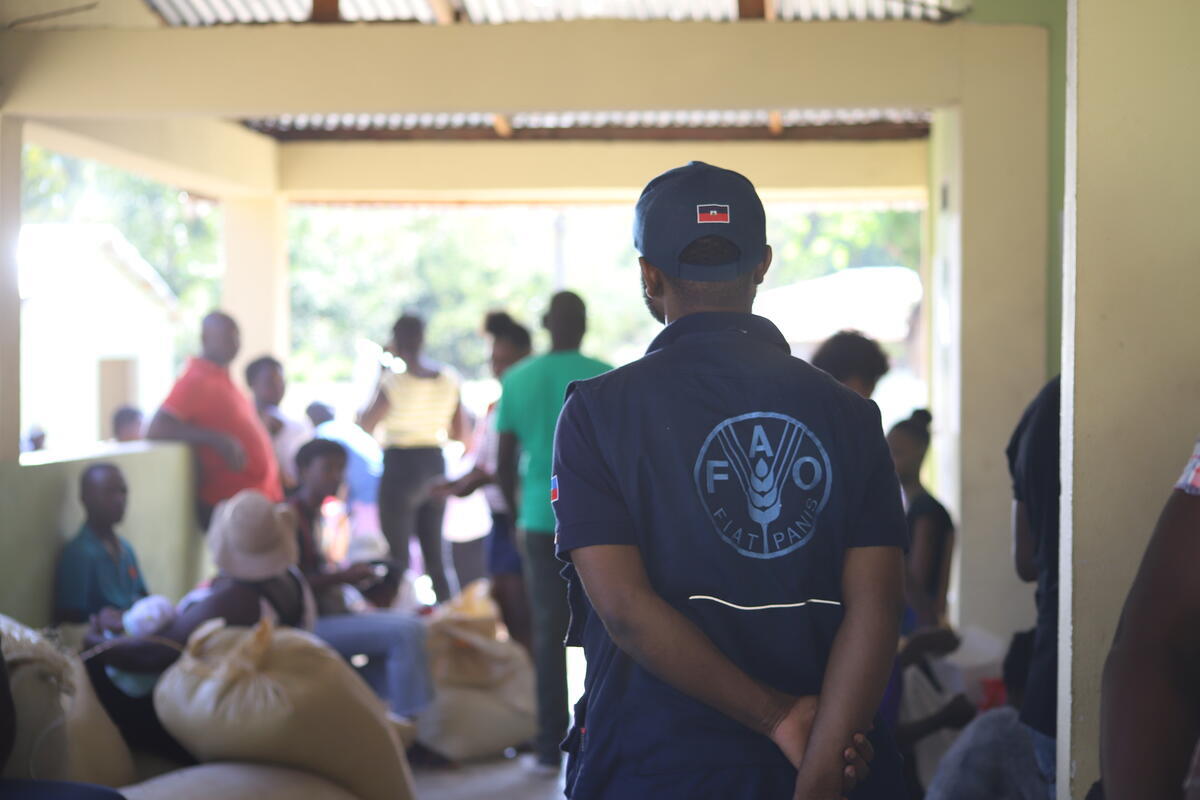
While skyrocketing gasoline and diesel prices choke the economy and worsen hunger, the Food and Agriculture Organization of the United Nations is rolling out $16 million in funding to distribute agricultural kits and small livestock in three vulnerable departments. A breath of fresh air, but a titanic challenge in a country where 5.8 million people suffer from acute food insecurity.
Announced on Friday by the Petroleum Market Monitoring Advisory Council, the slight drop of 25 gourdes per gallon of gasoline—down to 700 gourdes—is hardly a cause for optimism. It comes after months of dizzying price hikes that have paralyzed transportation, sent food prices soaring, and plunged thousands of families into even more extreme poverty.
In this country where more than one in two people regularly lack food, any fluctuation in fuel prices immediately affects what goes on the plate.
It is against this backdrop of overlapping crises—gang violence, political instability, climate shocks—that the FAO announced this week new funding of more than $16 million, granted by the Regional Humanitarian Fund for Latin America and the Caribbean (RHPF LAC)

5.83 Million Haitians in Acute Food Insecurity
The numbers are staggering. According to the latest report by the Integrated Food Security Phase Classification (IPC), dated April 2026, 5.83 million people—more than one in two Haitians—are experiencing acute food insecurity (IPC Phase 3 or higher). In other words: families skipping meals, reducing portions, or turning to wild foods to survive.
This crisis is not accidental. It results from a succession of shocks: the rise of armed groups now controlling large swaths of territory, including rural areas; collapsing supply chains; chronic economic instability; and increasingly frequent climate hazards (droughts, floods, cyclones). Added to that, for several months, is the fuel crisis strangling transportation and local production.
326,600 People Targeted in Artibonite, Centre, and West Departments
The funding obtained by the FAO aims for an urgent humanitarian intervention: saving lives by rapidly reducing acute food insecurity, while also giving communities the means to produce again.

The operation will target 326,600 people—approximately 65,000 households—in three of the hardest-hit departments: Artibonite (the country’s breadbasket, severely affected by violence and drought), Centre (a mountainous region where isolation complicates aid delivery), and West (which includes the Port-au-Prince metropolitan area, the epicenter of the security crisis).
Concretely, the FAO will distribute emergency food production kits containing short-cycle seeds (vegetables, beans, corn) and small livestock (goats, chickens, ducks).
The idea is to provide agricultural tools capable of yielding results within 90 days, sometimes less. Each kit is designed to cover the food needs of a family of five for nearly six months.
“What makes these interventions effective is that they enable households to quickly meet their own needs, no matter what. This prevents irreversible survival strategies—selling tools, pulling children out of school—and reduces long-term dependence on aid,” explains Pierre Vauthier, FAO Representative in Haiti.
An Innovative Approach: Short-Cycle Seeds + Small-Scale Animal Husbandry
The originality of this project lies in its dual agricultural and livestock component. Where many emergency interventions are limited to food distributions, the FAO is focusing on rapidly restarting local production.
Short-cycle seeds—N22 beans, early-maturing corn, sweet potatoes—allow for a first harvest as early as the second half of the growing season. As for small livestock (egg-laying hens, goats, ducks), they provide a regular supply of protein and income (selling eggs, milk, kids).
Beneficiaries are not left on their own. Technical support is provided, with follow-up visits by agronomists backed by the Ministry of Agriculture, Natural Resources and Rural Development. The goal: ensure optimal use of inputs and prevent losses.
Chronic Underfunding and Absolute Urgency
The Regional Humanitarian Fund for Latin America and the Caribbean (RHPF LAC), which finances this operation, is part of the global system of Country-Based Pooled Funds (CBPF). It allows humanitarian partners to respond quickly to the most critical needs, particularly in complex and underfunded crises.
Chronic underfunding remains a recurring problem. In 2025, Haiti’s humanitarian response plan was only 35% funded. The result: interrupted assistance programs, reduced distributions, and worsening malnutrition.
This new $16 million funding, while significant, remains a drop in the bucket compared to the scale of needs. More than 5.8 million people are suffering from hunger, and the country is sinking into a multidimensional crisis where insecurity, rising fuel prices, and collapsing public services reinforce one another.
The FAO says it is working with local partners and community networks to secure distributions. “The challenge is to reach the most vulnerable where they are, without endangering teams. We adapt the modalities on a case-by-case basis,” says Pierre Vauthier.
Local Production to Restore Dignity and Independence
Beyond the numbers—326,600 people helped, 90 days to a first harvest, six months of food autonomy—this project carries a broader ambition: breaking the cycle of dependency.
Credit: © FAO / Nour Azzalini