

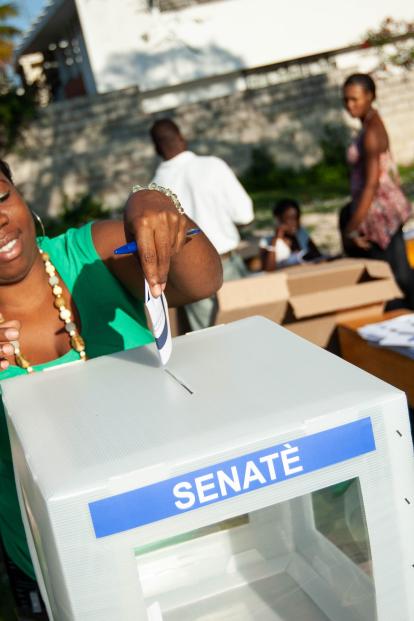
Port-au-Prince, Sunday, July 5, 2026 – After weeks of intense negotiations and technical debates among the highest spheres of the State, an agreement has been reached between the Office of the Prime Minister and the Provisional Electoral Council (CEP) regarding the funding of the upcoming general elections. The two institutions have reached a consensus on a total package of 120 million US dollars, intended to cover all electoral operations. A decision described by observers as a “decisive step forward” toward holding a ballot that the country has been deprived of for several years.
The official announcement was made public this Friday, July 3, through a joint communiqué signed by the Prime Minister and the President of the CEP, Jacques Desrosiers. According to the document, this amount was not arbitrarily set: it is the result of several in-depth working sessions conducted under the direct authority of the head of government and the CEP President, with the technical and financial support of the Ministry of Economy and Finance. These meetings made it possible to establish a rigorous assessment of the logistical, organizational, and security needs inherent to a nationwide electoral process.
The authorities specified that the 120 million dollar package was calculated taking into account complex and evolving parameters. Among these are the progressive improvement of the security situation across the territory, the anticipated reopening of certain difficult-to-access areas that were until recently under the influence of armed groups, as well as the real financial capacities of the Haitian State, severely strained by the economic crisis. The government, however, left the door open for a possible revision of this budget, should circumstances require it, upon joint decision of the Office of the Prime Minister and the CEP, thus ensuring a certain flexibility in the face of unforeseen developments on the ground.
A Strong Political Signal in a Climate of Distrust

Beyond the mere figure, this agreement carries considerable political weight. It comes in a particularly tense context, where the transitional authorities, in place since the fall of the last constitutional government, are under pressure from the international community and civil society to demonstrate their ability to put the country back on the path toward elected institutions. The signing of this financial protocol is seen as a concrete response to the numerous criticisms that had denounced inaction and lack of transparency in the preparations.
In their communiqué, the Office of the Prime Minister and the CEP firmly reaffirmed their shared commitment to implementing a “credible, transparent, inclusive electoral process that complies with democratic requirements.” They also insisted on the need for rigorous and impeccable management of public funds, a crucial point given that accusations of embezzlement and mismanagement have regularly tainted previous elections.
The government has committed to mobilizing the necessary resources, with the support of national and international partners, to finance the various phases of the process, ranging from the revision of electoral lists to the distribution of voting materials, including the training of polling agents and the securing of polling stations. For its part, the CEP reiterated its commitment to conducting operations with impartiality, professionalism, and independence, in strict compliance with the Constitution, current laws, and international standards.
This financial agreement comes less than three months after a major change at the helm of the electoral administration. On April 20, 2026, Uder Antoine was installed as the new Executive Director of the CEP, succeeding Jean Roger Philippe Augustin, who stepped down after a 22-year career within the institution.
During his installation ceremony, the President of the CEP, Jacques Desrosiers, did not hide the magnitude of the challenges ahead, notably mentioning the persistent insecurity that hinders the free movement of agents and voters, as well as the chronic mistrust among a segment of the population. He then called for the process to be conducted with rigor and responsibility. Uder Antoine, for his part, promised to strengthen administrative discipline, transparency, and the institution’s efficiency in order to meet the legitimate expectations of a population thirsty for democratic renewal.

This 120 million budget, if effectively well managed, could constitute the first real test for this new team.
By Marie Farah Fortuné and Darbouze Figaro