

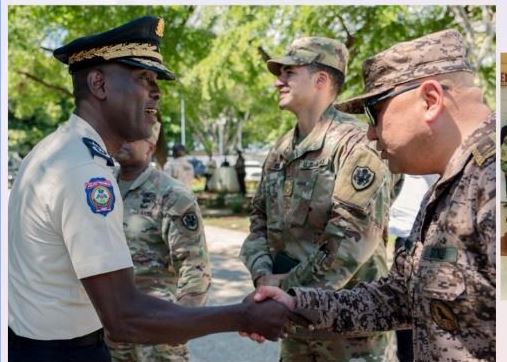
Hope for a decisive offensive against armed groups in Haiti is colliding with an increasingly dark reality on the ground. While the Commander-in-Chief of the new Gang Suppression Force (FRG), Major General Erdenebat Batsuuri (Armed Forces of Mongolia), arrived in the capital and met Tuesday with the Chief of the Haitian National Police (PNH), André Jonas Vladimir Paraison, the massacres carried out by criminal coalitions continue unabated, spreading terror among a population whose concern continues to grow.
The meeting, held at the PNH General Directorate headquarters in Tabarre, aimed to “exchange views on arrangements related to the operational implementation” of the FRG on national territory. General Batsuuri, surrounded by officers from Sri Lanka, Chad, and Mongolia, has received a clear offensive mandate: neutralize gangs, secure critical infrastructure, and support the under-equipped and overwhelmed Haitian police.
According to a statement from the Police Communication Directorate (DICOP), this international force will be tasked with “consolidating and stabilizing areas already retaken by the PNH,” before considering a gradual restoration of security across the entire territory.
While the FRG’s command structure is now in Haiti, an advance team has already arrived. Approximately 50 Chadian police officers and soldiers have arrived in the capital in recent days, accompanied by several civilian and military officials. Among the personalities already present are the Force’s Special Representative, Jack Christofides, as well as the head of the United Nations Office in Haiti (BANUH), German national Daniela Krosla. Meanwhile, shipments of heavy equipment, armored vehicles, and other supplies continue to be unloaded in Port-au-Prince, suggesting a large-scale deployment in the coming weeks.

Despite this visible buildup, concern remains strong within the Haitian population. Official announcements struggle to convince a civil society scarred by decades of foreign interventions with mixed results. Following the recent experience of the MSS, many are questioning the real effectiveness of the FRG, which is supposed to include 5,500 soldiers and police officers.
“They talk to us about Mongolian and Chadian special forces… but in the neighborhoods, it’s our children dying every night from gang bullets. Where is this force?” a resident of the Haitian capital said indignantly.
Gangs continuously challenge the state
While senior officials discuss strategy, armed groups are not disarming. In recent weeks, several areas of the country, particularly in Artibonite and the Southeast, have been targeted by coordinated attacks. The atrocities committed by criminal coalitions and clashes with the overwhelmed PNH continue to cause civilian deaths, hundreds of displaced people, and worsen the humanitarian crisis.
In this climate of chaos, the FRG appears to many as the last chance to regain control of the country. But while the leaders and first elements of the Force are on the ground, the gangs continue to write their own law, defying the Haitian state and its new allies.