


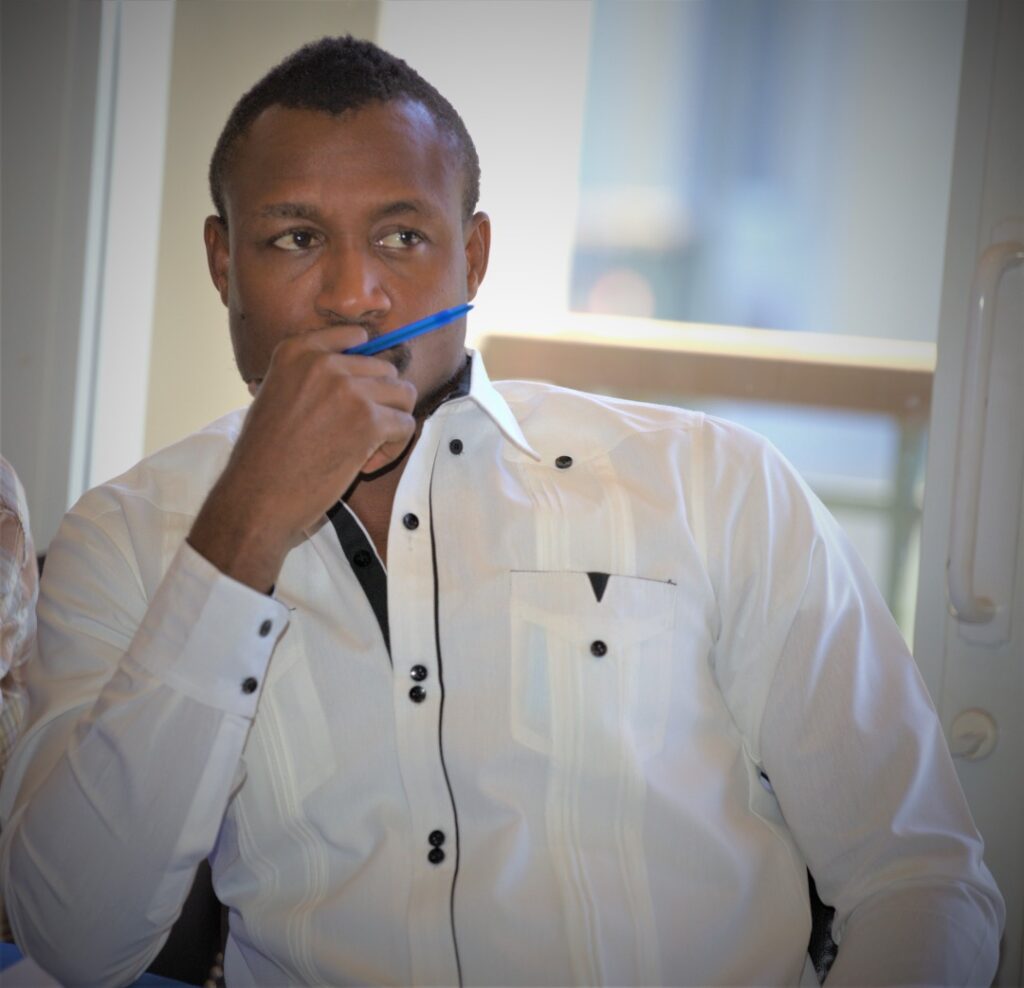
Five years after Haitian journalist Diego Charles was shot dead outside his home, his family has issued a public note of consternation and protest, condemning what it calls an intolerable denial of justice and warning that the state’s silence has become a wound of its own.
“Five years. Five very long years have passed since that tragic night of June 29 to 30, 2021, when the life of journalist Diego Charles was cravenly and brutally cut down by gunfire, right in front of his private residence in Christ-Roi,” the family said in the statement, dated June 29, 2026. The family, it added, “lives in the pain of an irreplaceable absence, compounded by the unbearable torment of impunity.”
The note was issued through the Gonaïves-based law firm Les Légalistes / Cabinet d’Avocats and signed on behalf of the family by Marie Samuelle Charles — Diego’s sister, who pressed authorities for answers in the months after the killing, as documented by Amnesty International.
The family’s statement reads more like a charge sheet than a memorial. It denounces, “with the greatest vigor,” four failures it lays at the feet of Haitian institutions.
First, “the revolting slowness of the Central Directorate of the Judicial Police (DCPJ) and the judicial apparatus, which seems to have consigned this cowardly assassination to the dustbin of history.” Second, “the total absence of any follow-up to the investigation,” which the family says has left the case frozen in “an unacceptable status quo, as if the life of a citizen, of an honest member of the press, had no value in the eyes of the State.”

Third, the family condemns “the flagrant inaction of the authorities,” writing that “to this day, no serious hearing has been held, no key suspect has been genuinely troubled. This institutional silence amounts to passive complicity.” Fourth, it points to “the glaring lack of political will on the part of the Haitian State to bring out the truth and render justice to Diego Charles.”
In the statement’s most searing line, the family writes: “The silence of justice is a second act of assassination for Diego. We cannot accept it.”
Diego Charles was 33 years old. He worked as a reporter for the private broadcaster Radio Vision 2000, wrote for the outlet Gazette Haïti, and had recently co-founded the news website Larepiblik Magazine with activist Antoinette Duclair, according to the Committee to Protect Journalists (CPJ) and Amnesty International.
His work made him enemies. At the time of his death, Charles was reporting on several sensitive subjects for Larepiblik, including the unsolved 2020 assassination of Monferrier Dorval, the president of the Port-au-Prince Bar Association. CPJ reported that his final article noted the judge in the Dorval case had faced death threats and assassination attempts, met with “the total indifference of state authorities.”
The night of June 29, 2021
At around 11 p.m. on June 29, 2021, unidentified men on a motorcycle opened fire on Charles at rue Acacia in the Christ-Roi neighborhood of Port-au-Prince and fled. A judicial police report reviewed by Amnesty International found that Charles was shot twice.
Killed alongside him was Antoinette Duclair, a 33-year-old feminist and human-rights activist and a member of the opposition movement Matris Liberasyon, who had just driven Charles home from a meeting. She was shot seven times, including in the head, while sitting in her car; a witness told Amnesty International they heard her cry out, “No, don’t shoot at us!” Known to friends as “Netty,” Duclair was widely respected for her analysis of the PetroCaribe corruption scandal, according to the Haitian outlet Infohaiti.
More than 15 people were killed across Port-au-Prince that night. The director of the national police at the time, Léon Charles, characterized the deaths as random shootings amid chaos following the earlier killing of a police officer. Journalists rejected that framing. One of Diego Charles’s colleagues told CPJ it was “ridiculous and suspicious” to lump the two deaths in with the others, arguing the grouping served “to avoid having to look into possible political motives and political complicity behind the killings of Charles and Duclair.”
Promises made, justice denied
In the days after the killings, the office of then-Prime Minister Claude Joseph condemned the “serial killings” and ordered the Ministry of Justice and the national police to identify and prosecute those responsible, declaring the crimes could not “go unpunished in a democratic society,” Al Jazeera reported.
The skepticism was immediate. Jacques Desrosiers, head of the Haitian Journalists Association, predicted at the time that authorities would announce investigations that lead nowhere, telling reporters, “We are used to that,” according to France 24. His warning proved accurate. Amnesty International later documented that the grieving families faced repeated death threats and intimidation as they sought justice, including gunfire outside both victims’ homes meant to silence witnesses.
The killings came barely a week before the July 7, 2021, assassination of President Jovenel Moïse, an event that consumed the country’s institutions and, critics say, pushed cases like Charles’s further into the dark.
For Haiti’s press, the Charles case is a familiar and painful one. The country has a long record of journalist killings that are never solved, stretching back to the still-unresolved 2000 assassination of celebrated broadcaster Jean Dominique. PEN International has noted that Charles’s murder added to a list of journalists killed since 2018 — including Vladimir Legagneur, Rospide Pétion, and Néhémie Joseph — for whom no investigation has been completed. At the time of the killings, PEN International reported, Haiti ranked 87th of 180 countries on the World Press Freedom Index compiled by Reporters Without Borders, and conditions for the press have only deteriorated as gangs have seized control of much of the capital.

“We are demanding a fundamental right”
The Charles family says it has not given up, and its statement frames the fight as a matter of principle rather than mercy.
“Despite the passing years, despite the feigned indifference of the authorities and the progressive collapse of our institutions, our determination remains intact,” the family wrote. “We wait, we demand, and we still hope that justice will be rendered to Diego Charles.”
The note closes with a vow. “We are not asking for a favor; we are demanding a fundamental right,” the family said. “Diego’s blood cries out for justice, and his family will not be silenced until the intellectual and material authors of this heinous crime answer for their acts before a court.”
Editorial Disclaimer: This article was originally written in English. The French and Haitian Creole versions are produced using AI translation, and errors are possible — the English version is authoritative. CTN also uses AI to convert text into audio. Readers and listeners should rely on the English text where any discrepancy arises.
https://ctninfo.com/five-years-on-di…enial-of-justice/
https://www.facebook.com/CaribbeanNewsMedia