



In her first interview with a Haitian news outlet since the House vote, the Massachusetts congresswoman details the anatomy of a historic legislative victory and says she is going to the Senate with momentum, a mandate, and no contingency plans.
Congresswoman Ayanna Pressley does not deal in contingency plans.
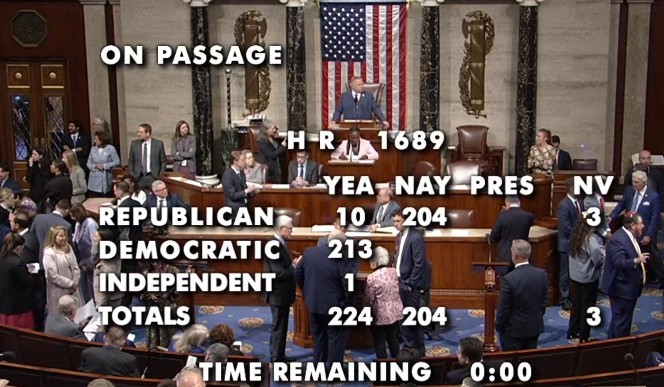
In her first sit-down interview with a Haitian media outlet since the U.S. House of Representatives passed H.R. 965 by a vote of 224 to 204 — a bill that would extend Temporary Protected Status for the approximately 360,000 Haitian nationals currently living in the United States — the Massachusetts Democrat was direct about what comes next.
“Of course, I believe that’s possible,” she said when asked whether TPS could be preserved through the courts or through Congress. “And the amicus brief is simply saying: enforce the law. Temporary Protected Status is a legal status.”

That combination of legal argument and political confidence defines how Pressley is approaching the Senate phase of what she describes as a relay race — one that began many weeks ago, required an extraordinary degree of coalition-building, and produced a legislative outcome that surprised even some of those closest to the effort. But the congresswoman is careful not to mistake a House victory for a finished race.
“We are certainly,” she said, pausing before continuing, “and I do want to say that the decisive mandate that came out of the House, and the momentum that was shown, the stamina that was shown, the strategy that was employed — all of that supports us in the Senate, because it demonstrates a decisive mandate.”
She is heading to the Senate, she said, with that mandate in hand. And she is not forecasting the final margin.
“I Come as One, But I Stand as 10,000”
To understand where this fight is going, Pressley insists you first have to understand where it came from — and more specifically, who built it.
When asked how she pulled off a victory that many observers did not see coming, the congresswoman reached for a line she had quoted on the House floor: “Maya Angelou once said, ‘I come as one, but I stand as 10,000.’ So when I said don’t underestimate me, it really was about not underestimating the strength of this coalition and this movement.”

That coalition, as Pressley describes it, was deliberately wide and required months of careful cultivation. It included Haitian Bridge, the IFSI, the Archdiocese, organized labor, the faith-based community, healthcare workers, and the families of those directly at risk of losing their protected status. It also, she was emphatic to note, included Haitian media.
“You were critical partners in keeping that drumbeat up and stressing the urgency,” she said. “And that supported our efforts to have phone banks from throughout the country, people flying in from throughout the country to lobby their members — and that was just to sign the petition.”
The strategy, as she frames it, was built on one central tool: storytelling. “We used the powerful tool of storytelling to amplify the lived experiences and to underscore the contributions being made by some 360,000 Haitian nationals in this country.”
It was not, she underscored, a campaign organized around charity or sentiment.
“This is not an appeal for charity or benevolence. Do I think it is the humane thing to do to extend Temporary Protected Status for the next three years? Of course, I think it’s the moral and humane thing to do. I also think it’s the smart thing to do. I also think it’s the responsible thing to do — not from a place of benevolence, but from a place of reciprocity. It’s the very least we can do. This is what we owe our Haitian neighbors.”
The Relay Race: Three Legs, Three Tests
Pressley organized her account of the legislative effort around a single recurring metaphor: a relay race with three distinct legs, each carrying its own pressure and its own risk of failure.
The first leg was the most fundamental — reaching the 218-signature threshold required to formally trigger the discharge petition process. In a political environment defined, in her words, by “the dysfunction and obstruction under the Republican majority in Congress,” that threshold was far from automatic.
“It has been nearly impossible to advance any legislative victories in any space on matters of consequence to everyone who calls this country home,” she said, “but including and especially when it comes to immigration.”
She noted that discharge petitions are a rare instrument. “In the last 40 years, only 15 of them have been able to meet that threshold. So that is a testament to the strength of this coalition.” The 218 signatures came from the full Democratic caucus plus four Republicans: Congressman Don Bacon, Congressman Lawler, Congresswoman Salazar, and Congressman Fitzpatrick.
Getting those four was itself a story. But securing signatures, Pressley explained, was only the beginning. The second leg of the relay was the formal discharge of the petition — the procedural step that moves the bill to an actual floor vote. And this, she said, was where the pressure intensified in ways that were not always visible from the outside.
“I didn’t stop lobbying members, because I wanted to make sure that those signatures on the petition would translate to votes,” she said. “And I had some Republicans that were saying they would support final passage on a bill, but they wouldn’t support a vote to discharge the petition. So up until the last minute and 30 seconds, I was organizing, pushing, pushing, pushing to ensure that we would be able to advance in the second leg of that relay race.”
The distinction she draws between signing a petition and voting to discharge it — and then voting for final passage — is important. Each step carried its own political calculation for members, particularly Republicans operating within a majority conference that had not voluntarily put the bill on the floor. For Pressley, navigating those distinctions required constant, granular engagement with individual members, right up to the moment the vote began.
The third and final leg of the House relay was the floor vote on final passage. And even here, with the outcome appearing increasingly likely, Pressley refused to stand down.
“Even when, on the floor, members were coming up to congratulate me in anticipatory delight for what they foresaw was about to happen, I still did not allow myself to fully believe that it was about to happen,” she said. “I said, ‘Nothing is real until it is, and I’m just going to keep having conversations, keep working.'”
She positioned herself deliberately in the well of the House chamber, wearing what she described as “a brightly colored fuchsia-pink jacket — as a way to sort of hold people accountable to their word.”
The final count: 224 to 204. Ten Republicans and one independent voted in favor, joining the full Democratic caucus. Pressley had hoped for more. “I was getting very bold — perhaps even greedy — in the work of organizing, and I desperately wanted us to reach a 230-vote threshold, both Democrats, Republicans, and independents, so that we would be veto-proof.” That number was not reached. But 224 was, by any measure, beyond what most had predicted.

“We certainly did exceed expectations,” she said. “I think we met the moment and succeeded in giving a lot of hope to a lot of people whose lives are uncertain in this landscape.”
Her Grandfather’s Counsel and a Pink Jacket
Throughout the interview, Pressley returned repeatedly to the personal framework that guided her through the months of organizing. She quoted her grandfather more than once: “Plan your work and work your plan.”
That discipline extended to her refusal to think about failure. “People kept asking me, ‘What will you do if you’re not successful? What will happen?’ And I wasn’t prepared to be considering contingency plans. I just wanted to continue to work towards a victory.”
There were moments on the floor when members she had not secured commitments from voted yes. “There were people that had not made commitments to me who surprised us on the floor,” she said, “and that is because they know full well the contributions that our Haitian neighbors are making to major industries like healthcare, construction, and hospitality — contributions that are being made to civic life, culture, the workforce, the economy, and our tax base.”
This, for Pressley, was the argument that transcended party lines. Not sentiment, but fact. Not appeals to conscience alone, but a clear-eyed accounting of economic and civic contribution.
The Amicus Brief and Every Available Lever
With the House vote secured, the congresswoman has been working the legal track simultaneously. An amicus brief, filed in advance of oral arguments at the Supreme Court, was led by Congresswoman Debbie Wasserman Schultz of Florida — who also served, Pressley noted, as an effective member of her whip team during the discharge petition effort. The brief was co-signed by Congressman Maxwell Frost of Florida, Congressman Tom Suozzi of New York, Representative Melanie Stansbury of New Mexico, Representative Alexandria Ocasio-Cortez of New York, and Congresswoman Laura Gillen of New York, whose legislation Pressley described as “foundational to the actual drafting of our discharge petition.”
The legal argument, Pressley said, is straightforward. “The amicus brief just says: enforce the law. The State Department, under the Trump administration, maintains that Haiti is not a safe country to visit — much less to be permanently deported to.”
She continued: “It is not safe. It is not a stable country. It’s a beautiful country, and I know that if it were stable, we wouldn’t be having this conversation, because many would want to return home and reunite with family and loved ones. But it is not a safe — albeit beautiful — country to be right now.”
On what the House vote might mean for the Supreme Court’s deliberations, Pressley was measured. “I think them seeing a decisive mandate and momentum coming out of the U.S. House of Representatives, them being thoughtful about the amicus brief that we filed, them seeing a vigorous effort coming out of the Senate — all of those things support the kind of pressure and visibility that we need for this issue.”
She framed her overall approach as four parallel tracks operating simultaneously: “Litigation in the form of an amicus brief, legislation in the form of the discharge petition that we forced a vote on, agitation — because we are not letting up, we are keeping our foot on the gas — and organization and mobilization.”
A Blueprint, Not Just a Bill
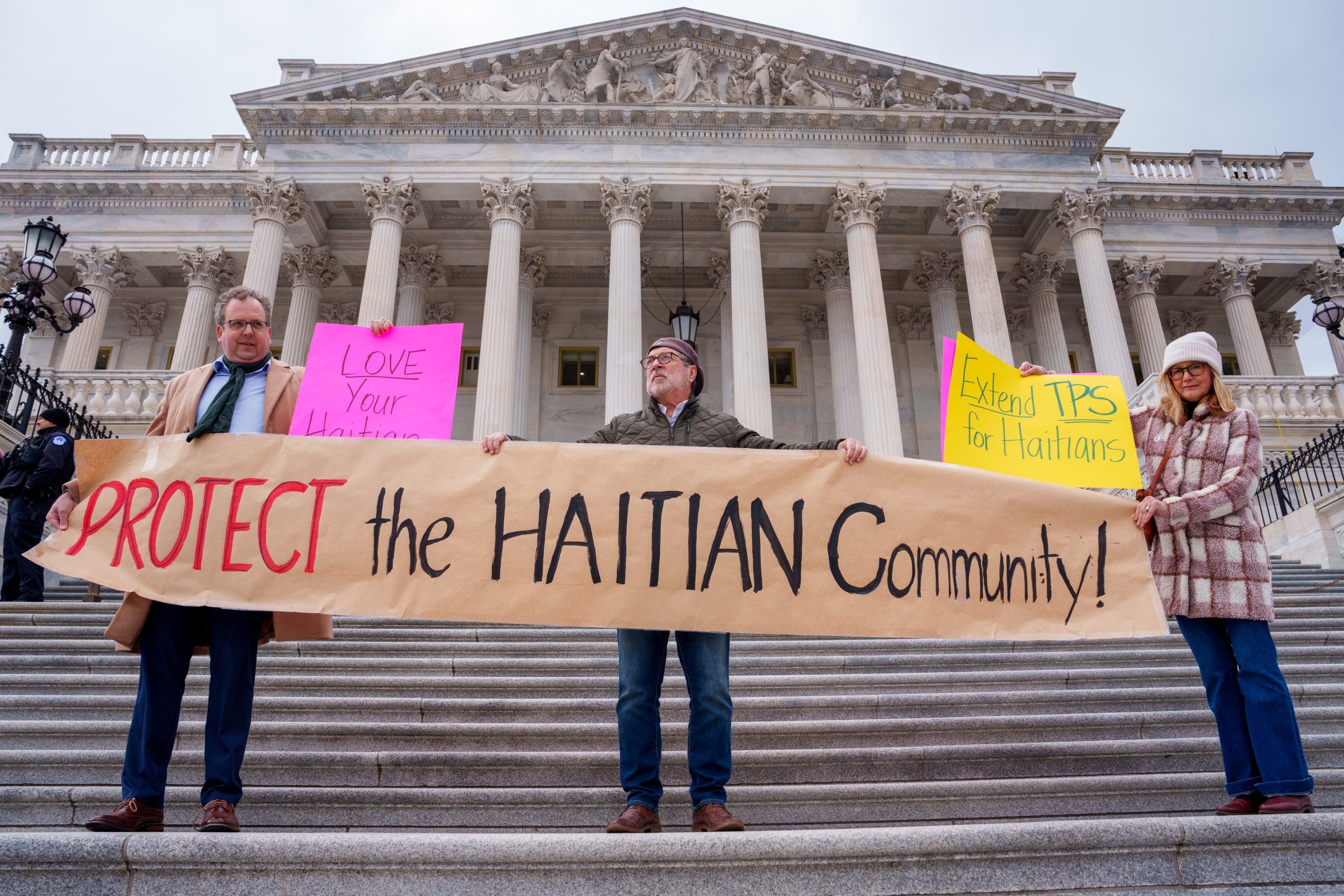
Pressley was also careful to place H.R. 965 in a broader context. She noted that the discharge petition on immigration was, to her knowledge, the first of its kind in Congressional history. She also pointed to what she sees as its implications beyond the Haitian TPS case.
“We now see dueling discharge petitions being filed in support of the 1.6 million TPS holders in this country,” she said. “And people are hopeful that, with this blueprint, perhaps we’re establishing a new floor — an effective workaround.”
Back home, in the Massachusetts 7th Congressional District — which includes the city of Boston and is home to the third-largest Haitian diaspora in the country — Pressley and Senator Edward Markey had already held a field hearing as the February TPS deadline approached. “We did a field hearing with Senator Markey to draw attention as the deadline was fast approaching.”
That local work, combined with the national coalition strategy, was, she argued, what produced the result. “This was a very broad and diverse national coalition that has proven it is not to be underestimated, that it is powerful.”
A Personal Debt
Pressley, who is not Haitian — a point she acknowledged directly and with warmth — was asked why she poured so much into this fight. She rejected the premise that she had nothing personal at stake.
“I will correct the record and say there is a personal benefit, and it is to demonstrate my gratitude actively,” she said. “It’s the people of Haiti who have been an inspiring example to me — as an African-American woman, as a Black woman, as a part of a larger diaspora — about what resistance looks like, about the work of liberation.”
And then she offered the most personal explanation of the interview: “It was Haitian nurses who cared for my mother in the final days of her life, in her cancer battle — who lovingly oiled her scalp and braided her hair and said prayers over her and sang songs to her. So it’s true I don’t have a political benefit, but there is a deeply personal benefit, and it’s really just for me to demonstrate my gratitude to our Haitian neighbors, to the people of Haiti.”
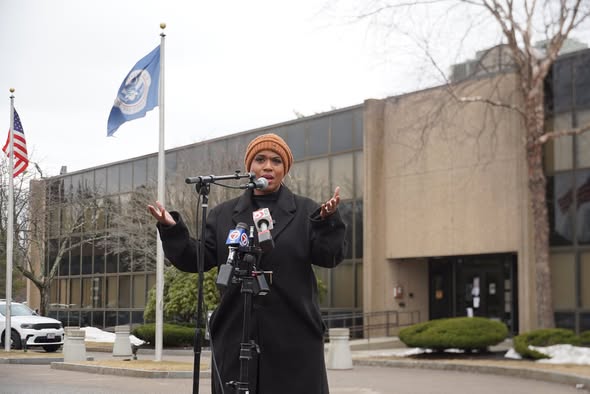
On the question of what comes next, she did not hesitate. The Senate. The amicus brief. The organizing. The coalition. The relay race continues.
“As I’ve said, these 360,000 Haitian nationals are already home,” she said. “They are already home.”
The full interview will be available on all CTN platforms starting Thursday, April 23, around 6 PM.
https://ctninfo.com/exclusive-pressl…e-for-the-senate/
https://www.linkedin.com/company/100253760/admin/dashboard/
Note to readers:
This content was originally produced in English by Caribbean Television Network. Translations in other languages are automatically generated using AI-powered software and may not perfectly reflect the original text. In the event of any discrepancy, the English version shall be considered the authoritative source.