
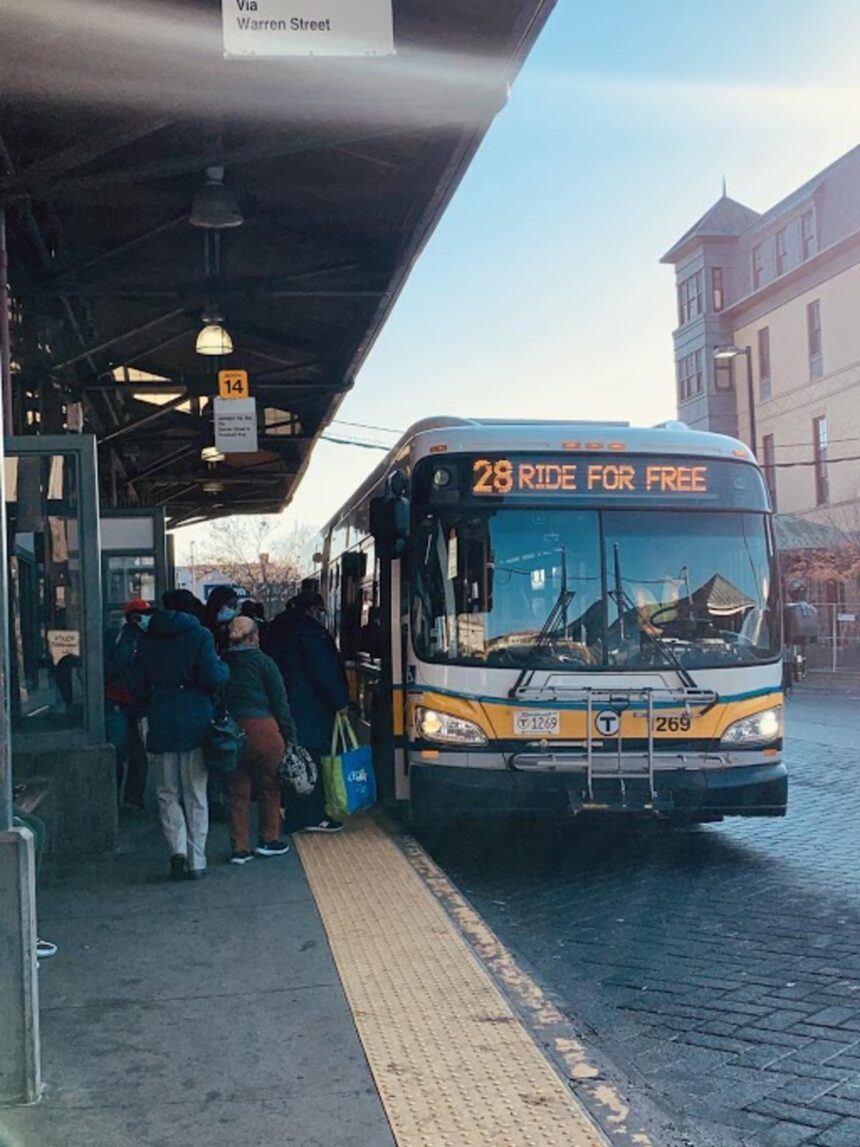
Enrollment for the MBTA’s Car-Free Seniors pilot opens Oct. 13. Residents 75 and older with a Massachusetts ID instead of a driver’s license can get a credential for free bus, subway, ferry, and Commuter Rail rides.
Older Massachusetts residents who have given up driving will soon be able to ride the T for free. Gov. Maura Healey announced Tuesday that enrollment for the MBTA’s new Car-Free Seniors pilot program opens Oct. 13, offering free fares across the transit system to residents age 75 and older who no longer drive.
Run by the MBTA in partnership with the Registry of Motor Vehicles, the program lets eligible seniors obtain a free-fare credential valid on MBTA buses, subway lines, ferries, and the Commuter Rail, according to the governor’s office and the MBTA. The key requirement is that the rider hold a Massachusetts identification card rather than a driver’s license — the ID is the official state credential for residents who don’t drive.
Here is how to sign up.
First, you need a Massachusetts ID. Anyone who doesn’t already have one can apply through the RMV; it is an official form of identification that does not carry driving privileges. Seniors who still hold a driver’s license would need the ID card to qualify.

Once you have the Mass ID, you can apply for the free-fare credential in one of two ways, both beginning Oct. 13:
Online: Complete the application on the MBTA’s website. Applicants who apply online will receive the credential by mail, or can choose to pick it up in person. The online form will not be available until the launch date.
In person: Visit the Charlie Service Center at 296 Washington St. in downtown Boston, between Milk and Water streets, near the State Street and Downtown Crossing stations. The center is fully accessible. Riders who apply there can get a temporary credential the same day, with a permanent one mailed afterward.
State officials framed the pilot as a way to keep older residents mobile and independent after they stop driving. “For seniors who have made the decision to stop driving, transportation shouldn’t become another cost or barrier,” Healey said in a statement. Interim Transportation Secretary and MBTA General Manager Phillip Eng said the agency wants “the older generation to have the ability to travel as they please, even without a license,” and Registrar of Motor Vehicles Colleen Ogilvie said the RMV was partnering with the MBTA to help seniors “maintain independent mobility and stay connected to their communities.”
The Car-Free Seniors program is one of several MBTA affordability measures the administration rolled out this year.
The broader package, announced over the summer, included 50 percent off monthly Commuter Rail passes from September through November, an extension of the $1 weekend companion fare, two-hour unlimited transfer windows, and eliminating higher express-bus fares. The senior program was part of that package, with Tuesday’s announcement setting the enrollment date.
Two points are worth keeping in mind. The free-fare benefit is distinct from the existing Senior CharlieCard, which offers reduced fares, and from The RIDE, the MBTA’s paratransit service; the new credential is specifically for residents 75 and older who hold a Mass ID and no license. And the program is a pilot: MBTA fare pilots run for up to six months and are then evaluated, so making the benefit permanent would require a separate, formal fare-change process.
For the many older Haitian and Caribbean residents across Greater Boston — in Mattapan, Dorchester, Hyde Park, Brockton and beyond — the change offers a concrete way to reach medical appointments, family and errands without a car or a fare. CTN will share the enrollment link and any updates once the application opens on Oct. 13.
https://ctninfo.com/?p=44726&preview=true
https://www.facebook.com/CaribbeanNewsMedia
AI Use Policy:
Some of CTN’s journalists are not native English speakers and draft their work in French or Haitian Creole. We then use AI-assisted translation software to produce the English versions, and traces of machine-generated phrasing may occasionally remain. Every article — in any language — is written, reviewed, and edited by CTN’s staff writers and editors, who remain responsible for its accuracy. CTN also uses AI to convert text into audio.