


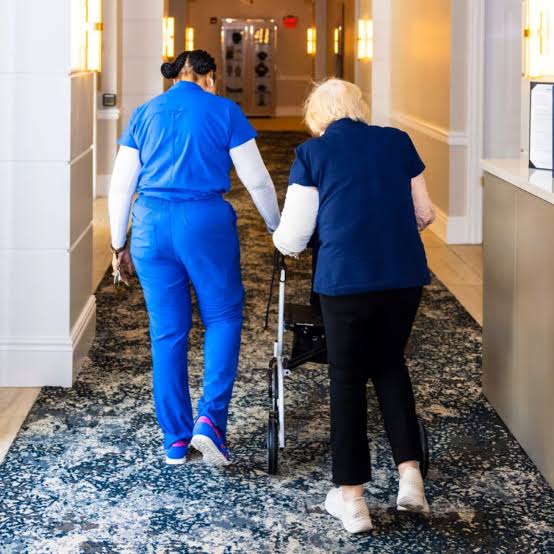
Byron Donalds, the Republican nominee for Florida governor, says the state can train a new workforce to replace the thousands of Haitian nurses and aides who are losing their jobs as Temporary Protected Status ends. A claim healthcare providers and labor leaders say collides with the immediate reality on the ground.
Asked in an interview with CBS News Miami how Florida would absorb the loss of its Haitian healthcare workers, Donalds pointed to his proposed LaunchPad Initiative, an employer-led program that would place high school juniors and seniors into internships and apprenticeships before they graduate. “By the time you graduate high school, you’re walking directly into the job,” he said. He also called for expanding adult education and the state’s CareerSource system so older workers could retrain for fields with openings, including healthcare.
Donalds has not released a healthcare-specific plan, and he offered no figures for how many workers would need to be replaced, how quickly they could be trained, or what it would cost. When the interviewer pressed him that Florida’s shortage is immediate — while an apprentice starting today would need years before performing roles that require certification and clinical judgment — Donalds said adults could also be retrained, proposing to “supercharge” adult education, but again gave no targets or timeline.


The gap Donalds is proposing to fill is large and specific.
The Florida Health Care Association, which represents long-term care providers, estimates that as many as 35,000 Haitian immigrants work in the state’s healthcare system, many of them certified nursing assistants and registered nurses in nursing homes, according to WUSF and Bay News 9. In a letter to the Department of Homeland Security, the association warned that losing even a small share of these experienced caregivers would harm residents’ continuity of care and deepen shortages at facilities already struggling to fill positions.
These are not easily interchangeable jobs. Florida employs roughly 1.2 million healthcare workers in total, according to KFF data cited by Healthcare Brew, so the Haitian workforce is a small share of the whole, but it is concentrated in long-term care, the hard-to-staff corner of the system. The Florida Hospital Association has projected the state could be short nearly 60,000 nurses by 2035 without action, which is why industry and labor leaders argue that removing thousands of trained caregivers now makes the problem worse, not better.
The disruption Donalds was asked about is not a future scenario.
Denise Bellville, director of the Home Care Association of Florida, said two agencies serving the Haitian community in Broward and Miami-Dade counties closed their doors after each lost more than 80 TPS holders, according to reporting carried by iHeart’s Florida stations. Bellville warned the losses could degrade patient care, especially in underserved areas, and pointed to the homebound patients those agencies served — people who may now be forced into higher levels of care, such as nursing homes.
Large hospital systems have felt it too. Jackson Health reported losing about 50 Haitian TPS workers, and Memorial Healthcare lost 27 caregivers, per the same reporting. Margarette Nerette, a vice president at 1199SEIU, Florida’s largest healthcare workers’ union, said the Supreme Court decision that cleared the way to end Haitian TPS had “failed our communities,” warning of a devastating impact on workers and the patients who depend on them, according to WUSF.
Behind the numbers are families facing an impossible choice.
“For me and for many, it’s just a death sentence,” Farah Larriex, a South Florida resident of 20 years, told CBS News Miami, rejecting the administration’s claim that Haiti is now safe to return to. A Haitian healthcare worker identified as Theo told Bay News 9 that many in her community understand TPS was meant to be temporary but cannot safely go back to a country gripped by violence. “They want to go home,” she said, “but yet they cannot go because home is blocked.”

The Trump administration terminated Haiti’s TPS designation effective July 27, 2026, and said work permits issued under the Haiti TPS categories were no longer valid after that date.
More than 330,000 Haitians nationwide held the status —the second-largest TPS population after Venezuelans—and Florida is home to nearly half of them, the largest Haitian TPS community in the country, according to WUSF and Bay News 9. The protection dated to 2010, granted after the earthquake that devastated Haiti, and was renewed for more than a decade as conditions failed to stabilize. The State Department still warns Americans against all travel to Haiti, citing kidnapping, violent crime, and unrest.
There is also a limit to what the office Donalds is seeking could do about any of it. TPS is a federal designation, and a Florida governor cannot restore it; a state can shape training, licensing, and education funding, but not immigration law. Donalds, for his part, has maintained that TPS was meant to be temporary and has said he met with Haiti’s transitional government and its ambassador, tying Florida’s staffing debate to efforts to stabilize Haiti itself.
One number that surfaced in the interview warrants scrutiny.
A claim of 100,000 Haitians in Florida healthcare circulated in the discussion — far above the Florida Health Care Association’s estimate of up to 35,000. The larger figure appears to describe Florida’s overall healthcare staffing gap rather than the Haitian workforce specifically, and its basis was not explained. The two should not be treated as interchangeable: not every Haitian resident holds TPS, and not every TPS holder works in healthcare.
For the caregivers at the center of the debate, the stakes are not abstract. They built careers caring for Floridians; they say they cannot safely go home where gang leaders continue terrorizing the population, and their absence is already showing up in shuttered agencies and short-staffed floors. Whether Florida can train enough new hands in time remains an open question — and for the patients who knew their caregivers by name, replacing them on paper is not the same as replacing them at the bedside.
https://ctninfo.com/byron-donalds-sa…unions-push-back/
Source:
Byron Donalds says Florida can replace thousands of Haitian health workers
This article was originally written in English. Other language versions are produced using AI translation software, and errors are possible — the English version is authoritative. CTN also uses AI to convert text into audio.