


Boston Public Schools reopened Tuesday in a difficult moment for the Haitian diaspora in Boston and across the United States.
As it does every year, Massachusetts opens its public schools the day after Labor Day.
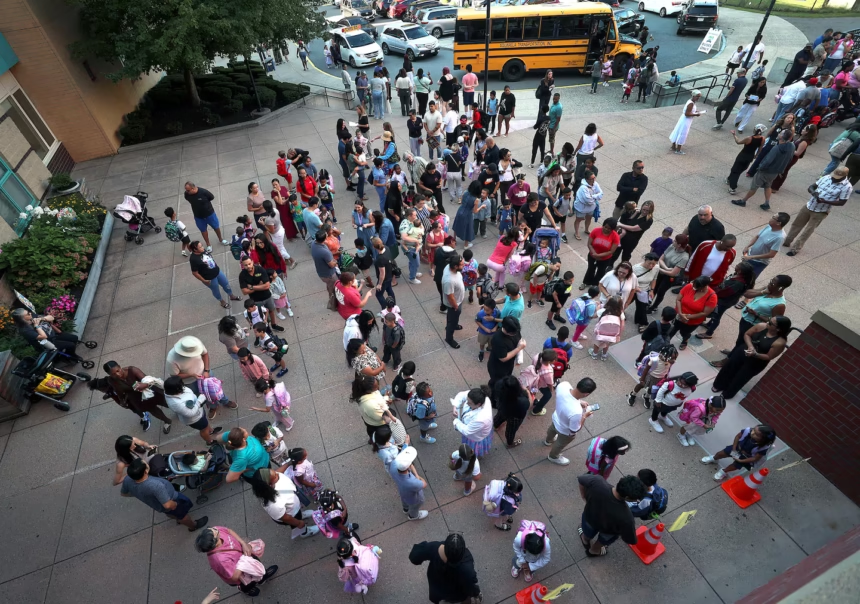
At 8 o’clock on Tuesday morning, September 8, thousands of students lined up, eager to start the new school year. At the Murphy K-8 School in Dorchester, parents and children spread across the schoolyard. For the students, it was an exciting day. For some Haitian parents, it was a day of mounting anxiety.
On June 25, the U.S. Supreme Court cleared the way for the Trump administration to end Temporary Protected Status for Haiti, and the termination took effect on July 27. By the administration’s own count, roughly 350,000 Haitian immigrants nationwide are affected. Many are now without legal status and at risk of deportation.
About a month ago, Governor Maura Healey signed the PROTECT Act, a state law that bars federal immigration agents from making warrantless civil arrests inside schools, child care centers, health care facilities and courthouses. The law does not, however, limit ICE activity in the streets around those places.
At a round table with journalists from immigrant communities, the state’s secretary of education highlighted the steps Massachusetts has taken to shield students from harassment by federal immigration agents. But he acknowledged that no measure can guarantee absolute protection: the federal government retains sole authority to enforce immigration law. He warned that more ICE agents could be deployed in neighborhoods with large immigrant populations.

At the Murphy K-8 School, CTN spoke with Jeanine, who asked that we use only her first name out of concern for her safety.
Jeanine has a 10-year-old daughter who started fifth grade Tuesday. She also has a 16-year-old who started 11th grade at a prominent exam school in Boston. She has worked as a nursing assistant at a major Boston hospital for more than 15 years. On July 27, she was placed on a two-week unpaid leave until she can update her immigration status, after which she risks being let go. She has a pending green card application, but more than a year has passed without any update. She also applied for a work permit tied to her I-485 application and has heard nothing on that either.
Out of a job for the first time in 15 years, Jeanine must now worry not only about paying her bills but about the possibility of being picked up by ICE. She has two daughters and no one to step in if she is arrested by ICE.
On the morning of Tuesday, September 8, Jeanine stood at the edge of the school lot and watched her daughter walk inside. She could not stop the questions from coming. Will she be able to keep her household together? What would happen to her daughters if she is deported?
Massachusetts is home to the third-largest Haitian community in the United States. Estimates of how many Haitians here hold TPS vary — the University of Massachusetts Boston has put the figure near 22,000, while the advocacy group FWD.us estimates closer to 20,000 — but they are part of a statewide TPS population of roughly 45,000 people of all nationalities, most of them Haitian, according to state figures.
Jeanine’s situation is far from unusual, and health care is among the sectors most exposed to the end of Haitian TPS.
A 2026 analysis cited by the state found that some 13,000 Haitian TPS holders in Massachusetts work as nursing assistants and that roughly 2,000 direct-care workers risk losing their work authorization. FWD.us estimates more than 10,000 Haitians in the state’s workforce, many of them in long-term care — a field where, according to a 2026 report from KFF, immigrants make up nearly half of all workers. Workforce specialists warn the losses would ripple well beyond hospitals: Amy Nishman of the nonprofit JVS Boston has cautioned that the state could be left short of caregivers and even school bus drivers this fall.

The legal picture remains unsettled even after the June ruling. In Mullin v. Doe, a 6-3 majority held that courts generally cannot review a homeland security secretary’s decision to end a country’s TPS designation, and it rejected the claim that Haiti’s termination was driven by racial animus.
The decision did not end the program overnight; the justices sent the cases back to the lower courts, and a separate federal order in late July temporarily blocked a policy that would have retroactively stripped some TPS holders of work permits.
Immigrant-rights groups, including the Massachusetts Immigrant and Refugee Coalition and Lawyers for Civil Rights, have urged TPS holders to meet with an immigration attorney before deciding, because some, like Jeanine, who has a pending green-card case, may qualify for other forms of relief.
For the families arriving at school this week, the most concrete change is the new state law.
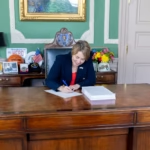
Healey signed the PROTECT Act on August 5 at La Colaborativa, a nonprofit that serves immigrants in Chelsea, and described it as the strongest measure in the country to protect residents from ICE.
The law requires immigration agents to produce a judicial warrant before making a civil arrest at a school, child care center, health care facility, or courthouse. It also codifies an earlier executive order, blocks new 287(g) agreements between state agencies and ICE, and, in a provision that speaks directly to Jeanine’s fear, lets parents pre-arrange legal guardianship for their children in case they are detained or deported.
Ahead of the school year, Healey framed the law around the classroom, saying in a statement that every child should feel safe “walking into their classroom” and every parent confident dropping them off. Under the measure, Massachusetts schools and licensed child care programs were required to adopt policies governing interactions with immigration agents by September 1, or by the first day of classes.
Boston’s district had already moved. In the spring, Boston Public Schools issued a 36-page directive, “Protecting All Students,” instructing staff on how to respond if federal agents appear at a school, on a bus, or during a field trip, and it opened a confidential family helpline.
Superintendent Mary Skipper has told families the district’s legal office is on standby to review any warrant, and that BPS will keep every student regardless of immigration status, pointing to children’s right to a public education under the Supreme Court’s 1982 Plyler v. Doe decision.
Skipper has pledged that all BPS schools will remain “safe and welcoming spaces.”
In February, Mayor Michelle Wu issued an executive order directing city departments, including the schools, to resist what she called federal overreach.
The response has stretched to Washington and across the wider diaspora.
The day before the PROTECT Act signing, Wu and more than 100 mayors and elected officials urged Congress to extend TPS for Haitians, warning of the economic damage to cities such as Boston. Among the first to sign was City Councilor Ruthzee Louijeune, the first Haitian American elected to Boston’s municipal government. Massachusetts’ congressional delegation is pressing a bill to extend Haitian TPS through 2029; a version passed the House this spring, and Senator Ed Markey is leading the effort in the Senate, where it has not yet come to a vote.
Back at the Murphy K-8 School, the first bell resolved none of Jeanine’s questions. She watched until her daughter disappeared through the doors, then turned toward the bus stop and a day without the job she had held for 15 years.
The PROTECT Act may keep immigration agents out of her daughter’s classroom. It cannot restore her paycheck, and it cannot tell her what the coming months will hold.
This article was originally written in English. Other language versions are produced using AI translation software, and errors are possible — the English version is authoritative. CTN also uses AI to convert text into audio.
https://ctninfo.com/?p=44526&preview=true
https://www.facebook.com/CaribbeanNewsMedia