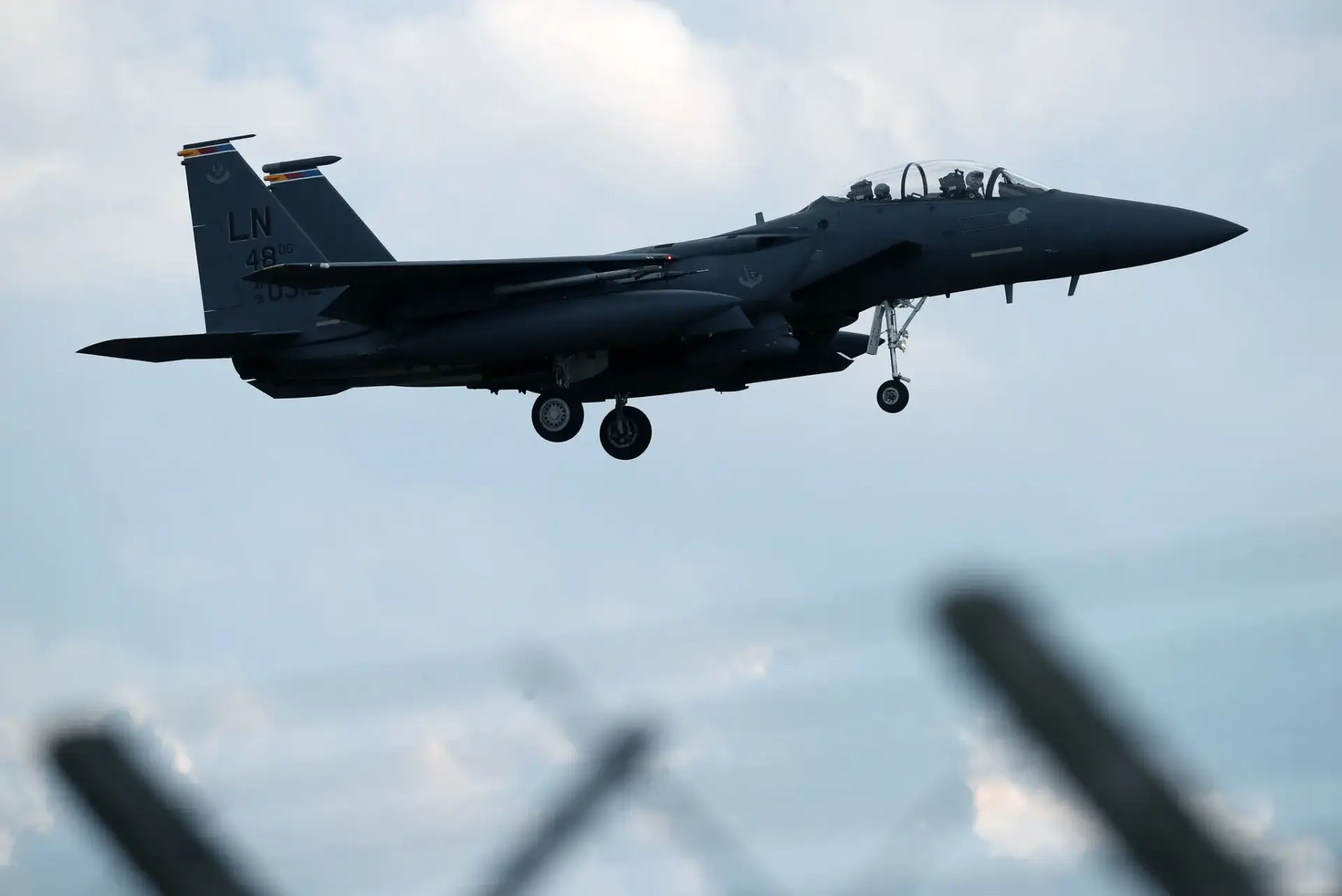


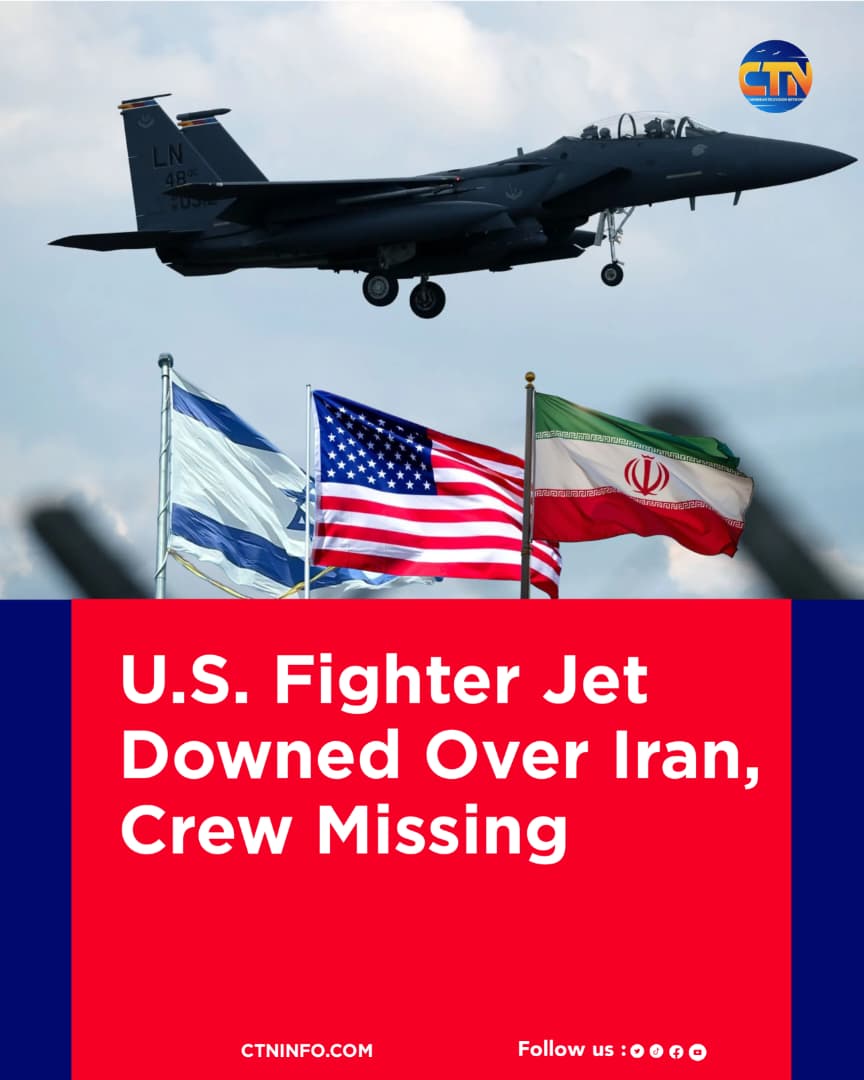
An American F-15E Strike Eagle fighter jet was shot down over Iran on Friday, U.S. officials confirmed. This marks the first known loss of a U.S. aircraft since the war began five weeks ago. The fate of the two-person crew remains unknown. U.S. forces are scrambling to mount a search and rescue operation deep inside Iranian territory, according to the New York Times.
The downing represents the most significant U.S. military setback since the conflict began on February 28. It comes at a moment when President Trump has escalated threats to destroy Iran’s civilian infrastructure. The targets named include bridges, power plants, and energy facilities.
The aircraft was an F-15E Strike Eagle assigned to the 494th Expeditionary Fighter Squadron. This unit is normally based at RAF Lakenheath in England and was deployed to Jordan for the conflict. The jet went down over central Iran on Friday, according to reports from the New York Times, CBS News, Axios, and the Washington Post. All reports cited U.S. officials.
Iran’s Islamic Revolutionary Guard Corps was the first to claim it had downed the aircraft. Tehran initially identified it as an F-35 stealth fighter. Photographs circulating on the Iranian state and social media showed debris. Aviation analysts, as cited by The Aviationist and the New York Times, identified the debris as from an F-15E, not an F-35. The wreckage included parts of a vertical stabilizer with the U.S. Air Force in Europe insignia and the red tail flash of the 494th Fighter Squadron. An ejection seat was also photographed at the crash site.
The F-15E carries a standard crew of two, a pilot and a weapons systems officer.
Whether either crew member survived and ejected remains unclear. The Washington Post reported that a search-and-recovery mission was underway for the two-person crew. CBS News confirmed the same, citing two sources.
Iranian state media reported that authorities in the Kohgiluyeh and Boyer-Ahmad Province were offering rewards for anyone who captures the American crew alive. According to Türkiye Today and The War Zone, Iran’s armed forces issued public appeals urging civilians not to mistreat any survivors. Videos appeared to show U.S. C-130 Hercules cargo aircraft and Black Hawk helicopters flying low over southwestern Iran. It was unclear whether these flights were confirmed as part of an official rescue operation.
Iran’s semi-official Tasnim news agency, which has close ties to the IRGC, claimed that the American rescue attempt had failed and that one of the helicopters involved was fired upon by air defenses near the border, according to The War Zone.
The Broader Day of Escalation
The downing occurred amid escalated regional fighting. Iran attacked energy sites in Kuwait, the UAE, and other Gulf states. The Kuwait Petroleum Corporation confirmed drone strikes on the Mina al-Ahmadi refinery. Firefighters worked to control several fires, the Associated Press reported. Kuwait also reported material damage to a power and water desalination plant from an Iranian attack, per Al Jazeera and the AP.
In Abu Dhabi, Emirati authorities said falling debris from an air defense interception started a fire at a major gas field, halting operations, the AP reported.
Iran and Hezbollah also fired additional missiles toward Israel, resulting in several impact sites and one injury.
On Thursday, the United States struck a highway bridge near the town of Karaj, west of Tehran. Iranian news outlets reported that at least eight people were killed — many of them civilians who had gathered under the bridge and along the riverbank to celebrate “Nature Day,” a traditional holiday, CBS News reported.
Trump’s Threats
President Trump has responded to Iran’s continued attacks with escalating threats aimed at the country’s civilian infrastructure.
Late Thursday, he wrote on social media that the U.S. military would target bridges, power plants, and energy facilities if Iran did not reopen the Strait of Hormuz. This is the narrow waterway through which roughly one-fifth of the world’s oil passes. Iran’s blockade of the strait has sent global oil prices surging since the war began.
“Bridges next, then Electric Power Plants!” Trump wrote. “New Regime leadership knows what has to be done, and has to be done, FAST!”
The threat to deliberately target civilian infrastructure has drawn criticism from international legal experts and human rights organizations.
Intentionally targeting energy infrastructure and civilian facilities could constitute a war crime under international humanitarian law.
Iran’s foreign ministry has rejected any prospect of negotiations under current conditions. Spokesman Esmail Baghaei said Thursday that talks with Washington were impossible while the strikes continued, the New York Times reported.
The Human Cost
The war, now in its fifth week, has produced a mounting death toll across the region.
The Human Rights Activists News Agency, an Iranian monitoring group, reported that at least 1,606 Iranian civilians have been killed, including 244 children, as of Thursday, according to the New York Times. Iran’s Health Ministry has cited a higher figure — at least 1,937 killed and more than 24,800 injured. The injured include some 4,000 women and 1,621 children, according to Al Jazeera’s live tracker.
In Lebanon, fighting between Israel and Hezbollah has escalated into what has been described as the 2026 Lebanon war. The health ministry reported at least 1,345 Lebanese killed as of Thursday, the New York Times reported. Al Jazeera’s tracker put the figure at 1,318.
Across Gulf nations, at least 50 people have been killed in attacks attributed to Iran, according to the New York Times. In Israel, at least 17 people had been killed as of Friday.
The American death toll stands at 13 service members killed in action, with hundreds more wounded, according to the New York Times and U.S. Central Command. The first U.S. combat deaths occurred on March 2 when an Iranian strike hit a makeshift operations center at the civilian port of Shuaiba in Kuwait, killing six service members, CNN reported at the time.
Some estimates suggest the war is costing the United States as much as $1 billion per day, the New York Times reported. This figure underscores the economic trade-offs facing an administration that came into office promising to reduce consumer costs and focus on domestic priorities.
The F-15E and What It Means
The loss of the F-15E complicates the administration’s narrative about the state of Iran’s military capabilities. Just days before the downing, Defense Secretary Pete Hegseth said Iran’s air defenses were so degraded that the United States was sending B-52 bombers over the country. The F-15E is a smaller, faster, and more agile aircraft than a B-52, making it a more difficult target. Yet, Iran’s defenses brought it down.
The F-15E Strike Eagle has been a workhorse of U.S. air combat operations for decades and is flown by a two-member crew. While Iran claimed the aircraft was an F-35 — which carries only one pilot — the physical evidence points to an F-15E, and the unit markings visible in the debris photographs match those of the 494th Fighter Squadron, deployed from Lakenheath, according to The Aviationist’s analysis.